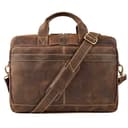
Messenger, briefcase or laptop sleeve? Get the format right first
These three get sold against each other and they solve different problems. A messengeris a soft flat body on a long single strap, worn across the body, opened by swinging it forward — it is a bag you work out of while standing up. A briefcase holds its own shape, is usually carried by a handle, and is designed to be set down and opened flat. A laptop sleeve is a skin for the machine and nothing else.
The decision underneath all of this is how the weight reaches your body, and we have taken it in full on messenger bag vs. briefcase and leather backpack vs. messenger bag. The short version: a messenger puts the entire load on one shoulder and gives you the fastest access of the three; a backpack splits it across two straps and is the right answer above roughly 12 pounds. If you want to see every format the site covers mapped in one place, start at types of leather bags.
The three specs we ranked on, and why
1. A stated laptop limit.Four of these six publish one as a number: 17.5 inches on the cuero, 17 inches on the Berliner, a 16-inch MacBook on the TIDING, and a size on the KomalC body rather than a sleeve. We rank a stated limit above an unstated one even when the stated limit is small, because a number is a commitment and “fits most laptops” is not. Check it against your own machine’s real width, not its marketing name — a 16-inch MacBook Pro is 14 inches wide.
2. A published body.Five of six give you three dimensions. This matters more on a messenger than on any other bag because the format has almost no spare volume: the body is a flat envelope, so depth is the difference between a bag that takes a laptop plus a folder and one that takes a laptop plus nothing. The spread here is real — 4 inches deep on the KomalC against 5 on the cuero.
3. A named zipper or closure.Two of these listings name YKK outright (the TIDING and the KomalC, the latter as all-metal YKK). The rest say “metal” or say nothing. A metal zipper is a material, not a quality claim, and on a bag whose main compartment isthe bag, a failed zip ends it. The TIDING sidesteps the question another way — it is the only flap-over here, and a flap plus a buckle has nothing to break.
Where a leather messenger actually fails
The strap anchors go first.Two small areas of hide carry the whole load whenever the bag is on your shoulder, and leather fibers under sustained tension lengthen and do not spring back — the mechanism is laid out in does leather stretch. On a messenger that shows as the anchor tabs elongating and the bag hanging lower than it did new. It is slow, it is normal, and it is the reason a dense, uncorrected full-grain panel at the anchor is worth more here than anywhere else on the bag.
The zipper or the flap edge goes second. On a zip-top bag it is the slider; on a flap bag it is the fold line, which creases in one place for years and eventually crazes if it is never conditioned. Both are cheap to prevent and expensive to fix.
The back panel goes third,and only on bags carried with a hard laptop in them for years. This is where the Berliner’s reinforced compartment and the TIDING’s padding earn their place: padding is not only about dropping the machine, it is about keeping a rigid rectangle from pressing a permanent line into a soft panel.
What these six publish about the hide, and what they do not
Five of the six use the words “full grain” and one says “top-grain.” The interesting part is which of them says anything else.
Only the Berliner states a tannage, and that single word changes what you should expect from the bag: a vegetable-tanned hide can absorb oils, darken and patina, where a chrome-tanned one mostly holds the color it shipped with. If that distinction is new, vegetable-tanned vs. chrome-tanned leather is the twenty minutes that makes half of these listings readable. The same listing also calls its tannage “chemical-free,” which is not true of any tannage — plant tannins are chemicals. The honest version of that claim is that it avoids chromium salts, and we record the tannage and reject the adjective.
The KomalC is the most honest listing on the page and it has the second-lowest grade claim. It says top-grain, names the hide as water buffalo, names the zipper as all-metal YKK and publishes a one-year warranty. A stated lower layer with three other disclosures behind it is a better buy than an unstated grade with none, and full-grain vs. top-grain leather explains exactly what you give up: the sanded, refinished surface will wear evenly rather than burnishing into a patina.
Not one of the six publishes a thickness in ounces, and on a strap anchor that is the number we would most like to have. It predicts how long a tab holds its shape far better than a grade word does, as leather weight and thickness sets out. Three other rows are blank for all six: country of manufacture, hardware metal and any statement about the lining beyond its material.
The six, side by side
Every cell is read from the listing or marked “Not published.” Read the laptop column first, then the grade column — in that order, because a bag that will not take your machine is not a candidate at any grade.
| Messenger | Stated grade | Stated laptop | Named zipper |
|---|
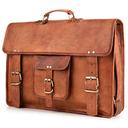
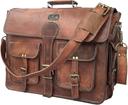
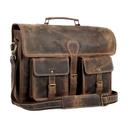
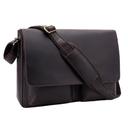
| Berliner Bags Berlin XXL | Full-grain, vegetable-tanned | 17 in (reinforced) | Not published |
| cuero 18 in | Full-grain | 17.5 in | Not published |
| KomalC 18 in | Top-grain buffalo | Not published (18 x 12.5 x 4 in body) | YKK, all-metal |
| TIDING 15.6 in | Full-grain | 16 in MacBook | YKK |
| Full-grain 16 in messenger | Full-grain | 15.6 in | Not published |
| Waxed canvas and leather | Not published | 15.6 in | Not published |
Four of these six publish a laptop size as a number and two publish a zipper brand. Not one publishes a thickness, a hardware metal or a country of manufacture. That is the disclosure profile of the format, and it is why we rank on fit rather than on romance.
How to buy one, in order
Measure your laptop, not its name. Write down its width and depth in inches, add half an inch for a sleeve if you use one, and reject any bag that will not state a number you can compare that against. This single step eliminates most of the disappointment in this category.
Then decide zip or flap. A zip top is faster to secure and slower to open; a flap is the reverse, and it has no mechanism to fail. If you are in and out of the bag ten times a day on a train, the flap wins. If the bag gets thrown in a car boot, the zip wins.
Then weigh the bag empty against what you carry. Three of these are around 3.9 to 4 pounds before anything goes in, which is a real load on one shoulder for a 40-minute commute. Leather is heavy for its strength compared with nylon, and leather vs. nylon states that trade honestly rather than pretending it away. If the weight is the problem rather than the look, a two-strap bag is the right answer, and best leather backpacks is the page for it.
Then condition the fold and the anchors, not the whole bag. A flap crease and two strap tabs are where a messenger dries out and crazes first; how to condition leather covers how often and how little. One closing note on method: we do not own any of these bags and we have not tested them. Every specification above is read from a live listing on the date shown on each card, every price renders from the live price layer, and no grade, thickness, warranty or country is asserted that a listing does not state. The full rules are on our methodology page.