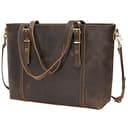
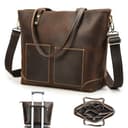
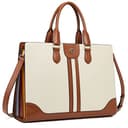
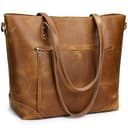
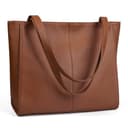
A tote is the least structured bag most people own. There is no rigid frame, no stiffened lid, often no base panel — just leather panels stitched into an open box and asked to stand up. Whether that works after a year of being loaded with a laptop, a water bottle and a lunch is almost entirely a question of what the leather is.
That is why this list is sorted the way it is. Full-grain keeps the hide’s dense outer layer, so the panels resist stretching at the handle anchors and the mouth of the bag holds a line. A tote made from a coated split looks identical in the photos and slumps into a soft sack within a season, because the strong fiber layer was sliced off before it was ever cut. Neither is dishonest; only one of them is what most people think they are buying.
Every bag below is here because its listing commits to something. Where a listing states full-grain, we say so. Where it only says “genuine leather” — a real but lower, usually split-based grade — we say that too, and price it accordingly. We have not carried these bags ourselves; we read each listing for the grade first, then compared capacity, laptop fit and structure.
How to choose a leather tote
Four decisions, in the order they actually matter:
- Grade, first and always. A tote is worked harder than its owner realizes — opened, filled, dumped out, hung on a chair back by its handles. Full-grain resists the stretching that turns handle anchors baggy. Full-grain versus genuine leather covers what the two words actually mean.
- Structure versus slouch. A stiff, boxy tote stands on the floor and looks sharp in an office. A soft one is friendlier to carry and more forgiving of odd-shaped loads. Neither is better; decide before you shop, because it is the hardest thing to change your mind about.
- Laptop reality. A tote is not a laptop bag by default. If yours will carry one, look for a stated laptop size and, ideally, a padded sleeve. A bare tote plus a hard-edged laptop is how the interior gets scuffed and how the base panel starts to sag.
- Handle drop. Short handles are for the crook of the arm; longer ones clear a coat and a shoulder. This is the spec people forget and then regret daily.
Why totes stretch, and what to do about it
The failure mode of a leather tote is almost never a tear. It is stretch. The load hangs from two narrow points — the handle anchors — and everything the bag holds is trying to pull those points apart. On a full-grain panel the tight outer grain resists that; on a split, the looser fiber structure gradually gives, and the handles start to look like they are pulling away because they are.
Two practical habits help whatever you buy. Do not leave a heavy tote hanging by its handles overnight — set it down. And do not use it as a laptop bag without something rigid or padded inside, because a hard edge concentrated in one corner does more to deform a soft bag than the weight ever does. Our guide to storing leather bags covers the stuffing-and-shelf routine that keeps an empty tote from collapsing on itself.
Tote or briefcase?
If your bag is mostly carrying a laptop and documents to an office, a structured briefcase or work bag protects both better and looks more deliberate; see leather briefcases for women. If it is carrying a laptop and a gym kit, a lunch and a pair of shoes, a tote is the honest answer — and buying one in full-grain is how you stop it looking tired by spring.