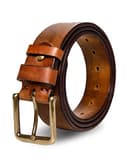
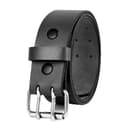
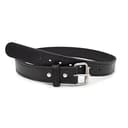
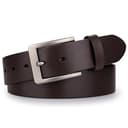
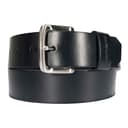
The three specs that decide a work belt
Stated grade.A belt is a strip of hide under constant tension, and the layer of hide you get decides whether it holds that tension or slowly gives. Full-grain keeps the dense outer fiber structure; a split or a bonded laminate does not have it, and under a tool load it will stretch and then delaminate. Three of our five state full-grain. The vocabulary, including why “genuine leather” is a label rather than a tier, is in full-grain vs. genuine leather, and the belt-specific version is in full-grain vs. genuine leather belt.
Published width.Width is the spec that stops a loaded belt rolling over. A 1.25-inch strap under a hanging weight twists so the top edge bites and the bottom edge lifts; a 1.5-inch strap resists it noticeably better, and 1.75 inches is the width worn by people who carry real weight all day. The cost is loop fit — 1.75 inches will not thread most dress trousers. Our belt width guide sets out which widths go with which trousers.
One-piece construction. This is the claim most worth reading and the one least often made. A one-piece strap is a single cut of hide from buckle to tip. The alternative is two or more layers bonded together, which is cheaper, looks identical on a photograph, and separates at the fold once water and flexing get into the glue line. Exactly one of the five states it.
What is almost never published, in this category or any other, is thickness in ounces. Only one belt in our whole registry publishes a figure, and it is not on this page. That matters because thickness is the spec that would let you compare stiffness on paper — see leather weight and thickness for what the ounce scale actually measures and why its absence is such a common gap.
The five, side by side
Every cell is read from the listing or marked “Not published.” Read the width row and the grade row together — a belt that discloses neither is a belt you are buying on a photograph.
| | wolksprong | PBF | Relentless Tactical | Buffway | Carhartt |
|---|
| Grade as stated | Full-grain | Full-grain | Not published (“US Leather”) | Full-grain | Not published (bridle is a finish) |
|---|
| Width as stated | Not published | 1.75 in | 1.25 in and 1.5 in offered | 1.5 in | Not published |
|---|
| One piece stated | Not published | Not published | No - steel core inside the strap | Yes, solid one piece | Not published |
|---|
| Thickness in oz | Not published | Not published | Not published | Not published | Not published |
|---|
| Buckle as stated | High-hardness buckle | Removable double prong, nickel-free | Not published | Not published | Nickel roller bar |
|---|
| Warranty / country | Not published | Not published | Lifetime; made in USA | Not published | Not published |
|---|
| Best read as | Everyday trade belt | Wide strap, long length | Holster and heavy gear | Disclosed construction | A brand with support |
|---|
The thickness row is blank all the way across, and that is the central finding of this page. In the one belt category where stiffness is the whole product, not a single listing publishes the number that measures it. What you get instead are proxies — “thickened,” “heavy duty,” a steel core, a wider strap. The two proxies that are actually verifiable on paper are width and one-piece construction, which is why they lead our ranking.
The other row worth reading twice is the Relentless Tactical column. It is the most precise listing on the page about rigidity — it names spring steel, states a lifetime warranty and states a country of manufacture — and it is the vaguest about its leather, which it calls only “US Leather.” If your belt problem is roll-over under a holster, that trade is probably worth making. If you want a hide you can read the spec of, it is not.
Work belt, gun belt, or just a thick belt?
These three categories overlap and the marketing blurs them deliberately, so here is the distinction we use. A work beltcarries distributed weight from a tool pouch and gets flexed and kneeled on — it wants width and thickness. A gun beltcarries a single concentrated mass at one point and must not let it shift — it wants rigidity above all, which is why steel cores and 14-ounce straps appear there and nowhere else. Our gun belt roundup ranks for that job specifically.
A plain thick belt is the right purchase for most people reading this, and the crossover is real: two of the picks here also appear in our big and tall roundup because long straps and work straps need the same thing — width and one-piece construction — for different reasons. If the belt is mainly for jeans and you do not hang anything off it, start at best leather belts for jeans instead, and treat this page as the heavy-duty end of it.
One format to skip for work: a ratchet. The track is excellent for fit and we rate it for everyday wear in our ratchet belt roundup, but a work belt gets dust, sawdust and fiber packed into the teeth, and a clogged track is the most common cause of a ratchet that slips. On a belt holding a tool bag up, slipping is the failure you least want.
Sizing, break-in and what actually wears out
Measure through the loops of the trousers you work in, over a tucked shirt, rather than using your jean size. The two numbers differ routinely, and on a work belt the error compounds because you will be wearing layers. The method is in how to measure belt size.
A thick full-grain strap is stiff out of the box and will feel wrong for a couple of weeks. That is normal and it is not a defect — the fiber network has to take a set at your fold. Do not accelerate it with heat or water; both cause permanent damage rather than break-in, as explained in does leather shrink. The patient method is in how to break in a leather belt.
As for what fails: the hole you use, then the fold, then the edges, then the buckle — in that order, as set out in how long a leather belt lasts. Rotating between two adjacent holes is the cheapest maintenance habit in leather and it genuinely extends a work belt by years, because the single-hole tear-out is what actually ends most of them. Conditioning twice a year is plenty; the routine is in how to care for a leather belt.
One last note on how we work: we do not own these belts, so nothing above is a load test. It is a comparison of what five listings publish and an argument about which of those facts a work load actually tests — the full version is on our methodology page.