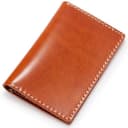
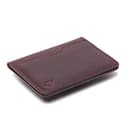
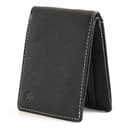
The finding: the Ridge wins on recourse, leather wins on material
Read the comparison row by row and one pattern runs through all seven listings. The Ridge is the only wallet here with a lifetime guarantee, and it is the only wallet here that will not tell you which layer of the hide it uses. The two picks that name the layer, the tannage anda measured size — HISCOW and Foxhackle — both cap their written term at twelve months. The three cheaper picks publish no term at all.
That is not a coincidence and it is not a failure of nerve by leather makers. It follows from how the two objects are built, and the mechanism is worth understanding before you choose:
A screwed-together wallet has replaceable parts. A stitched wallet does not.The Ridge’s guarantee bullet names what it replaces — the elastic, the screws, the cash strap. Those are the three things on a Ridge that wear out, they are all consumable hardware, and they all unbolt. A leather wallet has one part: a set of panels sewn together with thread. When it fails it fails at a stitch line, and the maker’s options are to replace the whole wallet or to decline. So a lifetime claim on a metal wallet costs its maker a few cents of elastic, and a lifetime claim on a leather wallet costs a whole wallet. One of those promises is easy to make.
Which way that should push you depends on what you think will break. If you want a written promise attached to the object, buy the original — nothing on this page matches it, and we say so again in the block at the bottom. If you would rather have a material that improves as it wears, note that the leather failure the guarantee would cover is almost always a seam, and a cobbler will restitch a wallet seam for less than the price of the cheapest pick here. Our guide to how long a leather wallet lasts sets out that failure order in detail.
The three things the Ridge does that leather genuinely cannot
An honest alternatives page has to name what you give up. There are three, and only one of them is about leather being worse.
1. RFID blocking by geometry rather than by claim.The Ridge’s shielding is a side effect of its construction: cards sit inside a closed aluminum box. A leather wallet has to add a shielding layer between the panels, and you cannot inspect it — you are trusting a sentence in a listing. Both card holders on this page state RFID blocking, and we report that as a stated claim rather than a verified property, which is the same treatment it gets on our guide to whether RFID wallets are worth it (short version: the real-world risk is smaller than the marketing implies, for most people).
2. A thickness that does not change.The Ridge listing contains the most pointed sentence on this whole page: it holds its stated card range “without stretching out.” That is a description of leather’s actual failure mode, written by a company selling against it, and it is accurate. Hide fibers under sustained load lengthen and do not return — the mechanism is in does leather stretch. A leather card holder that is snug at six cards is loose at six cards two years later. Aluminum does not do that.
3. Weight. 1.5 oz for the aluminum build, 2 oz for the leather one. Nothing on this page is heavy, but a stitched leather holder with eight cards in it is not 1.5 oz either, and if the ounce is what you are optimizing, the metal wallet wins and that is that.
Now the other direction, in one sentence, because it is the reason this site exists: a rigid frame cannot mold to a pocket, cannot darken, cannot take a scuff and turn it into character, and when its finish is scratched it is scratched. A full-grain panel does all four. That is the whole trade, and how patina actually forms explains why only the outermost layer of a hide manages it.
What we ranked on
Three questions, applied in this order, all of them answerable from a published listing rather than from an opinion about a brand.
1. Does the listing name a layer of the hide? “Full-grain” and “top-grain” name a layer. “Genuine leather” does not — it is a label that sits at the bottom of the grade ladder and covers split, corrected and heavily finished hide of widely varying quality. If that distinction is new, read full-grain vs. genuine leather before buying anything here. Three of our six name a layer; three say “genuine leather”; the Ridge names nothing at all.
2. Does it publish a size you can check against your own pocket?This is the Ridge’s own strongest habit and the fairest test to borrow. Two picks publish a full footprint. The rest describe themselves as slim and leave it there, and “slim” is not a measurement.
3. Does it commit to a capacity and a term?A stated card count, and a stated number of months or years. A wallet that says “holds 8 credit cards or 14 business cards” has given you something to hold it to; a wallet that says “minimalist” has not.
The comparison, read from the listings
Every cell below is read from the listing or marked “Not published.” Read the grade column and the warranty column together — that inverse is the argument of this page.
| Wallet | Stated grade | Published size | Stated term |
|---|
| The Ridge (leather) | Not published | 86 x 54 x 6 mm, 2 oz | Lifetime |
| HISCOW card holder | Full-grain, vegetable-tanned | 4.3 x 2.8 x 0.6 in | 1 year |
| Foxhackle RFID holder | Full-grain, vegetable-tanned | 4 x 3 x 0.2 in | 12 months |
| SERMAN BRANDS money clip | Not published | Not published | Not published |
| Swear Brands slim bifold | Full-grain | Not published | Not published |
| BULLIANT magnetic slim | Genuine leather | Not published | Not published |
| Travelambo front pocket | Genuine leather | Not published | Not published |
Two rows are worth sitting with. Three of the six leather wallets publish nothing in two of the three columns— no size, no term — and all three of those are the cheaper picks, which is the ordinary shape of this market rather than a scandal. And the single most complete row is the one for a wallet with no hide in it. Being honest about that is the only way this page is worth reading.
If you want the cash strap specifically
A lot of Ridge searches are really about the strap: bills carried flat on the outside of the wallet instead of folded inside it. In leather, the equivalent is a money clip, and the trade is specific. A steel strap under tension holds a thin stack very securely and marks the outer bills. A clip holds a thicker stack, is easier to work one-handed, and will loosen over years because the spring is the part that ages. Neither is better; they fail differently. Our comparison of a money clip against a wallet covers the choice properly, and best slim minimalist wallets is the wider field the format belongs to.
One practical note nobody publishes: the number of cards a slim wallet holds depends on the cards. Embossed cards with raised numbers are measurably thicker than flat printed ones, so three raised cards can occupy the space of five flat ones. Both the Ridge’s stated range and the HISCOW’s stated eight are quoted at the flat end of that. If most of your cards are old-style embossed credit cards, assume the lower number.
If you still want the original
Both Ridge listings we track, with their live prices and the specs each one actually publishes. Buying the original is a perfectly rational outcome of this page - no leather pick above matches a lifetime guarantee, a 6 mm frame or a 1.5 oz weight, and nothing we wrote above is intended to talk you out of a wallet that is genuinely good at what it was designed for.
- The leather-faced one
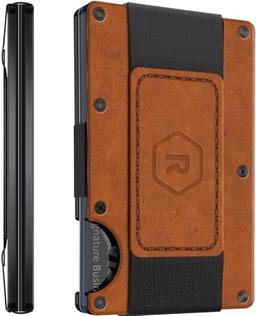
The Ridge Leather Wallet with Cash Strap (Tobacco Brown)
Leather grade: Not published
The version to buy if you want the Ridge architecture with a hide face: the same 86 x 54 x 6 mm frame and lifetime guarantee, at 2 oz, bought knowing the structure underneath is a solid aluminum body and the listing never names the layer of hide.
- The original metal build
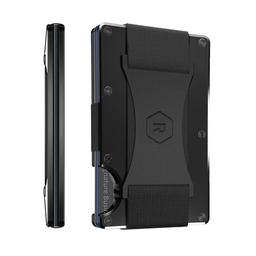
The Ridge Aluminum Wallet with Integrated Cash Strap (Royal Black)
Leather grade: Not published
The lightest and most completely specified wallet on this site - 1.5 oz, 6061-T6 aluminum with anodized plates, a stated 1-12 cards, and replaceable elastic and screws. No leather in it at all, which is the honest reason it sits at the bottom of a leather page rather than the top.
One closing note on method. We do not own any of these wallets, we have not carried or loaded them, and we do not review brands — a brand review implies handling the product. Everything above is read from a live listing on the date shown on each card, every price renders from the live price layer rather than from a figure typed into this page, and no grade, tannage, country or warranty is asserted that a listing does not state. The full rules are on our methodology page, and how to clean a leather wallet covers keeping whichever one you choose alive.