Leather Belt Buckle Types, Explained
The buckle is the only moving part on a belt, the part most likely to fail, and the part almost no listing describes properly.
How this is funded: we earn a commission if you buy through our links, at no extra cost to you. It never changes which product we recommend, and we’ll tell you when we’d skip one. Full disclosure.
A leather belt is a strap and a mechanism. The strap’s lifespan is decided by its grade; the mechanism’s is decided by how many moving parts it has and what they are made of. Most buying advice covers the first and ignores the second, which is odd, because on a good belt the buckle is usually what gives up first.
The types, at a glance
| Buckle | How it holds | Best for | Weak point |
|---|---|---|---|
| Frame / pin | Prong through a punched hole | Almost everything | Holes elongate over time |
| Double prong | Two prongs, two hole rows | Wide casual and work belts | Needs a matched hole pattern |
| Plate | Hook or clip behind a face plate | Western and statement belts | The hook fitting, not the plate |
| Box frame | Strap feeds into a housing | Dress belts, hidden tip | Fussy about strap thickness |
| Ratchet | Clamp onto a toothed track | Precise everyday fit | The mechanism itself |
| D-ring / O-ring | Strap threads back on itself | Casual, canvas-and-leather | Slips under heavy load |
| Interchangeable | Snaps or screws onto the strap | One strap, several looks | Snap wear from swapping |
Frame and pin buckles
The default, and for good reason: a frame with a bar, a prong pivoting on it, and nothing else. There is one pivot point and no spring, so a solid one-piece frame buckle is about as close to unbreakable as belt hardware gets.
What wears is not the buckle but the strap. The prong loads one hole every single day, and that hole slowly elongates from a circle into an oval. On full-grain the process takes a long time because the fibers around the hole are dense and interlocked; on a coated split the hole deforms quickly and the finish cracks around it.
Double-prong buckles are the heavy-duty variant: two prongs through two parallel hole rows, spreading the load and resisting the belt twisting under weight. Common on wide work and casual-width straps, and awkward with a narrow dress belt.
Roller variants add a rotating sleeve on the frame bar so the strap slides rather than drags across it. It is a small refinement that reduces wear at the point where the strap folds through — worth having on a belt you cinch tight daily.
Plate buckles
A plate buckle covers the front of the belt with a decorative face and attaches to the strap with a hook or clip on the back. The Western trophy buckle is the extreme version; plenty of quieter plate buckles exist.
Two things to know. First, plate buckles usually attach with a snap fitting, which means they are swappable — a single strap can carry several. Second, the failure point is that fitting, not the plate. A thin hook bent from sheet metal will deform long before a cast face does anything at all.
Box frame buckles
Here the strap end feeds into a hollow housing rather than through an open frame, and the tip disappears inside. The result is a clean rectangle at the front with no visible strap end — a dress look, and a very tidy one.
The catch is fit. The housing grips the strap by friction and thickness, so a box buckle wants a strap in a specific thickness range. Too thin and it slips; too thick and it will not feed. This is the buckle type where matching a replacement to an existing belt goes wrong most often.
Ratchet and automatic buckles
A ratchet belt replaces punched holes with a toothed track on the underside of the strap and a clamping mechanism in the buckle. Adjustment steps are far finer than the inch or so between traditional holes, which is genuinely useful — a belt that fits before and after a large lunch.
It is also the only buckle type with real moving parts under load. A good one lasts years; all of them are a mechanism that can eventually wear, and none can be repaired by a cobbler. Our ratchet vs. traditional comparison goes through the trade in full. The other consequence: the strap is trimmed to length rather than shortened at the buckle end, which is the one exception to the rule in how to shorten a belt.
D-rings, O-rings and interchangeable systems
Ring buckles thread the strap through two rings and back on itself, holding by friction. They are infinitely adjustable, casual by nature, and prone to slipping if the strap is slick or the load is heavy. Best on lighter, casual belts.
Interchangeable buckles are less a type than a construction choice: the buckle end fastens with snaps or Chicago screws so buckles can be swapped in seconds. Any belt with two visible fasteners at the fold is potentially in this category, and it is also the construction that makes a belt shortenable at home.
Reading the hardware on a listing
- A named material beats an adjective. “Solid brass,” “stainless steel,” “antique nickel finish” are facts. “Premium alloy buckle” is not.
- Solid beats plated, and plated beats nothing stated. Plating wears through at contact points and reveals the base metal underneath; solid brass just dulls and can be polished.
- Check how it attaches. Snaps or screws mean swappable and shortenable. Stitched means neither.
- Match the buckle width to the strap. Buckles are sized to strap width, not to your waist. A 35mm buckle does not fit a 30mm strap in any useful way.
Hardware also needs the same courtesy as the leather when you clean the belt: keep conditioner off the metal, dry the buckle if the belt gets wet, and do not leave a metal buckle pressed against damp leather in storage. Our belt care routine covers the rest, and the buckle’s place among the other checks worth making before you buy is set out in how to choose a quality leather belt.
Three straps, three buckle systems
One heavy-duty frame buckle, one classic dress-leaning frame, and one ratchet — so you can see what each system costs and what it buys.
- Heavy-duty frame
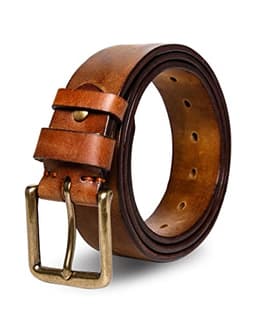
wolksprong Thick Full-Grain Heavy-Duty Work Belt
Leather grade: Full-grain
A thick stated-full-grain strap with a high-hardness buckle. The frame-and-prong system has one pivot and no springs, which is why it is still the default on belts expected to carry weight.
- Classic frame, dressier
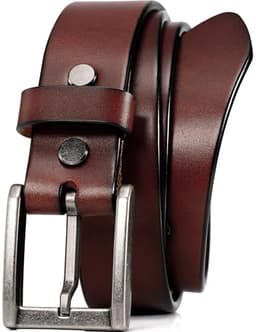
WOLFANT Italian Solid Full-Grain Leather Belt (1.5")
Leather grade: Full-grain
A solid single-strap 1.5-inch belt — narrow enough to read tidy, thick enough to last. A plain frame buckle on a solid strap is the combination with the fewest ways to go wrong.
$39.98 · View on AmazonPrice as of October 20, 2026. #ad How we’re funded
- Ratchet
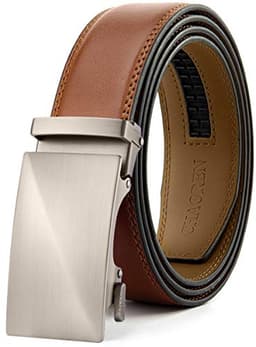
CHAOREN Full-Grain Leather Ratchet Belt (35mm)
Leather grade: Full-grain
Micro-adjustment in small steps instead of holes an inch apart, on a stated-full-grain strap. The trade is a mechanism that can eventually wear and cannot be repaired by a cobbler.
$14.99 · View on AmazonPrice as of October 20, 2026. #ad How we’re funded
Bottom line
Fewer moving parts means fewer things to fail, which is why a plain frame buckle on a solid strap remains the most durable belt you can buy. Ratchets buy precision at the cost of a mechanism; plate and box buckles buy a look at the cost of fussier fittings; rings buy adjustability at the cost of grip. Whichever you pick, read the listing for a named hardware material — it is the cheapest thing a maker can disclose and one of the most telling when they don’t. Then check the strap grade, which is what actually decides how long the belt lasts: full-grain belt picks.
How we know this. Veg Tan Club is written by an enthusiast, not a master leatherworker or a test lab. We compile each product’s published specs — grade, tannage, hardware — and reason from there. We say plainly when a listing doesn’t state a grade, and we haven’t physically handled every item we compare.
Frequently asked questions
What are the main types of belt buckle?
The frame or pin buckle (single or double prong) is the classic; the plate buckle covers the front with a decorative face; the box frame hides the strap end inside a housing; the ratchet or automatic buckle clamps onto a toothed strap for fine adjustment; D-rings and O-rings thread the strap back through itself; and interchangeable buckles snap on and off so one strap can take several.
Which belt buckle is most durable?
A solid, one-piece frame buckle with a simple prong, because it has almost nothing to go wrong — one pivot and no springs. Ratchet buckles are the most mechanically complex and therefore the ones with a wear path, though a good one lasts a long time. Plate buckles are usually fine; what fails on them is the hook or clip fitting rather than the plate.
Can you change the buckle on a leather belt?
On a belt with snaps or Chicago screws at the buckle end, yes — that construction exists so buckles can be swapped. On a stitched belt, no, not without unpicking and restitching. Look for two visible fasteners at the fold; that is the tell.
What is a box frame buckle?
A buckle where the strap end feeds into a hollow housing rather than through an open frame, so the tip is hidden and the front reads as a clean rectangle. It is a common dress-belt style, and its practical downside is that the strap has to be the right thickness to feed and grip properly.
Are heavier buckles better?
No — weight is not a quality signal. Solid brass and quality steel feel substantial, but so do cheap zinc castings, which are heavy and brittle. What matters is that the listing names a material and finish at all: a maker who says 'solid brass' or names its plating has told you it did not buy the cheapest possible part.
Sources
- Wikipedia — Leather — Overview of leather, grain layers and the full-grain / top-grain / split hierarchy (accessed July 18, 2026)
- Encyclopaedia Britannica — Leather — Britannica on leather as chemically treated animal hide and its uses (accessed July 18, 2026)
- Canadian Conservation Institute — Caring for leather, skin and fur — CCI preventive-conservation guidance on cleaning, dressing and storing leather (accessed July 18, 2026)
Keep reading
Ratchet vs. traditional belt
The two buckle systems most people actually choose between, compared in detail.
Compare the twoDress belt vs. casual belt
Buckle is one of the four things that separates the two categories — here's the rest.
See the differencesLeather belt width guide
Buckle and strap width have to match. This is the measurement that decides which buckles fit.
Read the guideBest leather belts for men
The full roundup, with the buckle type called out on every pick.
See the picksHow to choose a quality leather belt
Where the buckle fits among the seven checks that decide whether a belt lasts.
Read the buying guide