Leather Tote vs. Backpack
A tote hangs the whole load off two narrow handles; a backpack splits it across two straps and hides it behind you. That one structural difference decides the comfort, the capacity, the security and - the part nobody mentions - where the leather gives out first.
How this is funded: we earn a commission if you buy through our links, at no extra cost to you. It never changes which product we recommend, and we’ll tell you when we’d skip one. Full disclosure.
The short version: buy a backpack if the bag is heavy or the walk is long, and a toteif the load is light and you want to reach into it without stopping. Almost everything else people argue about — which looks more professional, which holds more, which is safer — follows from that one difference in how the weight is carried. A tote hangs its entire load off two narrow handles on one side of your body. A backpack divides the same load between two straps and puts it behind you.
That is the decision, and most readers can stop there. What follows is the detail that actually changes which specific bag you buy: how the two formats hold different shapes of cargo, how each one behaves in rain, which one a crowded train punishes, and — the part almost nobody writes about — where each format wears out first, which is the only part of this comparison that depends on the leather.
The load, honestly
A backpack splits a load across two shoulders. A tote does not. That is a statement about geometry, not about health, and we are going to keep it that way: we have seen plenty of confident claims online about what one-shoulder carry does to a spine, and we do not have a medical source worth citing for any of them. If weight on one side is a concern for you, that is a conversation with a clinician, not with a leather site.
What we can say is that the format changes the threshold at which a bag stops being pleasant. With a notebook, a charger and a water bottle, almost nobody notices the difference. Add a 15-inch laptop, a power brick, a lunch and a book and the tote becomes something you shift from hand to hand and set down whenever you can. The backpack at the same weight simply disappears. There is no leather or construction that changes this; it is the strap count.
Two practical consequences. First, a tote’s handle drop— the gap between the handle and the bag body — decides whether you can get it over a coat shoulder at all, and short-drop totes become hand-carry bags in winter whether you intended that or not. Second, a backpack’s strap width matters more than its padding. A narrow leather strap concentrates the same weight into less shoulder, and unpadded leather straps that are too narrow are the single most common complaint about otherwise good leather backpacks.
Access, and the thing you do forty times a day
A tote is open at the top and in front of you. You reach in while walking, standing in a queue or sitting at a desk, without taking anything off. For anyone who pulls a phone, a card, a notebook or a laptop out repeatedly through the day, that is a real and continuous advantage, and it is why totes dominate in jobs with a lot of short stops.
A backpack has to come off to be opened. Once it is off you have two hands and a wide opening, so loading and unloading a backpack properly is easierthan rummaging in a tote — it is the frequent small retrieval that it punishes. A front pocket or a side pocket fixes most of this, and the backpacks that get worn daily are almost always the ones with somewhere accessible to put a phone.
The related format worth knowing about here is the crossbody or sling, which is the answer when access is the onlything you care about — it swings to the front and opens without coming off. That is covered in crossbody vs. shoulder bag, and the sling-versus-two-straps version of the question is in leather backpack vs. messenger bag.
Capacity is not a number, it is a shape
Totes and backpacks of the same stated volume hold completely different things well, and reading the liters figure tells you almost nothing about which suits you.
A tote is a bucket: wide, shallow front to back, open at the top. It takes flat things beautifully — a laptop, a folder, a document portfolio, a magazine, a pair of shoes laid flat. It takes tall things badly, because they tip, and it takes small things badly, because they sink to the bottom and get lost under everything else. The totes that work are the ones with internal dividers or a padded sleeve that stops the whole interior being one pit.
A backpack is a column: deeper than it is wide, with the opening at the top of a tall cavity. It handles tall and bulky loads well, it carries weight closer to your center of mass, and a bottle in a backpack stays upright. The cost is that whatever went in first is now at the bottom, which is why the better leather backpacks either open wide at the top or add a laptop compartment that loads separately from the main body.
If your load is mostly paper and a laptop, the tote shape fits it. If your load includes a change of clothes, gym kit, a lunch, a flask or anything with a volume rather than a footprint, the backpack shape fits it. The full breakdown of what each leather bag format is actually built around is in types of leather bags.
Where each one wears out first
This is the part of the comparison that is specific to leather, and it is the most useful thing on this page if you are buying something you intend to keep.
A tote fails at the handles.The entire load passes through two narrow straps and then into a stitch line or a pair of rivets on a thin top panel. Two things happen there. The leather of the handle itself is under sustained tension whenever the bag is loaded, and leather under sustained tension realigns and lengthens — one-way, locally, mostly in the first months. And the anchor point takes a repeated shock load every time the bag is lifted, which is what eventually pulls stitching or tears a rivet through the panel. The mechanism is explained in does leather stretch; the practical upshot is that on a tote you want the handles to be one continuous piece that runs down the body or under the base if possible, and you want the anchors reinforced. A handle stitched to a single layer of thin leather is the thing that will end the bag.
A backpack fails at the base corners and the strap anchors.A backpack gets set down on the floor dozens of times a week — on grit, on wet pavement, on train carriage floors — so the two bottom corners abrade long before anything else does. Meanwhile the shoulder straps anchor at the top of the back panel and pull at an angle under the full load. Those three points are where to look on any used leather backpack, and the reason a stated full-grain hide genuinely matters more here than on a bag that lives on your lap: full-grain keeps the hide’s densest fiber layer intact, so it burnishes where a corrected or coated surface wears through. The grade vocabulary is in full-grain vs. top-grain leather, and the general failure order for a leather bag is in how long a leather bag lasts.
Both formats share one failure we have never seen a listing mention: the zipper. If a bag has a zip and the listing does not name the zipper brand, assume a generic one, and assume that it is the part most likely to end the bag’s useful life while the leather is still fine.
Rain, crowds, and the two situations that reverse the answer
Rain favors the backpack, but not by much.An open-top tote takes water straight into the interior, onto the laptop, and there is no fixing that with a hide. A backpack with a zip or a flap keeps the opening closed, which is a real advantage — but its back panel is pressed against you, so a wet backpack puts the water where you will notice it. Neither format is waterproof, because leather is not: is leather waterproof covers what the hide actually does with water, and how to waterproof a leather bag covers how far treatment gets you. If the bag does get soaked, the drying method matters more than the bag did: how to dry a wet leather bag.
Crowds reverse the security answer.Normally a zipped backpack is the more secure bag, and in a quiet office or a car commute it is. In a packed train or a tourist street, the backpack is behind you where you cannot see it, and a tote in your hand with the opening facing you is harder to get into unnoticed — which is exactly backwards from the way most people assume it works. The genuinely secure version of either is a bag that closes and sits where you can see it, which in practice means a zipped tote or a backpack worn on the front.
How each one reads in a room
Worth being straightforward about, because for a lot of readers this is the real deciding factor and it feels unserious to say so.
A structured leather tote reads finished. It sits upright beside a chair, it does not need adjusting, and in most professional settings it is invisible in the good sense. A leather backpack reads more casual, and how much more depends almost entirely on the bag: a dark, structured leather backpack with slim straps in a formal office is now unremarkable in a way it was not ten years ago, while a slouchy one with wide padded straps still reads student.
If your workplace is formal enough that you are genuinely weighing this, the low-risk answer is the tote or a proper briefcase — the backpack vs. briefcase comparison takes that version of the question on directly, and best leather work bags for women is where both formats get ranked against each other on an actual commute. For a student load, the arithmetic goes the other way and the backpack wins on weight alone, which is the argument in best leather bags for college.
So which one
Four questions, in the order that settles it.
How heavy is the load, really? Weigh it once. Under about five pounds, either format is comfortable and you should buy on looks and access. Above that, the backpack wins and keeps winning as the number grows.
How often do you reach into it? Many times a day, standing up: tote. Twice a day, sitting down: backpack.
What shape is the cargo?Flat things — laptop, paper, folders: tote. Things with volume — clothes, a flask, gym kit: backpack.
How far do you walk? This is the tiebreaker, and it is the one people underestimate. A tote is fine across a car park and punishing across a city.
One of each, from listings that state a grade
A tote, a backpack and the convertible that refuses to choose. All three state a leather grade in their own listing, which is the minimum we ask of a bag whose handles or straps carry the whole load - and we have not handled any of them.
- The tote, for a paper-and-laptop load
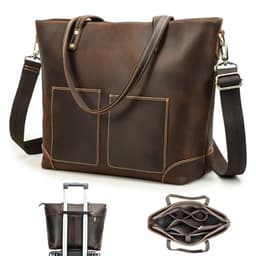
CONTACTS Full Grain Leather Laptop Tote (14.2")
Leather grade: Full-grain
The tote argument at its strongest: a stated full-grain hide and a published laptop size, which together are rarer in totes than in any other format - most totes are one open bucket with no stated device fit at all. Read the handle anchors when it arrives, because that is the part that decides how long a loaded tote lasts.
$90.00 · View on AmazonPrice as of October 20, 2026. #ad How we’re funded
- The backpack, for a heavy commute
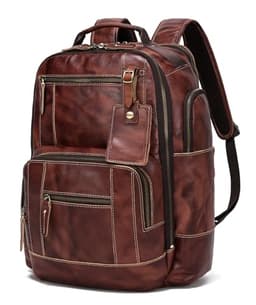
LANNSYNE Full Grain Leather Backpack (16")
Leather grade: Full-grain
States full-grain and publishes a 16-inch laptop fit, which is the combination to want on a bag whose base corners get set on the floor every day. Full-grain is not a luxury here - it is the layer that burnishes instead of wearing through exactly where a backpack gets abraded.
$149.99 · View on AmazonPrice as of October 20, 2026. #ad How we’re funded
- The one that works as both
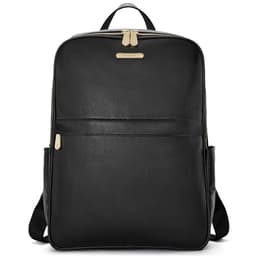
BOSTANTEN Genuine Leather Laptop Backpack Purse (15.6")
Leather grade: Genuine leather
A backpack-purse that carries a 15.6-inch laptop and can be worn either way, which is the honest answer for anyone whose day has a long walk at one end and a meeting at the other. The listing states genuine leather rather than full-grain, so buy it for the dual function and the laptop fit, not as a decade bag - and accept the extra hardware every convertible carries.
$139.99 · View on AmazonPrice as of October 20, 2026. #ad How we’re funded
Whichever you buy, the care is the same
Both formats want the same small habits, and both have one specific vulnerability worth naming. Keep a tote’s handles clean and lightly conditioned, because hand oils and grit work into exactly the spot under the most tension. Keep a backpack’s base corners dry and never store it sitting in a damp spot, because that is where a bloom of mold starts.
Beyond that: clean before you condition rather than over the top of dirt, condition rarely rather than often, and stuff the bag when you store it so the body does not crease into a fold it keeps. The order is in leather cleaner vs. conditioner, the frequency is in how often to condition leather, and the storage method is in how to store leather bags.
As everywhere here, none of this is a wear test — we do not own these bags. It is a structural argument about two formats, plus what three listings are willing to publish, and the method behind that is on our methodology page. If neither format is quite right, the leather bags hub has the rest of them.
How we know this. Veg Tan Club is written by an enthusiast, not a master leatherworker or a test lab. We compile each product’s published specs — grade, tannage, hardware — and reason from there. We say plainly when a listing doesn’t state a grade, and we haven’t physically handled every item we compare.
Frequently asked questions
Is a leather tote or a leather backpack better for work?
It depends on what the bag holds and how far you walk with it. A tote is better if the load is light, you want to reach into it without stopping, and your office reads a backpack as casual - it also sits flat against a chair and looks finished in a meeting. A backpack is better the moment the load gets heavy or the walk gets long, because it splits the weight across both shoulders instead of hanging it off one. Most people who switch, switch because the laptop got heavier, not because their taste changed.
Can a leather tote carry a laptop?
Many can, but check that the listing states a laptop size rather than assuming the bag is big enough. A tote's interior is usually one open bucket, so unless there is a dedicated padded sleeve the laptop sits loose against keys, bottles and whatever else is in there. If a tote does not publish a laptop size and a padded compartment, treat it as a bag you would add your own sleeve to.
Do leather totes stretch out over time?
The body does not change shape much, but the handles and their anchor points do. A tote carries its whole load through two narrow straps, and the leather at the top of each strap is under constant tension while the bag is in your hand. Leather under sustained tension realigns and lengthens slightly, and the change is one-way - so a tote that is routinely overloaded ends up with longer, softer handles than it shipped with. Stitch lines and rivets at the handle base are the first place to look for wear.
Which is more secure, a tote or a backpack?
They fail in opposite ways. An open-top tote is in front of you where you can see it, but anything in it is reachable in a second. A zipped backpack is closed, but it is behind you where you cannot see it being opened. In a crowd, the safest version of either is a bag that closes and sits in front of you - which in practice means wearing a backpack on your chest in a busy station, or choosing a tote with a real zip rather than a magnetic snap.
Does a backpack ruin a leather bag's shape?
No, but it wears in a different place than a tote does. A backpack is set down on its base constantly, so the two bottom corners abrade first and the shoulder-strap anchors at the top of the back panel take all the load. A tote wears at the handles. Neither is a flaw - it is just where to look when you are inspecting a used bag, and where a thicker, stated full-grain hide earns its money.
Is a leather backpack unprofessional?
Less than it used to be, and it depends on the bag more than the format. A structured leather backpack in a dark hide with slim straps reads very differently from a slouchy canvas-and-leather daypack, and plenty of offices now treat the first as normal business carry. If your workplace is formal enough that the question is live, the honest answer is that a tote or a structured briefcase still carries less risk - and a convertible bag that can be worn either way sidesteps the question entirely.
What about a convertible tote-backpack?
They are a genuine answer and not just a gimmick, with one trade: every convertible has more hardware than either format needs on its own - extra rings, clips and anchor points - and hardware is the most common failure on a leather bag. Buy one if you really do need both modes on the same day. If you only ever use one mode, you are carrying the weight and the failure points of a feature you do not use.
Is carrying a tote on one shoulder bad for you?
We are not going to answer that, because answering it properly needs a medical source and we do not have one worth citing. What we can say is mechanical and uncontroversial: a tote applies the whole load to one shoulder and one side of your body, while a backpack divides it between two. If weight on one side is a concern for you, that is a question for a clinician rather than a leather site, and the format that splits the load is the backpack.
Sources
- Wikipedia — Leather — Overview of leather, grain layers and the full-grain / top-grain / split hierarchy (accessed July 18, 2026)
- Encyclopaedia Britannica — Leather — Britannica on leather as chemically treated animal hide and its uses (accessed July 18, 2026)
- 16 CFR Part 24 — FTC Guides for Select Leather and Imitation Leather Products — The FTC guides on leather labeling: unqualified 'leather' claims, imitation-leather disclosure, backing material and misuse of trade names (accessed August 19, 2026)
- Canadian Conservation Institute — Caring for leather, skin and fur — CCI preventive-conservation guidance on cleaning, dressing and storing leather (accessed July 18, 2026)
Keep reading
Best leather backpacks for women
If the comparison lands on backpack, these are the convertible picks for that decision.
See the picksBest leather bags for teachers
This format decision applied to a teaching day, with picks on both sides of it.
See the picksBest leather totes
If the tote is the answer, this ranks the registry on stated grade, structure and what each listing publishes.
See the picksBest leather backpacks
The other side of this comparison, ranked grade-first with laptop sizes where a listing states one.
See the picksLeather backpack vs. messenger bag
The adjacent format question - two straps against one diagonal strap, and what each does on a commute.
Compare the formatsHow to choose a leather bag
The full checklist behind this page: grade, structure, hardware and the specs a listing has to state.
Read the guideDoes leather stretch?
Why a tote's handles lengthen and the body does not, and why the change only goes one way.
Read the guideBest leather work bags for women
Where this format decision gets made in practice - totes, satchels and convertible backpacks side by side.
See the picks