The RFID question, answered properly
Six of the eight picks on this page advertise RFID blocking, so it is worth knowing what that lining is actually defending. A modern e-passport carries a contactless chip, and the standard protection for it is Basic Access Control: the chip will not hand over data until the reader supplies a key derived from the machine-readable zone printed inside the book — the document number, your date of birth and the expiry date. A reader has to have physically seen the inside of your passport before it can read the chip. On top of that, some issuing countries, the United States among them, laminate a very thin metal mesh into the passport cover itself, so the chip is shielded whenever the book is closed.
Both of those protections are optional under the standard, so they are not universal, and a blocking lining is not useless. But the honest version of the claim is narrower than the listings imply: the lining mostly protects the contactless credit cards you keep in the same case, not the passport. Our guide to whether RFID wallets are worth it covers why documented real-world card skimming is rare in the first place. Treat RFID here the way we treat it everywhere on this site: take it if it is already built in, and never let it outrank the leather.
One listing on this page is unusually honest about the limits of its own lining. The WANDERINGS cover states that its RFID shield still lets entry cards scan through it, because those run on a different frequency. That is a caveat a marketing team would normally bury, and publishing it is a better signal about the seller than the feature itself.
How we chose
The criteria came first, in this order, and the ranking follows how many of them each listing answers in writing. Where two wallets disclose a similar amount, we favored the one that solves the real failure mode in this category — losing it.
- A stated grade. “Full-grain,” “top-grain” or “genuine leather” in the listing’s own words, not “premium” or “luxury.” Seven of eight state something. The Crazy Horse Craft states no grade at all, and is ranked second anyway because it states more about its leather than any other pick. What the words mean is in full-grain vs. top-grain leather.
- Whether the listing agrees with itself. Two do not read the same way twice. The WANDERINGS says “Genuine Leather” in the title and “100% full-grain genuine leather” in the first bullet, which cannot be true as written because those are different grades. The Karmiir is less serious but still worth knowing: the title says only “Leather,” and “full grain cowhide” turns up three bullets down. Neither is disqualifying; both cost the pick places.
- Published capacity, in passports. Slot counts are easy to pad. “Fits two standard U.S. passport books” is a real number. Three picks commit to two passports, one commits to six, and the rest are single-passport cases.
- A closure, and which kind. A magnetic flap, a zip-around, or nothing at all. This is the spec that decides whether a boarding pass is still in the case when you land, and only three of our eight picks state a closure at all.
- A tracker pocket. Three picks have one, and it is the single most useful feature in this category — see the section below.
- A published warranty. Three state a term: one lifetime, two one-year. Everything else states nothing, or offers a vague satisfaction promise.
- Currently purchasable. Every pick returned an in-stock availability type from the live catalog on the day this page was built. Several otherwise-plausible listings were down to single-digit units and were left off rather than sent to a page that might be empty by the time you read it.
The tracker pocket is the feature that matters
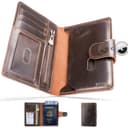
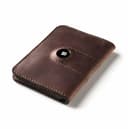
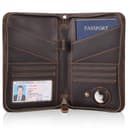
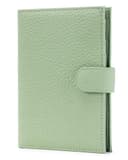
Of everything a passport holder can offer, the one that changes outcomes is a stitched pocket sized for a tracker. This is the item you hand over at a check-in desk, put down on a security tray, leave on a hotel bed and carry through four airports in a day, and unlike a wallet it contains the one document you cannot replace in an afternoon. Three picks here have a tracker slot: the FTDENE hides it behind a back strap, the Crazy Horse Craft has a stitched pocket with a round window that works front or back, and the Polare family wallet has a snap slot. None of them includes the tracker, and every one of those listings says so.
A hidden slot is better than an exposed one for an obvious reason: the point of a tracker is to find the case after it goes missing, which only works if whoever picked it up has not removed the tracker. The FTDENE’s back-strap pocket is the most discreet of the three. The Crazy Horse Craft’s window is the opposite — visible by design, so you can see at a glance whether the tracker is still in there.
What size do you actually need?
A U.S. passport book is about 5 x 3.5 inches, and every case here is built around that. The real decision is how far past the passport you want to go, and the picks split into three clear sizes.
- Covers, roughly 4 x 5.5 inches. The Maruse at 5.51 x 3.93 in, the Crazy Horse Craft at 4.13 x 5.51 in, the Karmiir at 4.13 x 5.51 in and the WANDERINGS at 4 x 5.5 in. These go in a jacket pocket. One or two passports, a few cards, folded notes.
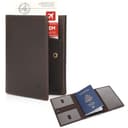
- Organizers, roughly 4.5–6 inches. The FTDENE at 5.8 x 3.9 in, the Polare pilot wallet at 4.5 x 5.75 in and the F&L Classic at 4.5 x 6 in folded. Still pocketable in a coat, not in jeans. Cards, cash, tickets and either a second passport or a second document type.
- Document cases, 8 inches and up. Only the Polare family wallet, at 5 x 8 in. This is a bag item with a removable strap, and it is the right answer for exactly one job: one adult holding several people’s passports through check-in.
Three picks state a weight in their own bullet copy, which is unusually good for this category: 4.5 oz for the WANDERINGS, 0.22 lb for the Polare pilot wallet and about 0.48 lb for the Polare family case. Where a spec is not published anywhere in the listing, the spec table says so.
Grade, tannage and the two words that look like specs
Two phrases recur across these listings and neither is a specification. “Italian leather” names geography, not process or quality — our explainer on what Italian leather means sets out what the phrase does and does not commit a seller to. And “napa,” which the Polare family wallet pairs with “full grain,” names a soft, fine-grained finish rather than a layer of hide; our nappa leather guide explains why the word is doing sensory work rather than structural work.
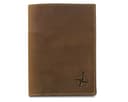
Tannage is where this category is thinnest. Exactly one pick states it: the Crazy Horse Craft, which names vegetable-tanned Italian Crazy Horse cowhide and ships with a certificate of authenticity for the leather. That matters more in a passport holder than in most items, because veg-tan darkens with handling, and a passport cover is handled in short, intense bursts — heavily for two weeks, then not at all for eight months. The result is a patina that records your trips rather than your commute, which is a real argument for veg-tan here even though it also means the case marks more readily if it gets wet. Our guides to vegetable-tanned leather and how a patina actually forms cover both halves of that trade.
Nobody publishes a thickness. That is normal for this format — a passport cover wants to be thin and flexible, so the hide is split lighter than belt or bag leather, and makers who are not proud of the number simply omit it. Our leather weight guide explains what the ounce figures would mean if any of them printed one.
Closures: flap, zip or nothing
Five of the eight picks state no closure at all. The Maruse, the Crazy Horse Craft and the WANDERINGS are plain folding covers; the Polare pilot wallet is a trifold that stays shut by being a trifold; and the Karmiir has a zip on its coin pocket but nothing holding the case itself closed. That is not a flaw if what you carry is a passport and a few cards in dedicated slots, and the Crazy Horse Craft makes a point of it — no snap or magnet adding bulk. It becomes a flaw the moment you add a boarding pass, a receipt or a currency note to an open compartment and drop the case into a tote.
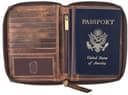
The F&L Classic is the other extreme: a metal zipper all the way around, so nothing escapes, at the cost of thickness and of a second action every time you need the passport. The Polare family case also closes on a zipper, and names YKK for it. The FTDENE’s magnetic flap sits in between — one-handed to open, fast at a check-in desk, and reliable right up to the point where you overfill it. If you are the kind of traveler whose case ends up holding four receipts and a boarding pass by day three, buy the zipper.
Is a “women’s” passport holder a real thing?
Mostly no, and this is one of the few leather categories where that is true. A passport is the same size for everyone, so the cases are the same size, and the differences between a listing sold “for men” and one sold “for women” come down to color and to which secondary pockets the designer prioritized. The Karmiir is sold as a women’s wallet, comes in fashion colors, and its own listing says the black and grey variants suit men equally — the reason it is on this page is the SIM-card slots and the ejector tool, not the label. If you want a women’s wallet for everyday carry rather than travel, our best leather wallets for women roundup is the right page.
Who should skip each pick
- FTDENE. Skip it if you need a zipper or a stated tannage. A magnetic flap will not contain an overfilled case, and the listing names the hide’s home state without ever saying where the wallet itself was made.
- Crazy Horse Craft. Skip it if a stated grade is non-negotiable. It is the most forthcoming listing here about tannage, hide and workshop, and it never names the grade. The wool felt lining also stains and pills where leather would not.
- Polare family wallet. Skip it unless you are genuinely carrying several passports. At 5 x 8 inches it is a bag item, and putting a whole family’s documents in one case concentrates the risk this page is otherwise about reducing.
- Polare pilot wallet. Skip it if you carry one passport and nothing else. The clear windows and document slot are the reason to buy it, and if you have no certificate to show, you are paying for layout you will not use.
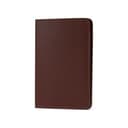
- Maruse. Skip it if you want features or value. It is the most expensive pick and has the fewest: no RFID lining, no tracker pocket, no closure. Buy it for the stated grade, the stated country and the slimness, or do not buy it.
- F&L Classic. Skip it if you want slim, or if a vague certification claim bothers you — “Tested & Approved by Independent Lab Tests” names no lab and no standard. It is also sold by a third-party seller rather than the brand.
- Karmiir. Skip it if you want the grade stated where you first read it, or if you want a tracker pocket. The SIM slots are the feature; everything else is unpublished.
- WANDERINGS. Skip it if the self-contradiction on the grade bothers you, which it reasonably might. It is the cheapest here and the capacity is real, but there is no closure and no tracker slot.
Keeping it, and the one rule about a wet passport
A passport holder gets very little use for most of the year and a great deal in short bursts, which means it needs almost no routine. Wipe it when it comes home from a trip, condition the fold lightly if it feels dry, and store it flat and empty rather than stuffed, because a passport left in a case for ten months will set a permanent bow into the leather. Our guide to cleaning a leather wallet applies directly, and how to condition leather covers how little product to use on something this thin.
The one rule worth saying plainly: if the case gets soaked, get the passport out of it immediately. Leather holds water against whatever it is touching, and a passport is paper and laminate. A damaged passport can be refused at a border, which makes a wet leather cover a far more expensive problem than a wet wallet. Dry the case open, away from heat, as set out in drying a wet leather bag — and dry the passport separately. If you are still deciding what to look for in leather generally, our guide to choosing a leather wallet runs the same checks at pocket scale. And a note on how we work: we do not handle these products, so nothing above is a wear test. It is a comparison of what each listing publishes and an argument about what that means, as set out on our methodology page.