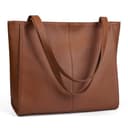
What a teaching day actually tests
Start with the number of straps. A teacher carries a bag that is heavy by office standards — a laptop, a charger, a set of 30 exercise books, and whatever came home to be marked — and carries it while walking and standing rather than sitting. A single shoulder strap puts the whole of that load on one side, and the leather-specific consequence is covered in our tote vs. backpack comparison: a one-strap bag fails at its handle anchors, because the strap leather is under sustained tension every moment it is loaded. Two straps halve the load per side and move the wear to the base corners, which are cheaper to live with.
Second, the footprint. Marking is letter-size paper, and paper that is carried bent comes back bent. A bag whose main compartment is at least about 12 inches on its short side takes a stack flat; a fashionable bucket shape makes you fold it. This is why two of the five picks here are rectangular work totes rather than prettier bags — the shape is the feature.
Third, the stated laptop size. School-issued laptops skew large, and a bag sold as “fits a laptop” without a number is a bag whose maker did not measure. Three of our five publish a figure. Our laptop-bag sizing guide explains why the diagonal on the box is not the dimension that decides fit.
Fourth, and last in importance, the grade. Teachers do not retire bags because the hide wore out; they retire them because a zipper died or a strap tore. But grade still matters for one classroom-specific reason: a stated full-grain or genuine-leather surface can be wiped and re-conditioned after a coffee or a whiteboard-marker incident, while a coated split or a bonded panel lifts and peels. The difference is set out in full-grain vs. genuine leather, and why peeling happens at all is in how to fix peeling leather.
The five, side by side
Every cell is read from the listing or marked “Not published.” Read the strap row first — it is the row that decides how your shoulders feel in March.
| | BOSTANTEN pack | KomalC satchel | BOSTANTEN satchel | DEKVIO pack | befen tote |
|---|
| Carry | Two straps | One shoulder | Shoulder + handles | Two straps | Shoulder + handles |
|---|
| Grade as stated | Genuine leather | Not published | Not published | Genuine leather | Genuine leather |
|---|
| Laptop size as stated | 15.6 in | 16 in | 15.6 in | Not published as a figure | Not published |
|---|
| Takes letter paper flat | Yes | Yes | Yes | Yes | Yes |
|---|
| Best read as | Everyday all-rounder | Grab-and-go between rooms | Desk-to-desk work bag | Maximum volume | Lowest cost |
|---|
The row worth a second look is the grade row on the two single-shoulder picks. Both are sold as leather and neither names a grade, which on this site means the field is published as nothing rather than guessed at. That silence is not proof of a bad hide — plenty of honest sellers simply never write it down — but it does mean you are buying the shape and the hardware, not a disclosed material. We keep both because the format is the reason to buy them.
Backpack, satchel or tote: pick by how your day moves
If you move rooms several times a day and walk to work, buy a backpack. The weight question is settled and it is not close: two straps, worn on both shoulders, at the height of your upper back. The cost is that a backpack is awkward to open while you are wearing it, so you will be taking it off at each room.
If you teach in one room and the bag mostly travels car-to-classroom, a satchel or a work tote is genuinely better: it opens on a desk without being unpacked, and a flat rectangular tote is the easiest shape in which to keep two piles of paper separate. The honest caveat is the strap. Keep the load sensible, rotate shoulders, and expect the anchors rather than the leather to be what eventually gives — per does leather stretch, a strap under sustained tension changes shape once and does not change back.
A note on a format we did not include: a rolling case. For a teacher who carries a full class set of books every night, wheels beat any leather bag on this page and we are not going to pretend otherwise. This roundup is for the far more common case — a laptop, a folder or two, and the marking that fits around them.
Making one last a career
Three habits do nearly all the work. Do not leave it on a radiator or in a hot car — that is how leather gets permanently stiff, and the mechanism is in does leather shrink. Empty it at the end of each week so it is not stored under load. And condition it two or three times a year rather than monthly, because the failure mode in a school bag is dirt driven into the grain, not dryness — the order to do it in is in leather cleaner vs. conditioner.
One last note on how we work: we have not handled any of these bags, so nothing above is a durability result. It is a comparison of what five listings publish and an argument about which of those facts a teaching day actually tests. The full version is on our methodology page, and the short answer to “why should I trust a page with no testing on it” is in our FAQ.