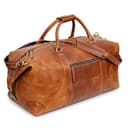
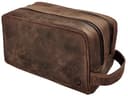
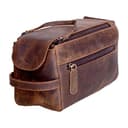
The four, side by side
Every cell is read from the listing or marked “Not published.” The hardware row is the one that separates them, because once all four state the same grade and the same hide, the next thing that can fail is the zipper.
| | Cuero duffle | moonster crossbody | RUSTIC TOWN kit | KomalC kit |
|---|
| Grade as stated | Full-grain | Full-grain | Full-grain | Full-grain |
|---|
| Hide named | Buffalo | Buffalo | Buffalo | Buffalo |
|---|
| Hardware stated | YKK zippers | Not published | Not published | YKK metal zippers |
|---|
| Size as stated | 28 in | Not published | 10.5 x 5 x 6 in | 9.5 x 5 x 4.5 in |
|---|
| Weight as stated | Not published | Not published | 0.88 lb empty | 0.65 lb empty |
|---|
| Lining stated | Not published | Not published | Waterproof | Water-resistant |
|---|
| Compartments | Organizer pockets | Not published | Two lined | One plus external zip |
|---|
The moonster row is the interesting one, and not in a flattering way. It is the cheapest stated-full-grain bag in this comparison and it publishes less than any of the others: no dimensions, no hardware, no weight, no warranty. The listing does say “handmade,” which is a description rather than a specification — nobody audits it. We have still ranked it second, because the two claims it does make are the two that matter most, and because an honest gap is better than an invented figure.
Why buffalo shows up cheap, and what that costs you
Three things are true about buffalo hide at once, and the picks above all trade on them.
It is thicker. A buffalo hide is substantially heavier than a cow hide of the same area, so a maker can cut a full-grain panel from it and still have material to spare. On a bag that gets thrown into a car boot or dragged through a station, that extra thickness is a straightforward advantage: a scuff that would break the surface of a thin, corrected cowhide only marks the top of a thick buffalo one. Why thickness matters this much is set out in leather weight and thickness.
It is coarser.Buffalo grain is visibly pebbled rather than smooth, and the pattern is irregular across the hide. Nobody can call that a fault — it is the look the category is sold on — but it is a look, and it is not the right one for a formal bag. A pebbled, distressed buffalo briefcase reads as rugged, never as sharp. If you want sharp, you want a smooth, fine-grained hide, and that means paying cowhide or calf prices; our briefcase roundup is the place for that decision.
It is heavier to carry. This is the honest cost. A thick hide is a heavy hide, and a 28-inch buffalo duffel weighs noticeably more empty than a nylon duffel of the same volume. For a weekender you lift twice a trip, that is nothing. For a bag you carry across a city every day, it is a real consideration, which is why the two smaller kits here are the formats we would push a weight-conscious buyer toward.
How we chose
- Both claims, stated. Every pick names buffalo as the hide andstates full-grain. A listing that says “buffalo leather” with no grade has told you the species and nothing about the layer, and a split buffalo hide with a sprayed finish is still a split hide. The grade words are decoded in full-grain vs. genuine leather.
- Named hardware breaks the tie. Two of the four name YKK zippers. On a bag whose leather is thick enough to outlast everything else attached to it, the zipper is the realistic failure point, and a named zipper brand is a replaceable, identifiable part rather than an anonymous one.
- Published dimensions over adjectives. “Large” and “spacious” are not sizes. Three of the four publish real numbers, and the two kits publish empty weights as well — which is the only way to know whether a toiletry bag will still fit a packed carry-on.
- We print the claims we do not accept. One listing here calls itself “TSA-approved carry-on size,” which is not a thing the TSA issues for bags; another says “ethically sourced,” which nobody independently audits. Both bags are still good buys, and both claims are still marketing. We leave them visible on the cards rather than quietly dropping them.
Living with a buffalo bag
Thick hide changes the care routine in two small ways. A new buffalo bag is stiff, sometimes alarmingly so, and the fix is use rather than product — the fibers soften where the bag flexes, which is also where it will eventually crease. Resisting the urge to soak a stiff new bag in conditioner is the single best thing you can do for it; the reasons are in how to soften stiff leather.
The second difference is that a pebbled grain holds dust and conditioner in its low points, so product applied generously will dry into the texture and look patchy. Thin coats, worked in and buffed off, twice a year at most — the cadence is in how often to condition leather and the method in how to condition leather. Done that way, a stated full-grain buffalo hide darkens into exactly the patina the category promises, and it does it faster than cowhide because the grain gives the color somewhere to collect.
As on every page here, none of this is a wear test — we have not owned these bags. It is a comparison of what four listings publish and an argument about which of those facts decide the purchase, and the full version of that method is on our methodology page.