One piece or two: the spec that decides a tooled belt
Most belts under $40 are two layers: a thinner outer strip bonded to a backing strip, stitched round the edge. It is cheaper, it uses smaller offcuts of hide, and on a plain belt it mostly works. On a western belt it is a problem, and the reason is the tooling itself.
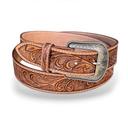
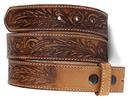
Tooling is cut and stamped into the surface of the leather.That means the top layer is deliberately compressed and incised across the whole working length of the strap — thinner in the cuts, denser at the edges of them. Flex a laminated strap repeatedly and the stress concentrates along those lines, which is exactly where the two layers can start to part. A one-piece strap has nothing to delaminate. Two of our six state one-piece construction outright; the other four say nothing, and on a tooled belt silence is worth noticing.
The second half of the same question is thickness, and here every listing fails. Not one of the six publishes a figure in ounces.A western belt wants roughly 8 to 10 oz of hide to hold a heavy buckle without curling, and none of these will tell you what you are getting — leather weight and thickness covers what the missing number would have told you, and our belt width guide covers the number they do publish.
Snaps or Chicago screws: how the buckle is held on
Three of these belts name their fixing and the difference is worth real money if you own a heavy buckle.
Snapsare two or three press studs at the buckle end. They are fast — buckle off, buckle on, ten seconds — and they are the reason the western format exists at all. They are also the part that gives way: a 5 or 6 ounce buckle swinging against a chair arm works a snap loose over months, and a popped snap at the wrong moment drops the buckle.
Chicago screws are a post-and-screw pair through the strap. They take a coin or a screwdriver to change rather than a thumb, and they do not release under load. If the buckle is decorative and heavy, screws are the right fixing. The trade is that screws back themselves out slowly with flex, so they want a check with a coin a couple of times a year.
A stitched-in buckle is not a western belt at all, and if that is what you want, our belts for jeans and dress beltpages are the right place — leather belt buckle types maps every fixing the site covers.
The finding on this page: the brand you know states the least
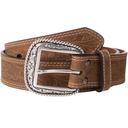
ARIAT is the most recognisable western label here by a distance, and its listing is the only one of the six that never claims a layer of hide. It says “100% Leather,” which is a material statement, not a grade — it rules out polyurethane and says nothing about whether the panel is full-grain, top-grain or a split. Meanwhile two belts at well under its price state full-grain and one-piece construction.
This is not a reason to avoid it. What the ARIAT listing does publish is the hardware — a removable silver-tone rope-edge buckle — plus the strap width, the contrasting white double stitching that makes a belt read western across a room, and a clear sizing rule. That is a real set of disclosures, and the belt is from a company with a reputation in the category to protect. It is simply not a grade claim, and we will not record one it did not make. The same pattern turns up on best leather goods brands: brand recognition and published specification often run in opposite directions.
There is one more label trap specific to this category, and it is the difference between two words that look interchangeable in photographs. Tooled means cut and burnished into the hide by hand. Embossed means pressed in under a press. Tooling needs an uncorrected surface to bite into. Embossing can be stamped onto a corrected, pigment-coated surface and often is, which is why an embossed floral pattern is weak evidence about the hide underneath. Three of these listings say tooled or engraved, two say embossed, and one says both.
The listing on this page that contradicts itself
The XZQTIVE is our budget pick and it comes with a caveat we will not paper over. Its title says “Genuine Leather.” Its first bullet says “full grain cowhide leather.” Those are two different layers of the same hide and a belt strap is cut from one of them, so a listing claiming both has made no grade claim at all. We record no grade for it, exactly as we do anywhere else on this site when a listing states two.
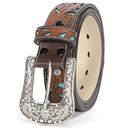
It is worth knowing which half is more likely. “Genuine leather” is the claim in the title, where a seller puts what it wants to compete on; the full-grain claim is buried in bullet one, where nobody is checking. If you are new to that ladder, full-grain vs. genuine leather is the page to read before you buy a grade word anywhere. What the XZQTIVE does deliver is honest and worth having at the price: a complete belt with an engraved buckle included, a snap system so the strap outlives the look, a published waist range, and the turquoise and diamond buckle options that are the actual western market.
The six, side by side
Every cell is read from the listing or marked “Not published.” Read the one-piece column against the grade column: together they tell you more than either does alone.
| Belt | Stated grade | One piece? | Buckle fixing |
|---|
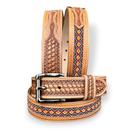
| DANIEL’S ARTPLANET one-piece | Full-grain | Stated one piece | Snap-on, interchangeable |
| DANIEL’S ARTPLANET beaded | Full-grain | Not published | Chicago screws |
| ARIAT floral embossed | Not published (“100% Leather”) | Not published | Removable rope-edge buckle |
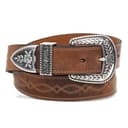
| ARIAT women’s center stitch | Full-grain | Not published | Silver-tone buckle |
| F&L Classic strap (no buckle) | Full-grain | Stated one piece | None supplied |
| XZQTIVE engraved tooled | Not published (contradictory) | Not published | Snaps, buckle included |
Three rows are empty for all six: thickness in ounces, buckle metal and country of manufacture. The buckle metal is the one that costs people money — a plated zinc buckle and a solid brass one look identical in a photograph and behave completely differently after two years of sweat.
How to buy one, in order
Size it two inches over your trouser waist, not to your waist. Every listing here that gives a sizing rule says the same thing, and a western belt sized to the waist measurement will sit on the first hole with no margin. How to measure belt size walks through measuring the belt you already own, which is the reliable method.
Then decide whether you are buying the strap, the buckle or both.If you have a buckle you care about, buy the strap alone — you will get more hide for the money, and the F&L Classic exists for exactly this. If you want one object that works out of the box, buy a complete belt and treat the buckle as replaceable.
Then choose 1.5 inches unless you know you want otherwise. Five of these publish a width and five say 1.5 inches, which is the standard western strap and what almost every decorative buckle is cut for. A 1.25 inch strap will rattle in a 1.5 inch buckle.
Then care for the tooling differently from a plain belt.A tooled surface holds dust and conditioner in the cuts, so it wants a soft brush rather than a cloth, and far less product than a smooth strap — how to care for a leather belt covers the routine, and best leather conditioners covers what to use. One closing note on method. We do not own any of these belts and we have not tested them. Every specification above is read from a live listing on the date shown on each card, every price renders from the live price layer, and no grade, thickness, metal or country is asserted that a listing does not state. The full rules are on our methodology page.