How Long Does a Leather Bag Last?
We will not give you a number, because nobody honestly can. What we can give you is the failure order - stitching, lining, zipper, strap anchor, edge - and which of the five ends the bag.
How this is funded: we earn a commission if you buy through our links, at no extra cost to you. It never changes which product we recommend, and we’ll tell you when we’d skip one. Full disclosure.
The honest answer is that we will not give you a number, and you should be suspicious of anyone who does. “Ten to twenty years” is the figure that circulates, and it is invented — a bag carried empty to an office three days a week and a bag loaded with textbooks five days a week are not the same product in any meaningful sense.
What can be said precisely is this: on a bag made from a stated full-grain hide, the leather is almost never what ends it. Five other things fail first, they fail in a fairly predictable order, and four of the five are repairable. Knowing which is which is the difference between a bag you keep for twenty years and a bag you throw away in four.
The five failure points, in order
1. Stitching. Thread is the consumable part of a leather bag. Every time the bag flexes under load, the thread abrades against the leather and against itself, and it goes first at stress points: a strap anchor, a bottom corner, the join where a gusset meets a panel. This is the most common reason a bag is retired and the cheapest thing on this list to fix. A bag with visible saddle stitching is a bag a repair shop can re-sew; a bag whose seams are glued and hidden is often not.
2. Lining.The fabric inside takes the abuse nobody thinks about: keys, pen leaks, grit, and the corner of a laptop. A torn lining does not look like failure — it looks like a bag that has become annoying — and it is the point at which most people mentally give up on a bag that is otherwise fine. It is rebuildable, and it is worth rebuilding if the hide is good.
3. Zipper. A zipper is a mechanism, and mechanisms have a finite life. Teeth deform, sliders wear loose, pull tabs snap. This is why a named zipper brand in a listing is worth more than it looks: a known make is a part a repairer can source, where an unbranded one has to be replaced with a near-enough substitute. The bags in our registry that name YKK are flagged for exactly this reason.
4. Strap anchor.Where the strap meets the body is the most heavily loaded square inch of the bag, and it fails in one of two ways: the thread lets go (see point one), or the leather itself tears through at the rivet or D-ring. The second version is the serious one, because it means the hide at that point was too thin or too weak for the load — which is a construction fault, not wear. It is repairable with a reinforcing patch, and it tends to recur.
5. Edges. Cut edges are the only place the inside of the hide is exposed. On a well-made bag they are burnished or sealed; on a cheaper one they are painted, and paint cracks and flakes. Fraying edges are cosmetic for a long time and then become structural, because a frayed edge is a loose fiber bundle that keeps unpicking. Re-dyeing and re-burnishing is straightforward.
Notice what is not on the list: the leather. A stated full-grain hide that is kept out of extremes will outlive all five of those parts, which is the entire case for buying one. The vocabulary is in full-grain vs. top-grain, and the ranking of which hides last longest is in what leather lasts the longest.
The two things that kill the hide itself
There are exactly two ways to end the leather rather than the hardware, and both are avoidable.
Heat, usually in the form of fast drying. Leather is a protein fiber network, and water leaving it quickly pulls those fibers tight as it goes. A bag dried on a radiator, in a hot car or under a hair dryer comes back hard, and hard leather cracks at the folds. The bag was not ruined by the rain; it was ruined in the hour after. The method that avoids it is in how to dry a wet leather bag, and the underlying physics is in is leather waterproof.
A finish with nothing under it.On a corrected or split hide the visible surface is a sprayed coating, and coatings lift. Once a finish starts flaking there is no dense grain layer beneath to burnish, so the failure is terminal rather than cosmetic. This is what people mean when they say a leather bag “peeled” — and it is why a listing that will not state a grade is telling you something about its lifespan. See how to fix peeling leather for the limits of what can be done, and what bonded leather is for the floor of the category.
What actually extends the life
Three habits, roughly in order of how much they matter.
Do not overload it. Every failure point above is a load problem. A bag carried at its design weight ages; a bag carried 50 percent over it fails at anchors and seams. If a bag publishes a laptop size, that is also a hint about the load it was built around.
Store it with its shape and with air around it.Loosely stuffed, upright or flat, in a breathable cotton bag — never sealed in plastic, which traps moisture against the hide and invites mildew. The detail is in how to store leather bags.
Condition occasionally, not often. Leather loses flexibility as it ages and as cleaning strips oils, and a light conditioner replaces some of that. But oils oxidize, and oxidized oils can stiffen leather rather than soften it, so more product is not more protection. Twice a year is plenty for a bag in daily use; the cadence argument is in how often to condition leather, and the method in how to condition leather.
Bags built to be worth repairing
A bag only justifies a twenty-year relationship if the hide is worth re-stitching at year twelve. These three state the grade that makes that arithmetic work - everything below is read from the live listing, and we have not handled any of them.
- Best daily carry to keep
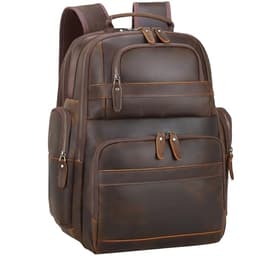
TIDING Full Grain Leather Backpack (15.6")
Leather grade: Full-grain
The listing states full-grain, which is the grade that burnishes rather than peels - the single fact that decides whether a repair at year ten is worth paying for. Sized for a 15.6-inch laptop, which is also a useful signal about the load it was designed around.
$169.99 · View on AmazonPrice as of October 20, 2026. #ad How we’re funded
- Best long-haul format
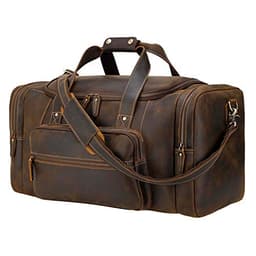
Polare 23" Full-Grain Cowhide Weekender Duffel
Leather grade: Full-grain
A duffel is the format leather ages best in, because the flex points are broad panels rather than tight corners, and this listing states full-grain cowhide in a 23-inch overnight size. The honest trade is weight: a full-grain duffel is heavy before anything goes in it.
$199.99 · View on AmazonPrice as of October 20, 2026. #ad How we’re funded
- The maintenance half
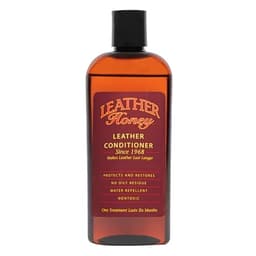
Leather Honey Leather Conditioner (8 oz)
Type: Conditioner
Occasional conditioning is the one habit on this page you buy rather than do, and this is the product our conditioner roundup ranks first on what the maker publishes about it. Twice a year, thin coats, buffed off - the failure mode in this category is using too much, not too little.
So what is the realistic expectation?
Frame it as a relationship rather than a lifespan. On a stated full-grain bag, expect to re-stitch something once, replace a zipper once, and possibly rebuild a lining once across a long ownership — and expect the hide to look better at the end of that than at the beginning, because handling and light are what produce a patina. On a bag whose listing never states a grade, expect the finish to decide the ending, and expect that to be the point at which repair stops making sense.
That is the whole argument for reading the grade before the price, and it is why every product page on this site prints the grade the listing actually states — or “Not published” when it does not. Our methodology page explains why we refuse to fill that blank with a guess.
How we know this. Veg Tan Club is written by an enthusiast, not a master leatherworker or a test lab. We compile each product’s published specs — grade, tannage, hardware — and reason from there. We say plainly when a listing doesn’t state a grade, and we haven’t physically handled every item we compare.
Frequently asked questions
How long does a leather bag last?
Longer than any other part of it, which is why the question is better asked about the bag than the hide. A stated full-grain bag that is kept dry, dried slowly when it gets wet and conditioned occasionally will outlive its own stitching, lining and zipper - all of which are repairable. We do not publish a number of years, because the honest answer depends on the load you put in it and the weather you carry it through, and anyone quoting a figure is guessing.
What fails first on a leather bag?
Stitching, almost always, and almost always at a stress point - a strap anchor, a corner, or the join where a gusset meets a panel. Thread is a consumable; it abrades against itself every time the bag flexes under load. The useful news is that it is also the cheapest repair in the category, and a bag with visible stitching is a bag a cobbler can re-sew.
Is a full-grain leather bag worth the extra money for durability?
For longevity, yes, but not for the reason most listings imply. Full-grain keeps the hide's dense outer layer, so a scratch burnishes into the surface instead of breaking through a sprayed coating - which is what peeling actually is. The bag still fails at its thread, zipper and lining first. Full-grain is what makes repairing those parts worth doing twenty years in.
Can a leather bag be repaired?
Most of it, yes. Stitching can be re-sewn, a zipper can be replaced, a lining can be cut out and rebuilt, a strap can be remade, and edges can be re-dyed and burnished. What cannot be fixed is a hide that has gone brittle from heat or repeated soaking and fast drying, or a coated split whose finish has started flaking - there is nothing underneath to restore.
Does conditioning a leather bag make it last longer?
Occasional conditioning helps; frequent conditioning does not. Leather fails when its fibers lose flexibility, and a light conditioner replaces some of what age and cleaning remove. But oils also oxidize and can stiffen leather over time, so more product is not more protection. Twice a year is a reasonable cadence for a bag in regular use, and less for a bag that lives indoors.
What ruins a leather bag fastest?
Heat, and specifically drying it fast after it gets wet. Water alone is survivable; water leaving the hide quickly - near a radiator, in a hot car, under a hair dryer - pulls the fibers tight as it goes and leaves the leather hard and prone to cracking at the folds. Second place goes to storage: a bag crushed flat in a sealed plastic bag for a year arrives creased and often mildewed.
How long does a genuine leather bag last compared with full-grain?
Expect years rather than decades. "Genuine leather" is the vaguest grade word in the trade and usually describes a split, corrected hide with a sprayed finish. It wears acceptably for a while and then fails by flaking rather than by scuffing, and once a finish starts lifting there is no layer beneath it to burnish. That is the practical difference between a bag you repair and a bag you replace.
Sources
- Wikipedia — Leather — Overview of leather, grain layers and the full-grain / top-grain / split hierarchy (accessed July 18, 2026)
- Wikipedia — Conservation and restoration of leather objects — How the field cleans and stabilizes leather; why oils oxidize and can harden leather over time (accessed July 18, 2026)
- Canadian Conservation Institute — Caring for leather, skin and fur — CCI preventive-conservation guidance on cleaning, dressing and storing leather (accessed July 18, 2026)
- U.S. National Park Service — Curatorial Care of Objects Made From Leather and Skin — NPS museum-handbook guidance on cleaning, handling and storing leather; humidity below ~65% (accessed July 18, 2026)
- 16 CFR Part 24 — FTC Guides for Select Leather and Imitation Leather Products — The FTC guides on leather labeling: unqualified 'leather' claims, imitation-leather disclosure, backing material and misuse of trade names (accessed August 19, 2026)
- Wikipedia — Patina — Patina as the surface change materials develop with age, handling and exposure (accessed July 18, 2026)
Keep reading
How long does a leather wallet last?
The same question in the format that gets the hardest use - a wallet flexes hundreds of times a week.
Read the guideHow long does a leather belt last?
The third lifespan page - a belt fails in a sequence too, starting at one hole.
Read the guideHow to dry a wet leather bag
The single most damaging hour in a bag's life, and the method that gets it through.
Read the guideHow to store leather bags
Why a sealed plastic bag is the worst place to keep one, and what to do instead.
Read the guideWhat leather lasts the longest?
Grade, tannage and thickness ranked by how much each one actually contributes to lifespan.
Read the guideBest full-grain leather bags
The bags whose listings state the grade that makes a twenty-year repair worth paying for.
See the picks