Why full-grain is available here and not in a bag
A standard cowhide is roughly 45 to 50 square feet, and the best of it — the unmarked back and sides — is what large panels have to be cut from. A briefcase needs several of those panels; a bifold needs scraps. That single fact explains the whole price structure of this category: the same hide that cannot yield an affordable full-grain bag yields dozens of affordable full-grain wallets. It is also why “full grain” appears in wallet titles at $35 and almost never in bag titles at $90 — the makers are not being braver, they are buying less leather. We lay the arithmetic out in how much a leather bag should cost, and the grade vocabulary itself is in full-grain vs. genuine leather.
The practical consequence: in this band, the grade claim is close to free, so an absent grade claim is expensive information. Two picks here state genuine leather instead of full-grain, and both earn their place on layout or price rather than on the hide — which is said plainly on their cards rather than smoothed over.
The six, side by side
Every cell is read from the listing or marked “Not published.” Current prices are on the Check price button in each row of the table above; no number is typed into this page.
| | Carhartt | SERMAN BRANDS | FREYAMIRA | Karmiir | Buffway | Travelambo |
|---|
| Format | Full-size bifold | Trifold | Long bifold | Passport / travel case | Slim front-pocket | Slim front-pocket |
|---|
| Grade as stated | Full-grain saddle | Full-grain | Not published | Full-grain (in a bullet, not the title) | Genuine leather | Genuine leather |
|---|
| RFID stated | Yes | Yes | Yes | Yes | Yes | Yes |
|---|
| Layout published | Not published | 11 slots + cash divider + ID window | Long-wallet capacity | Card + SIM slots, zip coin pocket, cash compartment | Not published | Not published |
|---|
| Dimensions published | Not published | 4.5 x 3.3 in closed | Not published | 4.13 x 5.51 x 0.6 in, approx. 0.24 lb | Not published | Not published |
|---|
| Warranty stated | Not published | 12 months (defects) | Not published | Not published | Not published | Not published |
|---|
| Tannage stated | Not published | Not published | Not published | Not published | Not published | Not published |
|---|
| Thickness stated | Not published | Not published | Not published | 0.6 in case depth | Not published | Not published |
|---|
Two rows are worth staring at. Every single wallet here claims RFID shielding— six for six, across six formats and the whole price spread. That is not a coincidence or a quality signal; it is what the category is now sold on. Our honest read has not changed and is set out in are RFID wallets worth it: contactless skimming is a real but uncommon attack, chip transactions are tokenized, and shielding is worth having when it is free — which here it effectively is, so take it and do not pay a grade downgrade for it.
Nobody publishes a tannage. Not one of the six says whether the hide was vegetable-tanned, chrome-tanned or a combination, and that is the spec that decides how the wallet ages: a vegetable-tanned hide darkens and burnishes, a chrome-tanned one stays closer to the color it shipped in. If that matters to you, it is worth more money, and the wallets that do state it are on our vegetable-tanned wallet picks — the tannage this site is named after, and why it is explained in vegetable-tanned vs. chrome-tanned leather.
Pick the format first, the leather second
A bifold is the default for a reason: one fold, the fewest stress lines, a bill compartment and enough slots for most people. It is the format least likely to annoy you in year three.
A trifoldbuys panel area and pays in depth — more slots and more pockets in a smaller outline, at the cost of a thicker wallet. The trade is set out in bifold vs. trifold, and the format’s own ranking is on best leather trifold wallets.
A long wallettakes notes flat and is read as a bag wallet rather than a pocket one — the right answer if you carry a purse and want everything visible at once, the wrong one for a front trouser pocket.
A travel case is a different product that happens to be made of the same material: it holds a passport, and the Karmiir goes further than anything else in this band with SIM-card slots and an ejector tool in the box. If that is your actual need, the full format comparison is on best leather passport holders.
A slim front-pocket walletis the honest answer for anyone whose complaint is bulk rather than capacity, and both slim picks here state genuine leather rather than full-grain — which in a wallet that carries four cards matters less than it does in one that flexes around twelve. The dedicated ranking is on slim and minimalist wallets.
What fails, and in what order
A wallet is a fatigue product with no hardware to blame, which is why the grade does more work here than in any other leather good. The fold line goes first: the leather creases, then a corrected or coated finish crazes along the crease, then the lining splits behind it. Next the slot mouths stretch, and that is permanent — leather takes a set at whatever you keep in it, so a slot carrying two cards for a year stays loose when you go back to one. Then the stitching at the ends of the slots, where the thread does the most work. Full-grain does not make the sequence disappear; it slows the first step, which is the step that triggers the rest. The general case is in how long a leather wallet lasts.
Two habits are worth more than any pick on this page. Do not overstuff the bill compartment, which forces the outer panels apart at the crease. And condition the fold lightly and occasionally rather than the whole wallet generously — a fold that stays supple does not craze. Which products state what is in them is in our conditioner picks, and the routine is in how to clean a leather wallet.
Which one for you
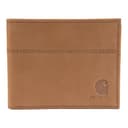
If you want the best leather on the page: Carhartt. Stated full-grain saddle leather with RFID, from a brand whose whole proposition is durability. It is chunkier than a slim wallet and the looks are classic rather than fashionable.
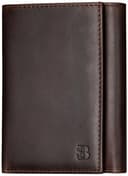
If you carry ten cards or more: SERMAN BRANDS trifold. The most slots here, a cash divider, dual thumb cutouts and the only stated warranty on the page. Accept that eleven filled slots across three panels is a thick wallet by construction, and that the listing quotes its own capacity two different ways.
If you carry a bag and want everything visible: FREYAMIRA. A roomy long bifold with RFID at a sensible price. The grade is not published, so buy it for the layout.
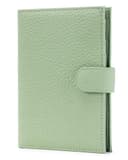
If you travel internationally: Karmiir. A bullet states full-grain cowhide, the case publishes its own dimensions and weight, and the SIM slots plus ejector tool solve a real arrivals-hall problem nothing else here addresses. The grade is in a bullet rather than the title, and there is no tracker pocket.
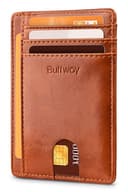
If your complaint is bulk: Buffway. A slim front-pocket wallet that still holds a usable number of cards, with RFID, at a budget price. Genuine leather rather than full-grain, and not the absolute thinnest option made.
If you want the cheapest wallet we will stand behind:Travelambo. Genuine leather, RFID, front-pocket format, minimal capacity. It is not an heirloom and does not pretend to be — it is the cheapest honest route out of a fat back-pocket wallet. Every rule behind these picks is on our methodology page.