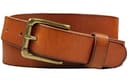
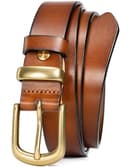
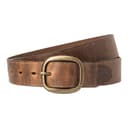
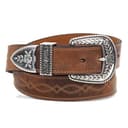
What is actually different about a women’s belt
Less than the marketing suggests, and the differences that exist are physical rather than decorative.
- Width runs narrower. Men’s belts cluster around 1.25 inches for dress and 1.5 inches for jeans. The women’s belts we read publish widths from 1.1 inches (28mm) up to 1.5 inches, with several at 1.25 or 1 3/8. Women’s trouser and jean loops are usually cut to match, so the rule from our belt width guide still applies: measure your narrowest loop before you shop.
- Two sizing systems compete. Strap makers size in inches, measured from the fold at the buckle to the middle hole, the way men’s belts are sized. Fashion brands size by dress size — Small, Medium, Large, or 8–10, 12–14 — which is convenient until you try to compare two belts. Three of the six picks use one system and three use the other, and the section on sizing below deals with it.
- The belt often sits at the hips, not the waist. A belt worn over jeans at the hip needs a longer strap than the same person’s waist measurement, and a belt worn over a dress at the natural waist needs a shorter one. This is the single biggest reason women’s belt returns happen, and it is why a hole-free D-ring belt, which fastens anywhere along its length, exists as a category.
- Hardware is described by color, not by metal. “Gold buckle,” “gold-tone,” “antique brass finish.” On men’s belts the buckle metal is a spec; on women’s belts it is a colorway. Only two listings here name the buckle metal at all.
The trap specific to this category: the “leather belt” that is PU
While building this page we read a listing titled as a women’s leather belt for jeans and dresses whose first bullet stated the belt was crafted from “premium PU leather.” PU is polyurethane — a plastic coating on a fabric or split backing, as our guide to what PU leather is explains. It was in stock, cheap, and sat in the top ten of two of the nine searches we ran. It is not on this page, and it is the reason the first criterion below is what it is.
This happens more in women’s belts than anywhere else on this site, because a thin strap with a shiny buckle photographs the same whether it is leather or not. The FTC’s leather guides govern when a product may be described as leather and require imitation materials to be disclosed — which is why that listing said “PU” somewhere — but nothing makes a seller put it in the title. Read the bullets. If the word “PU,” “vegan,” “faux” or “synthetic” appears anywhere, the title’s “leather” is decorative. Our guide to telling real leather from fake covers what to check once the belt arrives.
How we chose
The criteria came first, in this order, and the ranking follows how many of them each listing answers in writing. Where two belts disclose a similar amount, we favored the one whose buckle can be replaced.
- Real leather, stated as such. A material claim that says leather and nowhere says PU, vegan or faux. All six pass. One rejected listing did not.
- A stated grade. “Full-grain” in the listing’s own words, not “premium” or “high quality.” Four picks state it: Belts.com, WOLFANT, Artisana Leather and ARIAT. The Levi’s and the Fossil do not, and they are ranked last for it. What the word means, and why it matters more in a belt than in a bag, is in full-grain vs. genuine leather belts.
- One-piece construction. Full-grain names the layer of hide; “one piece” or “no bonding” names how the strap was built. Two picks state it: Belts.com (“one-piece full-grain cowhide”) and WOLFANT (“one single piece, no fillers, no bonding”). A belt can honestly say full-grain and still be a thin full-grain face glued over a split, and the fold at the buckle is where that glue lets go.
- A published width. Five of six publish one. The Fossil does not, which matters more on a D-ring belt than most, because the rings have to match the strap.
- Thickness, if published. One listing prints it: the Belts.com strap at 8–9 oz, about 4mm. Our leather weight guide puts everyday belts at roughly 8–10 oz, so that is a full-weight strap in a narrow width, and it is the reason it will feel stiff at first.
- A buckle that can be replaced. Belts.com states snaps; ARIAT states a removable buckle and tip. The other four do not say, which usually means stitched.
- Currently purchasable. Every pick returned “In Stock” from the live catalog on the day this page was built. Two belts we would otherwise have included — a vegetable-tanned bull-leather strap and a workwear brand’s women’s belt — were down to their last two or three units and were left off rather than sent to a page that might be empty by the time you read it.
Width: dress loops, jean loops and the one belt that does both
The narrowest pick is the WOLFANT at 1.1 inches (28mm), and the widest is the ARIAT at 1.5 inches, which tapers to 1 inch at the buckle. In between sit the Belts.com at 1-1/8 inches (30mm), the Artisana at 1.25 inches and the Levi’s at 1 3/8 inches. That spread maps neatly onto the two jobs a belt does. Below about 1.2 inches a strap threads dress-trouser loops and looks in proportion over a dress or a tucked blouse; from about 1.25 inches up it starts to read as a jean belt, and by 1.5 inches it will not thread most dress loops at all.
If one belt has to do everything, the Artisana’s 1.25 inches and the Belts.com’s 30mm are the safest middle. The Levi’s 1 3/8 inches is a jean width, and the listing says so — it describes the belt as sized to sit at the hips in high-, mid- or low-rise jeans. The ARIAT’s taper is worth understanding: the strap is Western-wide where it passes through the loops and narrows where it meets the buckle, so the hardware does not swamp a small frame. Our comparison of dress and casual belts covers what else changes between the two ends.
Sizing: inches or dress size, and how to convert
Belts.com, WOLFANT and ARIAT size in inches. Belts.com states its method outright — measured from the fold where the buckle attaches to the middle hole — and recommends measuring a belt you already own from the fold to the hole you use. That is the same method in our belt sizing guide, and it is the only reliable one, because belt size is not your pant size and it is not your waist measurement either.
Levi’s sizes by dress size, from X-Small (0–2) to 3X (20–22W), and the Artisana and the WOLFANT variant we read state a waist range per letter (the Artisana’s Medium fits a 32–34 inch waist). The Fossil is sold by lettered size (the variant we read is a Large) with no waist range stated in the listing. To compare a dress-sized belt against an inch-sized one, measure a belt that fits, then check the dress-sized listing’s size chart for the letter whose range contains that number — and remember to add an inch or so if the belt will ride at the hip over jeans rather than at the waist. The WOLFANT and Belts.com include seven holes; the WOLFANT ships with a hole punch; and the Belts.com and ARIAT can be shortened at the buckle end because the buckle comes off. Our guide to shortening a leather belt covers that job.
Buckles: solid brass, plated finishes and the D-ring
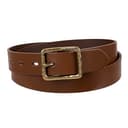
Two listings here say what the buckle is made of. Belts.com states an antique solid brass roller buckle, and WOLFANT states a brass buckle described as sturdy and scratch-resistant. Three others describe a color: the Levi’s hammered center bar is in an “antique brass finish,” the Fossil D-ring is “gold-tone,” and the Artisana’s title says antique brass while a bullet says antique silver. The ARIAT states an antiqued silver floral-engraved buckle without naming the base metal.
The distinction matters more than it sounds. A finish is a plated color over a base metal, and at the prong and the frame edge, where a belt rubs every time it is fastened, plating wears through. Solid brass just darkens. Neither will fail in a season, but if you want the buckle to age with the strap rather than against it, the two brass picks are the ones. Our guide to belt buckle types walks through frame, center-bar, roller, D-ring and interchangeable buckles and how each attaches.
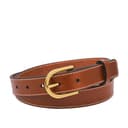
The D-ring deserves its own note because it is the one buckle here with no holes. The strap threads through two rings and doubles back on itself, and friction holds it. That is why it fastens at any point — over a dress at the waist one day, over a knit at the hip the next — and why it is the wrong belt for heavy denim: pull hard and it creeps. It is also the one buckle that never stretches a favorite hole, because there is none.
Recognized brands and the silence around the leather
Three of the six picks carry names most people know: Levi’s, Fossil and ARIAT. Only ARIAT states a grade. The Levi’s listing describes a cut-edge strap and a hammered buckle in detail and calls the material “leather.” The Fossil listing says “Material: Leather” and describes the leather as soft and known for looking good over time. Those are not false statements. They are just not specifications, and a brand that had cut its women’s belts from full-grain would almost certainly say so, because it is the strongest true thing a belt listing can say.
We kept both because they are real, purchasable belts people search for by name, and because putting them beside a strap maker’s listing that prints its ounce weight makes the point better than any explainer could. If you want the Levi’s or the Fossil for the look, buy it knowing the leather is undisclosed. If you want a belt that states what it is, the first four picks do. Our guide to judging a leather goods brand explains why the spec sheet is the brand.
Who should skip each pick
- Belts.com. Skip it if you want a belt that looks like a fashion accessory. It is a plain, thick, vintage-finish strap that will be stiff for the first few weeks, and it is sized in inches, so you will need to measure a belt you own.
- WOLFANT. Skip it if you need a published thickness or a stated tannage. “Italian” names where the leather came from and nothing more, and the listing does not say how thick the strap is.
- Artisana Leather. Skip it if the buckle color matters to you and you cannot tolerate a surprise: the title and a bullet disagree on whether it is antique brass or antique silver. Thickness and construction are also unstated at a price near the top of this page.
- ARIAT. Skip it if you want a dress belt, a low price or a spec sheet beyond the grade. The floral buckle and center stitch are unambiguously Western, and thickness, tannage and origin are unpublished.
- Levi’s. Skip it if a stated grade is non-negotiable. The listing is thorough about the styling and silent about the hide, and the buckle is a finish rather than solid metal.
- Fossil. Skip it if this belt has to hold up jeans. A D-ring holds by friction and creeps under load, and the listing publishes neither the grade nor the width.
Breaking it in and keeping it
A full-weight strap like the Belts.com pick arrives stiff and relaxes with wear. Our guide to breaking in a leather belt covers the safe ways to speed that up and the ones that ruin the leather. After that, the routine is short: wipe it, condition the fold lightly when it looks dry, keep it away from radiators and hot cars, and hang it or coil it loosely rather than leaving it buckled in a pair of jeans. On a vegetable-tanned strap expect the tan to darken noticeably in the first year; that is the patina people buy veg-tan for, and our guide to caring for a leather belt has the rest.
If you are still deciding what to look for in any belt, not just a women’s belt, our guide to choosing a quality leather belt runs the seven checks in order. And a note on how we work: we do not handle these products, so nothing above is a wear test. It is a comparison of what each listing publishes and an argument about what that means, as set out on our methodology page.