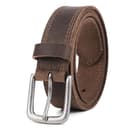
Why belts state full-grain when bags do not
This is the structural fact behind the whole belts hub and it is worth two paragraphs, because it changes what you should accept at a given price.
A belt is one long strip cut from the back and butt of the hide.That is the densest, flattest, least scarred area of the animal — the part a tannery is least likely to need to sand and re-emboss to make presentable. A bag needs large clean panels from the sides and belly as well, which is where the scars and the loose fiber are, and that is why a stated full-grain bag under $100 barely exists while a stated full-grain belt under $25 is ordinary. Our bags under $100 page makes the same argument from the other end.
The consequence for you: in this category, a stated full-grain claim is cheap enough to be the baseline rather than the prize. So do not pay a premium for the grade word alone. Pay for what the grade word does not tell you — the thickness, the buckle metal and the fixing — because those are what separate a belt that lasts a decade from one that curls in two years. Best full-grain belts is the whole field filtered on that claim, at every price.
The three numbers that actually decide a belt
1. Thickness in ounces.This is the number that predicts whether a belt holds its shape. Leather thickness is quoted in ounces, where one ounce is roughly 0.4 mm: a dress belt is comfortable at 6–8 oz, a jeans or work belt wants 8–10 oz, and a gun belt goes higher still. Exactly one belt on this page publishes a figure— 8–9 oz, stated as 4 mm, on the Belts.com strap — and that single disclosure is why it is labelled the best-disclosed pick rather than the best overall. Leather weight and thickness is the page that makes ounces readable.
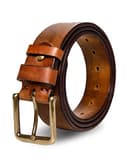
2. The buckle metal.A plated zinc buckle and a solid brass one look identical in a photograph and behave completely differently after two years against skin: plating wears through at the contact points and the base metal corrodes, where solid brass simply dulls and can be polished back. Two belts here name their hardware — antique solid brass on the Belts.com, a removable nickel-free double-prong on the PBF — and four say nothing. Leather belt buckle types covers the forms.
3. The width, against your own belt loops. Five of six publish one, and the spread matters more than people expect: 1-1/8 inch (30 mm) on the Belts.com, 1.38 inch (35 mm) on the Prospero, 1.5 inch on the WOLFANT, 1.75 inch on the PBF work belt. A 1.75 inch strap will not pass through many dress trouser loops, and a 30 mm strap looks thin in jeans. Our belt width guide is the page for matching it.
The finding on this page: the best-disclosed belt is a women’s belt
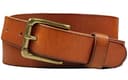
The Belts.com women’s roller-buckle strap is not just the best-disclosed belt under $50 — it publishes more about itself than most belts at three times the price anywhere on this site. Stated full-grain. Stated vegetable-tanned. Stated 8–9 oz at 4 mm. Antique solid brass, named as solid rather than plated. A snap-on fixing, so the buckle is replaceable. A published 30 mm width.
That is six disclosures from one listing in a band where most belts manage one. And the cause is worth noticing: it comes from a seller that sells nothing but belts. The same pattern turned up on our vegetable-tanned roundup, where the only item publishing a thickness came from a company that makes nothing but straps — disclosure tracks specialism more closely than it tracks price. If you want more in this direction, our women’s belts page judges the field on exactly these specs.
The honest counterpoint: at 1-1/8 inch and 30 mm it is a narrower strap than most men want in jeans, and the vegetable tannage that makes it patina also makes it the pick most likely to darken unevenly if it gets wet — vegetable-tanned vs. chrome-tanned explains that trade, and how to care for vegetable-tanned leather is the maintenance it needs.
The one top-grain pick, and why it is here
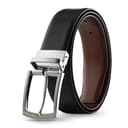
The Prospero is the only belt on this page that states top-grain rather than full-grain, and it is included because of what it is: a reversible belt, which is a format that forces the compromise rather than choosing it. A reversible strap has two finished faces, which means two surfaces have to be coated and colored, and a rotating buckle mechanism in between. Something has to give, and on reversible belts it is almost always the grade. A stated top-grain Italian hide is the best stated hide this format allows at this price, which is a genuinely useful thing to know before you go looking for a full-grain reversible belt that does not exist here.
The trade specific to the format is mechanical rather than material. A pin buckle has no moving parts and cannot fail; a rotating reversible buckle does, and not one reversible listing anywhere on this site names the metal in that mechanism. Best reversible leather belts and ratchet vs. traditional belt take that argument in full. Our view is consistent across both: buy a mechanism only if you want what the mechanism does, because every moving part is a part that can break.
The six, side by side
Every cell is read from the listing or marked “Not published.” Read the thickness column — it is the honest shape of this band.
| Belt | Stated grade | Width | Thickness |
|---|
| WOLFANT Italian full-grain | Full-grain | 1.5 in | Not published |
| Belts.com roller buckle | Full-grain, vegetable-tanned | 1-1/8 in (30 mm) | 8-9 oz (4 mm) |
| wolksprong work belt | Full-grain | Not published | Not published |
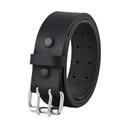
| PBF heavy duty big-and-tall | Full-grain | 1.75 in | Not published |
| Prospero reversible | Top-grain | 35 mm (1.38 in) | Not published |
| VATAN casual jean belt | Full-grain | Not published | Not published |
Five stated full-grain, one stated top-grain, one stated tannage, one stated thickness, two named buckles and zero published countries or warranty terms. If $25 is your real ceiling, the stated full-grain rate barely changes — see belts under $25. If you want solid brass and a published thickness as the rule rather than the exception, that starts above this cap.
How to buy one, in order
Size it from the belt you already wear, not from your trouser waist. Measure from the fold at the buckle to the hole you actually use, and buy that number. How to measure belt size walks through it, and it is the single most common reason a belt gets returned.
Then match the width to the loops, not to the look. 1.5 inches (35 mm) is the safe default for jeans and chinos; 1.25 inches and under is dress territory; 1.75 inches is a work belt that will not fit many dress trousers. Five of six publish a width here, so this is checkable before you buy.
Then spend on the buckle and the thickness rather than the grade word, because at this price the grade is nearly free and the hardware is not. If only one listing in the band names solid brass, that is information.
Then break it in and condition it twice a year. A new belt is stiff because it has not taken the curve of your waist yet; how to break in a leather belt covers doing that without cracking it, and how to care for a leather belt covers the routine. One closing note on method. We do not own any of these belts and we have not tested them. Every specification above is read from a live listing on the date shown on each card, every price renders from the live price layer rather than a figure typed into this page, and the $50 cap is enforced at request time against those live prices rather than trusted. The full rules are on our methodology page.