Bifold vs. Trifold Wallet
One fold or two. The trifold gives you a third panel of slots in a shorter footprint and charges you for it in thickness - which is the entire decision, in one sentence.
How this is funded: we earn a commission if you buy through our links, at no extra cost to you. It never changes which product we recommend, and we’ll tell you when we’d skip one. Full disclosure.
The decision in one sentence: a trifold gives you a third panel of card slots in a shorter, squarer footprint, and charges you roughly 50 percent more thickness for it. Everything else follows from that trade.
So the honest recommendation is conditional. Buy a bifold if your pocket is shallow on depth — a back pocket, a jacket chest pocket, anywhere a block of leather looks obvious. Buy a trifold if your pocket is short on length and you carry enough cards that a two-panel wallet overflows. That is a real population of people, and the format exists for them rather than by accident.
What each format actually is
A bifold folds once. Opened, it is a wide rectangle: a full-width bill compartment along the spine, with card slots stacked on one or both inner faces. Closed, it is roughly 4.5 by 3.5 inches and the thinnest of the two, because you are stacking two layers of leather and two columns of cards.
A trifoldfolds twice, like a letter. Opened it is three panels wide; closed it is shorter and squarer than a bifold — often nearer 3.5 by 4 inches — because the extra panel folds inward rather than extending the footprint. The bill compartment still runs the full width, so banknotes stay unfolded, but they are now hidden behind two flaps rather than one.
The important consequence is geometric rather than aesthetic. Closed, a trifold has three leather layers and up to three card columns in the same stack. Load each column with three cards and you are carrying nine cards through a single cross-section. That is why a trifold that looks neat in a product photo becomes a visible brick in a pocket.
The five differences that matter
- Thickness. The bifold wins, and not narrowly. If anyone has ever commented on the shape of your back pocket, this is the row that decides your purchase.
- Footprint. The trifold wins. It is shorter, so it clears the top of a shallow front pocket where a tall bifold catches on the edge. The two formats fit different pockets badly in opposite directions.
- Cards visible at once. The trifold wins again, and this is its underrated advantage. Opening three panels lays out most of your cards in one view instead of making you thumb through a single stacked column.
- Bills. A draw on paper, a bifold win in practice. Both keep notes unfolded, but a bifold gives you the compartment in one motion where a trifold makes you open two flaps to reach it. If you still pay cash often, that matters more than it sounds.
- Leather life. The bifold wins. One fold means one stress line; two folds mean two, and the outer fold on a loaded trifold is the hardest-worked leather in the whole category. Wallets fail at the spine, which is why how long a wallet lasts is really a question about folds.
What the fold does to the leather
Worth a paragraph of its own, because it is the part no listing mentions. At a fold, the inside face of the leather is compressed and the outside face is stretched, every single time the wallet opens. Over years, the fibers on the outside of that curve realign and thin — the same one-way behavior described in does leather stretch— and the spine becomes the place where a crack or a split eventually starts.
Two things reduce it. A thinner hide folds with less internal strain, which is why wallet leather is thinner than belt leather and why a thick wallet in thick leather is a bad combination. And a stated full-grain hide has its densest fiber layer intact at exactly the point that is being stretched, which is the structural reason to prefer it here rather than just a cosmetic one. The grade words are decoded in full-grain vs. genuine leather, and thickness in leather weight and thickness.
The practical upshot: if you want a trifold, the hide matters more than it does on a bifold, not less. The format works its leather harder, so a listing that will not state a grade is a bigger gamble in this shape than in any other.
Which to buy, decided properly
Answer three questions and the format chooses itself.
How many cards do you genuinely carry?Count them, including the loyalty cards. Under about six, a bifold or a slim wallet is correct and a trifold is solving a problem you do not have. Over about ten, neither a bifold nor a trifold is really the answer — you want a long wallet, which is what our high-capacity roundup is for.
Which pocket will it live in?Back pocket or jacket: bifold. Shallow front trouser pocket with cards to carry: trifold. Front pocket and minimal carry: neither — see slim minimalist wallets.
Do you need to show ID quickly? Both formats offer window options, but the layout differs: a trifold can put a window on an outer panel so it shows without fully opening, which is the one functional advantage that beats the bifold outright. Our ID-window roundup covers who publishes one.
An honest note on what we stock
Our registry holds no everyday trifold, and we are not going to invent one to balance this page. Every pocket trifold we read while putting this together either stated no grade at all or contradicted itself between its title and its bullets, and the rule here is that a pick has to state something checkable before it earns a card.
What we do have is the trifold format in its travel form — a document organizer that uses three panels to lay out a passport, cards and certificates at once, which is the use case where the shape is unambiguously right. It is included below as the trifold example precisely because it is the version of the format whose extra panel earns its depth.
One of each, from listings that state a grade
Two bifolds and the one trifold-format wallet we cover. Each states a grade in its listing, which is the minimum for a format that works the leather at a fold - everything here is read from the live listing, and we have not handled any of them.
- The bifold, for card carriers
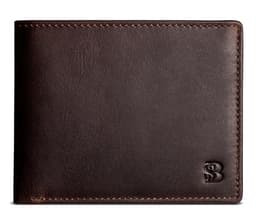
SERMAN BRANDS Full Grain Leather RFID Bifold
Leather grade: Full-grain
The bifold argument at its strongest: a stated full-grain hide with 12 card slots, an ID window and RFID blocking at a budget price, which is more capacity than most bifolds attempt. Twelve loaded slots will make it thick - this is the format pushed to its sensible limit before a trifold or a long wallet becomes the better answer.
$34.95 · View on AmazonPrice as of October 20, 2026. #ad How we’re funded
- The bifold, for the long haul
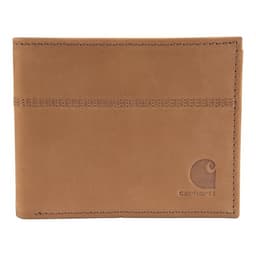
Carhartt Full Grain Saddle Leather RFID Wallet
Leather grade: Full-grain
Stated full-grain saddle leather from a workwear brand with a durability reputation to protect, which is the combination to want at a fold - the spine is the part that eventually fails, and full-grain keeps its densest fiber layer exactly there. Chunkier than a slim wallet, and classic rather than fashionable.
$42.99 · View on AmazonPrice as of October 20, 2026. #ad How we’re funded
- The trifold, in the format it suits
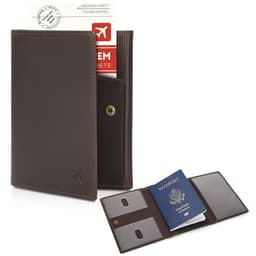
Polare Full Grain Leather Pilot Wallet and Document Organizer (Dark Brown)
Leather grade: Full-grain
A three-panel organizer that uses the extra width the way a trifold should: two clear ID windows, a document slot, a passport pocket and a boarding-pass pocket, all readable at once. It states full-grain leather and publishes a weight. Read it as a travel wallet, not a pocket wallet - it is one passport slot and solo-traveler sized.
$36.99 · View on AmazonPrice as of October 20, 2026. #ad How we’re funded
Looking after either one
Wallet care is mostly restraint. Do not carry it at capacity permanently, because a permanently splayed wallet sets in that shape. Do not sit on a loaded one if you can avoid it, which bends the spine against its grain. And clean it occasionally rather than conditioning it often — a wallet picks up more skin oil than any other leather good, and adding more oil to that is rarely the fix. The routine is in how to clean a leather wallet, and the cleaner-versus-conditioner question is in leather cleaner vs. conditioner.
As everywhere here, none of this is a wear test — we do not own these wallets. It is a structural argument about two formats plus what three listings publish, and the method behind that is on our methodology page.
How we know this. Veg Tan Club is written by an enthusiast, not a master leatherworker or a test lab. We compile each product’s published specs — grade, tannage, hardware — and reason from there. We say plainly when a listing doesn’t state a grade, and we haven’t physically handled every item we compare.
Frequently asked questions
What is the difference between a bifold and a trifold wallet?
The number of folds. A bifold folds once into two panels, so it is wider when open and slimmer when closed. A trifold folds twice into three panels, which makes it shorter and squarer closed but about 50 percent thicker, because three layers of leather and three layers of card stack up instead of two.
Is a bifold or trifold wallet better?
A bifold for most people, a trifold if your pocket is short rather than slim. The bifold is thinner, sits flatter in a back or jacket pocket, and keeps bills unfolded in a full-width compartment. The trifold holds more cards in a smaller footprint and shows most of them at once, which genuinely suits anyone who carries a lot of cards and wears trousers with shallow front pockets.
Do trifold wallets hold more cards?
Usually yes, because a third panel adds slots without making the wallet longer. The catch is that the extra capacity arrives as depth, not as volume you do not notice - a loaded trifold is a visible brick in a pocket, and the fold furthest from the spine is where the leather creases hardest. If capacity is the goal and thickness is not a constraint, a long bifold is often the better answer.
Are trifold wallets out of style?
They are less fashionable than they were, which is a different thing from being wrong. The market has moved toward slim and minimalist formats, so most new releases are bifolds and card holders, and trifolds have become a smaller and more specialized part of the aisle. If the format suits your pocket and your card count, that trend is not a reason to avoid it.
Which wallet format lasts longer?
A bifold, slightly, and for a structural reason: fewer folds mean fewer stress lines in the leather. Every fold is a place where the fibers are repeatedly compressed on the inside and stretched on the outside, and that is where a wallet eventually cracks or splits. A trifold has two of those lines, carries more weight, and flexes harder - so it works its leather more than a bifold does.
Does a trifold wallet fit in a front pocket?
Often better than a bifold does, which surprises people. A trifold is shorter and squarer, so it drops into a shallow front pocket without the top edge sticking out the way a tall bifold can. What it does not do is sit flat - it will show as a block through the fabric. A slim front-pocket wallet or card holder is the format designed for that job.
What about a long wallet or a card holder?
They are the two ends of the same spectrum. A long wallet keeps bills completely flat and gives you the most slots of any format, at the cost of needing a bag or a jacket rather than a trouser pocket. A card holder drops the bill compartment entirely for the thinnest possible carry. Bifold and trifold sit between them, and the right one is whichever matches the pocket you will actually use.
Sources
- Wikipedia — Leather — Overview of leather, grain layers and the full-grain / top-grain / split hierarchy (accessed July 18, 2026)
- 16 CFR Part 24 — FTC Guides for Select Leather and Imitation Leather Products — The FTC guides on leather labeling: unqualified 'leather' claims, imitation-leather disclosure, backing material and misuse of trade names (accessed August 19, 2026)
- Canadian Conservation Institute — Caring for leather, skin and fur — CCI preventive-conservation guidance on cleaning, dressing and storing leather (accessed July 18, 2026)
- AARP — Do You Really Need an RFID-Blocking Wallet? — Consumer overview: documented real-world RFID card skimming is very rare (accessed July 18, 2026)
Keep reading
Bifold vs. slim wallet
The other format comparison - what you give up going from a bifold to a minimalist carry.
Compare the formatsBest wallets for lots of cards
If capacity is the reason you are considering a trifold, this ranks the registry on published slot counts.
See the picksHow to choose a leather wallet
The full buying checklist - format, grade, capacity and what a listing has to state.
Read the guideBest leather wallets for men
Five wallets ranked on stated grade, with both the budget and the brand-backed bifold options.
See the picksBest leather passport holders
Where the trifold format genuinely dominates - travel organizers built around documents.
See the picksHow long does a leather wallet last?
Why the fold is the part that fails, which is the structural argument underneath this comparison.
Read the guide