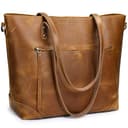
The five, side by side
Every cell is read from the listing or marked “Not published.” Read the format row first: it decides more about four years of comfort than the leather does.
| | LANNSYNE | DEKVIO | Waxed canvas | RAINSMORE | S-ZONE |
|---|
| Format | Backpack | Backpack | Messenger | Messenger | Tote |
|---|
| Weight on | Two straps | Two straps | One shoulder | One shoulder | One shoulder or hand |
|---|
| Laptop size stated | 16 in | Not stated (20 in body) | 15.6 in | 16 in | Not published |
|---|
| Grade as stated | Full-grain | Genuine leather | Not published (trim) | Not published | Genuine leather |
|---|
| Material | Leather | Leather | Waxed canvas with leather trim | Leather | Leather |
|---|
| Rain behavior | Needs care | Needs care | Best here | Needs care | Needs care |
|---|
The DEKVIO row needs reading carefully. Its listing publishes a 20-inch extra-large body rather than a laptop size, which is a capacity claim, not a fit claim — a big body does not guarantee a padded sleeve sized to your machine. It is the pick if volume is the problem you are solving, and it is not the pick if you want a laptop compartment a listing has committed to.
How we chose
Four criteria, weighted for a four-year stretch rather than a season.
- Two straps over one, for a daily textbook load. A messenger or tote puts the entire weight on one shoulder and one side of your neck. For an office bag with a laptop in it, that is fine. For a load that includes textbooks, five days a week, with a fifteen-minute walk at each end, it is the wrong tool — and it is the single most common mistake in “bags for college” lists. Two of the five here are backpacks and both are ranked above the single-strap options for that reason alone. The trade-off in detail is in leather backpack vs. messenger bag.
- A stated laptop size, not a stated volume. Three of these five name a laptop size in inches. That is the spec that tells you a padded sleeve was designed around a machine rather than a sleeve-shaped pocket being described as one. If you are unsure which number you need, our laptop bag size guide explains why the screen size on the box is not the measurement that matters.
- A stated grade, because the bag has to survive being treated badly. One pick states full-grain, two state “genuine leather,” and two state nothing. A student bag gets dropped on concrete, stuffed under a lecture seat and rained on. Full-grain scuffs and darkens; corrected and coated grades scuff and then peel. The words are decoded in full-grain vs. genuine leather.
- Honest behavior in rain. Leather is not waterproof — no leather is— and a campus involves walking between buildings in whatever the weather is doing. One pick here is a waxed-canvas hybrid precisely because that material handles repeated soakings better than any hide, and we have ranked it where a wet climate would put it.
Price, and what four years of use is worth
The buy-it-for-life argument is real, but it is weaker at eighteen than it is at thirty-five, and it is worth saying so on a page aimed at students. A stated full-grain bag costs more up front and will still be usable long after graduation; a genuine-leather bag costs a fraction of that and may not last past the degree. Both are defensible. What is not defensible is paying a full-grain price for a listing that never states a grade — which is exactly what happens when a bag is bought on a photograph.
The honest arithmetic: across four years, the difference between the cheapest and the most expensive bag on this page works out to a few dollars a month, and the cheaper bag may need replacing once inside that window. If you have the cash now, the full-grain pick is the better value. If you do not, the DEKVIO is the right bag and nobody should feel bad about it. Live prices on every card here come from our price layer with the date they were last checked, so you can do that sum with today’s numbers rather than ours. The wider version of this argument is in how much a leather bag costs.
Making it last to graduation
Three habits do almost all of the work, and all three matter more on a campus than in an office.
Do not overload it past the stitching.Bags fail at seams and strap anchors long before the leather gives out, and a stack of textbooks is the load that finds those points. If the bag has a bottom gusset, keep the heavy items flat against it rather than letting them hang off one side — the failure sequence is set out in how long a leather bag lasts.
Dry it properly the first time it gets soaked.Wet leather is not the problem; fast drying is. Away from heat, stuffed loosely to hold its shape, at room temperature — the method is in how to dry a wet leather bag, and it is the single most useful page on this site for a first-year student.
Condition it twice a year, not twice a month. Over-conditioning does more damage than neglect, and a new bag usually needs nothing for the first several months. The cadence is in how often to condition leather. Everything above is read from listings rather than from use; our methodology page explains why we say so on every page.