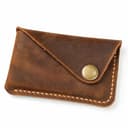
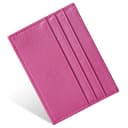
What $25 still buys, and what it stops buying
It still buys a grade claim.Four of seven name a layer: two say full-grain, one says top-grain, and one of the full-grain picks adds a vegetable tannage. That is a better rate than the under-$100 leather bag field manages, and the cause is hide geometry rather than generosity — our bags under $100 page sets out the same argument from the other end, where stated full-grain is confined to the smallest bodies.
It still buys RFID shielding, on six of seven. Whether that is worth anything is a separate question and we answer it honestly on are RFID wallets worth it. At this price the right way to read it is as a profile of who the category is sold to, not as a quality signal.
It stops buying a tannage.One of seven states one. A tannage is what decides whether the hide can absorb oils and darken at all, so its absence is the single biggest unknown in this band — vegetable-tanned vs. chrome-tanned explains what you are not being told.
It mostly stops buying a warranty.One of the seven publishes a term — twelve months against manufacturing defects on the FOXHACKLE — and the other six say nothing. On a wallet that matters more than it sounds, because what fails is stitching and edge coat, which is workmanship rather than hide. Our bifold page covers the one wallet we track with a stated lifetime term, and it costs more than everything here.
And it almost stops buying a thickness.One pick states a figure — the cheapest item on the page, a 0.2 cm panel on the URAQT — and six do not, which is actually a better rate than the dearer wallets on this site manage. Leather weight and thickness covers what the number tells you, and why a thin panel on a card holder is a design choice rather than a defect.
Pick the format first, because the format is the decision
At this price the difference between two wallets is almost never the hide. It is the shape, and the shape is the thing you cannot change later.
A card holderis two to six slots and no bill compartment. It is the thinnest thing you can carry and it forces you to carry less, which is either the point or the problem — our card holder page is the wider field. A bifold keeps bills flat and full length and is the default for a reason. A trifold carries the most cards in the smallest outline and sits three layers thick. A money clip walletputs the cash on the outside under a sprung clip, so the bill stack never adds a fold — money clip vs. wallet takes that decision in full. A travel wallet is sized around a passport and a boarding pass rather than around cards.
Our two comparison pages are the fastest way through this: bifold vs. trifold and bifold vs. slim wallet. Buy the format for how you actually carry, then take the best disclosure available inside it.
The two picks that beat their price, and why
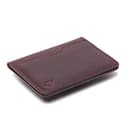
The FOXHACKLE is the outlier of the whole band. A stated full-grain, stated vegetable-tanned card holder with a published 4 x 3 x 0.2 inch footprint and a stated twelve-month term against manufacturing defects, under $25. It is the only wallet on this page that states a tannage, and the only one that states a warranty at all. What it gives up for that is capacity: it is a card-first holder, so if you carry cash as a habit rather than an emergency, it is the wrong shape no matter how good the hide claim is.
The Wise Owl is the only wallet on the page that answers “where was this made?”It says made in India. That is one more disclosure than the dearer picks here manage, and it is worth noticing which end of the price range it came from. What it does not do is name a layer: it says “real leather” and offers nappa or crazy horse as a choice, which are two finishes rather than two grades. We record no grade for it, and at this price that silence is the honest expectation rather than a scandal — what is crazy horse leather covers why the finish name is not a grade.
The seven, side by side
Every cell is read from the listing or marked “Not published.” Note the two columns that are almost entirely empty — that is the honest shape of this band.
| Wallet | Format | Stated grade | Tannage / country |
|---|
| FOXHACKLE card holder | Card holder | Full-grain | Vegetable-tanned / not published |
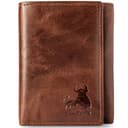
| BULL GUARD trifold | Trifold | Top-grain | Not published / not published |
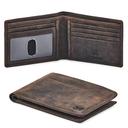
| Wise Owl bifold | Bifold | Not published | Not published / India |
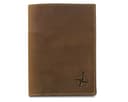
| WANDERINGS travel wallet | Passport / travel | Full-grain | Not published / not published |
| D&M leather studio holder | Card holder, handmade | Full-grain | Not published / not published |
| SERMAN BRANDS money clip | Money-clip wallet | Not published | Not published / not published |
| URAQT card holder | Minimalist card holder | Not published | Not published / not published |
One tannage, one warranty term, one country, one thickness, four stated grades and seven formats across seven wallets — and two of those seven listings contradict themselves on the grade, which is why their cards say so in writing. If you want the next band up, our wallets under $50 page is where the stated full-grain rate climbs to four in six and the formats get larger.
How to buy at this price without regretting it
Refuse a wallet that will not name a layer, unless you know why. Plenty of wallets in this band do name one, so an unnamed grade is a choice the seller made rather than a constraint of the price. The two exceptions on this page are both there for a specific stated reason: one publishes a country instead, and one is the cheapest thing on the site and does not pretend otherwise.
Count your cards and buy one slot more. Leather slots stretch permanently under load, so an overstuffed wallet loses its grip within a year and never recovers. That is the structural argument for a rigid card housing, and we take it seriously on Ekster alternatives even though it argues against our own picks.
Expect to replace it, and treat that as fine.No wallet here publishes a warranty, and a $15 wallet carried daily is a two-to-four-year object rather than a keeper — how long a leather wallet lasts sets out the failure order honestly. A trace of conditioner along the fold twice a year is the only maintenance that changes that number; how to clean a leather wallet covers the rest.
One closing note on method. We do not own any of these wallets and we have not tested them. Every specification above is read from a live listing on the date shown on each card, every price renders from the live price layer rather than a figure typed into this page, and the $25 cap is enforced at request time against those live prices rather than trusted. The full rules are on our methodology page.