Veg Tan Club

Best Leather Ratchet Belts

A ratchet buckle fixes the one thing a traditional belt gets wrong - holes an inch apart. It also adds the only part of a belt that can break. Three picks, ranked on the strap rather than the gadget.

By Stephen V.Last updated How we pick

The verdict: the CHAOREN Full-Grain Leather Ratchet Beltis the one to buy for everyday wear. It is the only ratchet belt we cover whose listing states full-grain leather, it adjusts in roughly 5 mm steps rather than one-inch jumps, and it costs less than most hole-punched belts with no stated grade at all. If you carry a holster, buy the Nexbelt instead; if your waist sits outside the usual retail range, buy the PlusZis.

Ratchet belts — also sold as micro-adjust, automatic or no-holes belts — replace the prong and punched holes with a toothed track hidden on the underside of the strap. A clamp inside the buckle grips the nearest tooth, so instead of five fixed positions you get something like twenty-five. If you have ever been between two holes, that is the problem this format solves, and it solves it completely. Whether a ratchet suits you at all is argued in our ratchet vs. traditional belt comparison; this page assumes you have decided and are choosing between them.

It is a short page because it is an honest one. Three ratchet belts are what the registry holds, and we would rather compare three we can verify than pad the list with listings we cannot. One of the three states full-grain; the other two state no grade at all, and in a format where the strap is cut to length at home that silence matters more than usual. We have not handled any of them — every claim below is read from the listing on the date at the foot of each card.

How this is funded: we earn a commission if you buy through our links, at no extra cost to you. It never changes which product we recommend, and we’ll tell you when we’d skip one. Full disclosure.

Quick picks

Ranked on leather grade, construction and buyer fit. Select a row to jump to the full write-up. We have not handled these items ourselves — here is exactly what we do instead.

#ProductBest forPrice
1
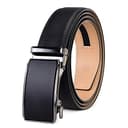
CHAOREN Full-Grain Leather Ratchet Belt (35mm)

CHAOREN Full-Grain Leather Ratchet Belt (35mm)

The listing states full-grain, and the ratchet track adjusts in ~5mm steps instead of inch-apart holes — so it fits after a big lunch or a winter layer. The most practical belt here, and it's cheap.

Best overall
$14.99 · View on Amazon

Price as of October 20, 2026. #ad How we’re funded

2
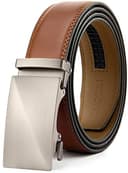
Nexbelt Rogue EDC Ratchet Gun Belt (1.5")

Nexbelt Rogue EDC Ratchet Gun Belt (1.5")

A carry belt with a micro-adjust track instead of punched holes, which matters more here than on an ordinary belt: the right tension changes the moment you add or remove a holster, and holes an inch apart rarely land where you need them. Listed with a nickel buckle, set screws and a nylon backing behind the leather.

Best for carrying
$74.99 · View on Amazon

Price as of October 20, 2026. #ad How we’re funded

3
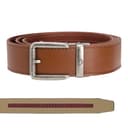
PlusZis Leather Ratchet Dress Belt, Big and Tall (28"-68")

PlusZis Leather Ratchet Dress Belt, Big and Tall (28"-68")

A ratchet track instead of punched holes, in a stated 28"-68" range. That combination answers the problem this whole category has: at a big-and-tall length, holes an inch apart are a coarse adjustment, and the tail left over is long enough to be a nuisance. A ratchet is trimmed to your exact length and then adjusts in small steps.

Best size range
$26.99 · View on Amazon

Price as of October 20, 2026. #ad How we’re funded

The picks in full

#1Best overall

CHAOREN Full-Grain Leather Ratchet Belt (35mm)

The listing states full-grain, and the ratchet track adjusts in ~5mm steps instead of inch-apart holes — so it fits after a big lunch or a winter layer. The most practical belt here, and it's cheap.

Strengths

  • Listing states full-grain leather
  • Ratchet adjusts in tiny steps — no fixed holes to stretch out
  • Trim-to-fit strap, low price

Trade-offs

  • The ratchet buckle is a mechanism that can eventually wear
  • 35mm width is casual, not formal
Leather gradeFull-grain
TannageNot published
ThicknessNot published
HardwareRatchet (micro-adjust) buckle
Made inNot published
WarrantyNot published

Specs read from the product listing, on July 18, 2026. “Not published” means the listing does not state that spec.

#2Best for carrying

Nexbelt Rogue EDC Ratchet Gun Belt (1.5")

A carry belt with a micro-adjust track instead of punched holes, which matters more here than on an ordinary belt: the right tension changes the moment you add or remove a holster, and holes an inch apart rarely land where you need them. Listed with a nickel buckle, set screws and a nylon backing behind the leather.

Strengths

  • Micro-adjust track means no fixed holes to stretch out or miss by half an inch
  • 1.5" width, and the buckle is designed to sit flat under a shirt
  • Set screws let the strap be trimmed to length

Trade-offs

  • Leather grade is not published
  • Some of the stiffness comes from a nylon backing rather than the hide itself
  • A ratchet is a mechanism, and mechanisms are the part that eventually wears
Leather gradeNot published
TannageNot published
ThicknessNot published
HardwareDistressed nickel ratchet buckle, set screws
Made inNot published
WarrantyNot published

Spec note. The listing names a nylon backing bonded behind the leather — worth knowing, because it means the rigidity is a laminate, not a single thick hide.

Specs read from the product listing, on August 30, 2026. “Not published” means the listing does not state that spec.

#3Best size range

PlusZis Leather Ratchet Dress Belt, Big and Tall (28"-68")

A ratchet track instead of punched holes, in a stated 28"-68" range. That combination answers the problem this whole category has: at a big-and-tall length, holes an inch apart are a coarse adjustment, and the tail left over is long enough to be a nuisance. A ratchet is trimmed to your exact length and then adjusts in small steps.

Strengths

  • Micro-adjust track fastens in small increments instead of one-inch jumps
  • Stated 28"-68" range, and the strap is trimmed to your length rather than ordered to it
  • Trimming the tail removes the excess a long belt otherwise leaves flapping past the keeper

Trade-offs

  • No leather grade is stated on the listing
  • A ratchet is a mechanism, and the mechanism is the part that eventually wears out
  • Once you trim the strap the cut is permanent — measure before you cut, not after
Leather gradeNot published
TannageNot published
ThicknessNot published
HardwareAutomatic ratchet buckle
Made inNot published
WarrantyNot published

Spec note. Ratchet belts are cut to length at home, which is why one listing can cover a 40-inch span. It also means the number printed on the box matters far less than usual.

Specs read from the product listing, on August 31, 2026. “Not published” means the listing does not state that spec.

The three, side by side

Every cell is from the listing or marked “Not published.” The grade row is the one to read first: it is the only row that describes the part of the belt doing the work.

 CHAORENNexbelt Rogue EDCPlusZis
Grade as statedFull-grainNot publishedNot published
Width / size as stated35 mm1.5 inStated range 28″–68″
Buckle as statedRatchet (micro-adjust)Distressed nickel ratchet with set screwsAutomatic ratchet
Adjustment stepRoughly 5 mm per toothNot published as a figureNot published as a figure
Strap trimmed to lengthYesYes, via set screwsYes
Backing statedNot publishedNylon backing bonded behind the leatherNot published
Best read asEveryday casualHolster and EDC loadHard-to-fit waists

The Nexbelt row that deserves a second look is the backing. Its listing names a nylon layer bonded behind the leather, which is useful information and unusual to publish: it means the belt’s stiffness is a laminate rather than a single thick hide. For a carry belt that is a legitimate engineering choice. It is also the reason we do not read “stiff” here as a claim about the leather.

How we chose

A ratchet belt is two products bolted together: a strap and a mechanism. Almost every review of the format talks only about the mechanism, which is backwards, because the mechanism is the part a maker can buy off the shelf and the strap is the part that decides how the belt looks in three years.

  • A stated grade on the strap. One of the three states full-grain. That matters more in a ratchet belt than in an ordinary one for a specific reason: the track is machined or pressed into the underside of the strap, so the leather is being asked to hold a row of teeth as well as hold tension. A split-and-coated hide has less to give. The vocabulary is in full-grain vs. genuine leather.
  • A published width. Two state one, and the numbers point at different uses: 35 mm is a casual width and 1.5 in (38 mm) is the size most holster slots are cut for. Our belt width guide covers which width belongs in which belt loop.
  • What the listing admits about the mechanism. A ratchet is the only moving part on a belt and therefore the only part that can fail outright. We prefer listings that describe the buckle in enough detail to tell whether it can be opened, serviced or replaced.
  • Honesty about trimming. All three are cut to length at home, which is why one listing can cover a 40-inch size span. It also means a measuring mistake is permanent. Two of the three say so plainly.

The trade you are actually making

A ratchet belt is strictly better than a hole-punched belt at fit, and strictly worse at repairability. Those two sentences are the whole decision.

On fit, there is no argument. Holes are punched about an inch apart, so an ordinary belt gives you five positions and your waist does not oblige by landing on one of them. It also changes through the day and through the year. A track that clamps every few millimetres removes that problem entirely, and it removes the secondary problem too: the hole you always use is the hole that stretches, tears and eventually becomes the reason the belt looks worn out while the rest of the strap is fine.

On repairability, the ratchet loses. A traditional belt has a buckle on a snap or a stitched loop, so a worn buckle is a five-minute swap and a stretched strap can be shortened at home. A ratchet buckle is a proprietary clamp matched to a proprietary tooth pitch. When it wears, you are buying the same brand again or buying a whole new belt. None of the three listings here publishes a replacement-buckle part number, and that is worth knowing before you spend.

There is a third, smaller trade: formality. A ratchet buckle is a visibly modern object, and plenty of them are chunkier than a dress belt wants to be. The PlusZis is sold explicitly as a dress ratchet and the Nexbelt’s buckle is designed to sit flat under a shirt, which tells you the category knows this is a problem. If the belt is for a suit, start at our dress belt roundup instead and treat a ratchet as one option within it.

How to buy and trim one without ruining it

Measure your waist through the belt loops of the trousers you will actually wear it with, not your jean size, and not a tape held against bare skin. The two numbers routinely differ by a couple of inches; our guide to measuring belt size sets out the method. Then buy the size band your measurement sits in, not the next one up — the whole point of the track is that you do not need headroom.

When it arrives, thread it, fasten it at the tension you want, and mark where the strap meets the buckle before you cut anything. Most ratchet belts are designed to be trimmed with ordinary scissors or a sharp knife and then re-clamped with a set screw. Cut long on the first pass. You can always remove another half-inch; you cannot put one back, and a strap cut short is a belt you have thrown away.

Keeping it

A ratchet strap needs the same care as any other belt, with one addition: the teeth on the underside collect lint and trouser fibre, and a clogged track is the most common reason a ratchet starts slipping. Wipe the underside occasionally with a dry cloth and the mechanism will usually come back. Beyond that, the routine is in how to care for a leather belt — condition sparingly, hang it rather than coiling it tight, and expect a stated full-grain strap to darken at the fold over the first year, which is a patina rather than wear.

One last note on how we work: we do not own these belts, so nothing above is a wear test. It is a comparison of what three listings publish and an argument about which of those facts decide the purchase — the full version is on our methodology page.
Frequently asked questions

Are ratchet belts better than regular belts?

Better at fit, worse at repair. A ratchet track clamps every few millimetres instead of every inch, so you always get the exact tension and there is no single hole stretching out over the years. But the buckle is a proprietary mechanism: when it wears, you cannot swap in a generic replacement the way you can on a pin buckle, and none of the listings we read publishes a replacement part.

Do ratchet belts wear out?

The strap wears like any leather belt. The mechanism is the part with a finite life, because it is the only moving component on the belt. Before you assume it has failed, wipe the teeth on the underside of the strap - lint and trouser fibre packed into the track is the most common cause of a ratchet that starts slipping, and cleaning it usually restores the grip.

How do you size and cut a ratchet belt?

Measure your waist through the belt loops of the trousers you will wear it with, not your jean size. Buy the band your measurement falls in without adding headroom, since the track removes the need for it. Then thread the belt, fasten it at the tension you want, mark where the strap meets the buckle, and cut long on the first pass - you can take off another half-inch, but you cannot add one back.

Can you wear a ratchet belt with a suit?

Yes, with the right buckle. A ratchet buckle is a visibly modern object and some are chunkier than a dress belt wants to be, so look for a slim profile designed to sit flat under a shirt - one pick here is sold specifically as a dress ratchet. If the belt is mainly for formal wear, compare it against traditional dress belts rather than only against other ratchets.

Are ratchet belts real leather?

Some are, and some are a leather face bonded to something else - which is why the stated grade matters. One of the three belts here states full-grain leather; the other two state no grade at all, and one of those names a nylon layer bonded behind the leather, meaning its stiffness is a laminate rather than a thick hide. Read for the grade, not for the word leather.

Sources

Keep reading