The number nobody publishes
Start with the omission, because it shapes the whole category. A trifold exists to trade depth for panel area, so the one figure that would let you judge it is how thick it gets. Every listing on this page publishes a closed footprint — the width and height of the folded wallet — and not one publishes a thickness, loaded or empty. That is not an oversight. The closed footprint of a trifold is flattering: fold the same amount of leather three ways and the outline shrinks, which is why four of these five land in a tidy 3.25 to 3.5 inches wide by 4.25 to 4.5 inches tall. The depth is where the format actually costs you, and it is the number left out.
So estimate it instead, which is easy once you know what to count. A bank card is about 0.03 in (0.76 mm) thick. A trifold with six slots across two panels puts three cards on top of each other at the thickest point; eleven slots can stack four or five. Add the leather — three panels plus the lining, call it an eighth of an inch per layer at the spine — and a loaded trifold is routinely three quarters of an inch to an inch thick where a loaded slim bifold is a third of that. If that sounds like too much, you do not want a trifold; you want the slim and minimalist wallets page or, if cards are all you carry, our card holder picks, where thickness is published far more often because it is the selling point.
The three things that do decide a trifold
1. The stated grade.A wallet is a fatigue product: three folds flexed thousands of times, with the spine taking the worst of it. Full-grain keeps the hide’s dense outer fiber layer, so a fold line burnishes and darkens; a corrected or coated split has no grain layer to fall back on and eventually crazes and lifts along exactly that line. Two of our five state full-grain, two state top-grain, and one states a label rather than a grade. The vocabulary is in full-grain vs. genuine leather and full-grain vs. top-grain; for which hides suit a wallet specifically, see what leather is best for a wallet.
2. The layout, counted honestly.Card capacity in this category is quoted three different ways and they are not comparable. One wallet states a slot count (six). One states a slot count in the title and a card count in the bullets, and they disagree. One states “fits 12+ cards” while publishing six slots, which can only mean doubling cards into slots. Slots, cards and “capacity” are three different claims, and the useful one is the slot count, because it is the only one that describes the wallet rather than your willingness to overfill it. If you genuinely carry eleven or more, the dedicated page for that is best wallets for lots of cards.
3. Whether anything other than the hide is named. This is where the picks separate. One listing names its lining material. One publishes both a closed and an open footprint. One publishes a warranty term. Those are the three pieces of disclosure that distinguish the top of this page from the bottom, and all three are things a maker only states when it is willing to be held to them.
The five, side by side
Every cell is read from the listing or marked “Not published.” Note that four of the five rows that matter most are blank for at least three of the wallets.
| | Carhartt | SERMAN BRANDS | Stealth Mode | Timberland PRO | BULL GUARD |
|---|
| Grade as stated | Full-grain | Full grain | Top-grain napa | Not published (“genuine Italian leather”) | Top-grain in the title, “Top Premium Leather” in a bullet |
|---|
| Finish or tannage stated | Natural oil finish | Not published | Napa | Not published | Not published |
|---|
| Lining named | Cotton duck | Not published | Not published | Not published | Not published |
|---|
| Card slots stated | 6 card pockets + 2 side pockets | 11 slots (bullets say up to 12 cards) | 6 slots + 3 side pockets | 6 slots + 2 slip pockets | 6 slots + 2 slip pockets |
|---|
| ID window | Yes | Yes | Yes | Yes | Yes |
|---|
| RFID stated | Yes | Yes | Yes | Yes | Yes |
|---|
| Footprint published | 4.5 x 3.5 in closed | 4.5 x 3.3 in closed | 3.25 x 4.25 closed, 9.25 x 4.25 open | 4.25 x 3.5 in closed | 3.25 x 4.25 in closed |
|---|
| Thickness published | Not published | Not published | Not published | Not published | Not published |
|---|
| Warranty stated | Not published | 12 months | Not published | Not published | Not published |
|---|
Three patterns come out of that table. The first is the uniform middle: all five have an ID window and all five claim RFID shielding. That combination is not a coincidence — it is a profile. The trifold is now sold primarily as a work and travel wallet, to someone who has to show a badge or a license and who has been told to worry about skimming. Our honest read on the second half of that pitch has not changed and is set out in are RFID wallets worth it: contactless skimming is real but rare, chip transactions are tokenized, and shielding is worth having when it is free and not worth distorting a purchase for. In this category it is effectively free, because every option has it.
The second is that disclosure does not track price. The wallets on this page sit within about fifteen dollars of each other, and the spread in what they will tell you is enormous: one states a grade, a finish, a lining material and a footprint, while another states a label, an origin and a logo. If you are shopping this category by price you are choosing between near-identical numbers; if you are shopping it by disclosure, there is a clear order.
The third is the one worth dwelling on, because it is the most common trap in leather marketing. “Genuine Italian leather” is two claims of different quality welded together.“Italian” is a hide origin, and a real one — Italy has a serious tanning industry. “Genuine leather” is a legal label meaning the material is leather, and it says nothing about which layer of the hide the wallet is cut from. Put them side by side and the phrase reads like a premium specification while containing no grade at all. We cover the origin half in what “Italian leather” means, and the same pattern shows up one hub over on our braided belt picks, where a belt states “100% genuine leather” and nothing else about the hide.
Two listings that contradict themselves
We record contradictions rather than resolve them in the maker’s favor, and this page has two worth naming.
The Carhartt listing calls the wallet a trifold in its title and describes a “slim bifold construction” in one of its bullets. Both descriptions appear on the same page. We have kept it on a trifold roundup because the title, the category and the stated pocket layout all describe a trifold, and we print the bullet because a reader who notices it deserves to know we did too.
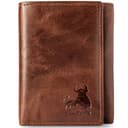
The BULL GUARD listing states top-grain leather in its title and then, in the bullet where you would expect that claim repeated, calls the same leather “Top Premium Leather 100% Cow.” “Top Premium” is not a grade; it is an adjective arranged to look like one. We have taken the grade from the title, which is a specific and checkable claim, and recorded the bullet in the product’s cons. A maker that cannot state its grade the same way twice is telling you how much weight the claim carries.
A third note is not a contradiction but a rounding problem. SERMAN BRANDS states 11 card slots in its title and “holds up to 12 cards plus cash” in its bullets. Both can be true if one slot takes two cards, which is normal — but it means the headline number and the capacity number are describing different things, and a page that quotes only one of them is rounding in the maker’s favor.
What wears out, and in what order
A trifold fails in a predictable sequence, and it is a shorter sequence than a bifold’s because there is more folding going on. The two outer fold lines go first: the leather creases, then the finish crazes along the crease if the hide is corrected, then the lining splits behind it. Next the slot mouths stretch, which is permanent — leather takes a set at whatever you keep in it, so a slot loaded with two cards for a year stays loose when you go back to one. Then the stitching at the ends of the slots, which is where the thread does the most work. The hardware-free construction is why the grade matters so much here: there is nothing else to blame. Our wallet lifespan guide sets out the general case.
Two habits extend it. First, do not over-stuff the bill compartment; a trifold spine is already carrying three folds and cash wedged in forces the outer panels apart at the crease. Second, condition the spine lightly and occasionally rather than the whole wallet generously — a fold that stays supple does not craze. Use a small amount of a conditioner that states what is in it; our conditioner picks cover which ones do, and how to clean a leather wallet covers the cleaning half. One pick here has an oil finish, which needs noticeably less product than a dry-finished hide and will transfer onto light trousers early in its life.
Which one for you
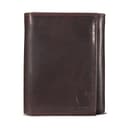
If you want the most disclosed wallet on the page: Carhartt. Stated full-grain with an oil finish, a named cotton duck lining, a published footprint, RFID and an ID window. It states no warranty term, and the oil finish will darken and can mark pale clothing.
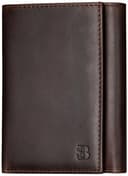
If you carry ten cards or more: SERMAN BRANDS. The most slots here, a cash divider, dual thumb cutouts for the two cards you pull constantly, and the only stated warranty on the page. Accept that eleven filled slots in three panels is a thick wallet by construction, and that the listing will not settle on one capacity number.
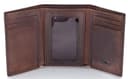
If you want to know what you are actually buying: Stealth Mode. It is the only wallet here that publishes its open footprint as well as its closed one, which is the number that tells you whether it will sit in a front pocket. Top-grain napa is soft and smooth and will not patina the way full-grain does.
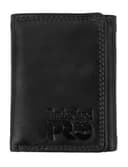
If you want a brand with a service record:Timberland PRO, bought with the label understood. Six slots, two slip pockets, two cash pockets, an ID window and RFID, from a company you can hold to a return. Just do not read “genuine Italian leather” as a grade, because it is not one.
If you want the most compartments for the least money: BULL GUARD. A double bill section, six slots, an ID compartment and a concealed pocket, with a title that states top-grain and a bullet that invents a tier instead of repeating it. The listing also warns that it feels stiff and bulky when new, which is honest and worth believing.
And if, reading all of this, the thickness argument has put you off the format entirely: that is a legitimate conclusion, and our main men’s wallet picks are bifolds and slim designs. The trifold is the right answer when you need the ID window and the bill compartment and more card slots than a bifold fits — and the wrong answer if what you actually want is a thinner wallet.
One closing note on method. We do not own these wallets, and we have not carried, flexed or stress-tested any of them. Every specification above was read from a live listing on the date shown on each card, every price renders from the live price layer rather than from a figure typed into this page, and where a listing publishes nothing we write “Not published” rather than an estimate. The full rules are on our methodology page.