Capacity, as published
Every number below is the listing’s own. Where a listing describes capacity in words rather than a figure, that is what the cell says — we did not convert a description into a number, because that is exactly the guesswork this page is trying to remove.
| Wallet | Capacity as stated | Format | Grade as stated |
|---|
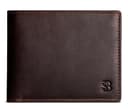
| SERMAN BRANDS bifold | 12 card slots + ID window | Bifold | Full-grain |
|---|
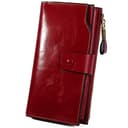
| YALUXE | 21 card slots + ID window | Long wallet | Genuine leather |
|---|
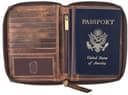
| F&L Classic zip-around | 10 card slots, ID window, 3 compartments, 1 zipped | Zip-around travel wallet | Full-grain |
|---|
| FREYAMIRA | Not published (described as a roomy long bifold) | Long bifold | Not published |
|---|
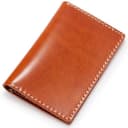
| HISCOW card holder | 8 credit cards or 14 business cards | Card holder | Full-grain |
|---|
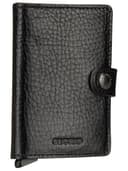
| SECRID Miniwallet | 4 embossed or 6 flat, plus 4 in the wrap | Card case | Not published |
|---|
Note what the SECRID row does that the other five do not: it splits the number by card type. “Four embossed or six flat” is a real-world figure from a company that evidently measured. Every other row on this table quietly assumes your cards are the thin kind.
How we ranked them
Capacity got you onto the page. The order is set by what else the listing publishes, because a wallet that holds twenty cards and cracks in a year has not solved your problem.
- A published capacity, in cards. Five of the six state a figure. The FREYAMIRA does not, which is why it ranks fourth despite being the roomiest format here — you are buying a shape rather than a number.
- A stated grade. Three state one. Two state full-grain and one states genuine leather. Capacity and grade pull against each other in practice, because more slots means more layers of leather, and makers who are competing on slot count rarely compete on hide quality too. The SERMAN BRANDS is the exception and that is why it leads. The vocabulary is in full-grain vs. top-grain leather.
- Whether it closes under load. A zip-around closes regardless of what you put in it. A bifold relies on the leather staying springy, and a card case has a fixed housing that simply will not take an extra card. Three different answers to the same problem.
- An ID window. Four picks have one. If your license or badge needs to be visible without being removed, that is a hard requirement and it quietly rules out both card cases.
- What the extra capacity costs you in bulk. Every slot is two more layers of leather at the fold. We say where each wallet puts that thickness, because the answer determines which pocket it can live in.
Twelve, twenty-one, or eight?
Work out your real number before you shop, and count the cards you have touched in the last month rather than the cards in your wallet. Most people land between eight and fourteen, and that is the band the SERMAN BRANDS and the F&L Classic are built for.
Above about fifteen cards you are no longer buying a wallet, you are buying an organizer, and the honest formats are the long wallet and the zip-around. The YALUXE’s twenty-one slots are genuinely useful if your wallet doubles as a card file — but a long wallet needs a bag or a jacket pocket, because it will not go in jeans. That is the trade nobody mentions: the capacity problem is usually solved by changing where the wallet lives, not by finding a thinner one.
Below about eight cards, stop reading this page. The HISCOW card holder’s stated ceiling of eight credit cards is a hard limit in a one-piece shell with no bill compartment, and it is on this page as the slim end of the range rather than as a high-capacity wallet. If that is where you are, our bifold vs. slim wallet comparison is the better starting point.
The bulk problem, and where each wallet puts it
Thickness in a card-heavy wallet is not evenly distributed, and that is why two wallets holding the same number of cards can feel completely different. A bifold stacks its slots in two overlapping columns, so the bulge lands at the spine and the wallet wedges itself into a back pocket. A long wallet lays the slots flat across a wider panel, so it stays thin and gets big instead. A zip-around splits the difference and adds the zipper’s own thickness on every edge. A rigid card case puts all of it in one block that does not flex at all.
If you have ever had a wallet that sat unevenly in a pocket, that is the spine bulge, and it is also what eventually splits the fold. Our guide to how long a leather wallet lasts sets out why the fold is the first part to fail and why overloading accelerates it. A wallet carried permanently at capacity is a wallet with a shorter life.
RFID, briefly
Four of the six listings here advertise RFID blocking, which is close to standard in high-capacity wallets now. Take it if it is built in and do not pay extra for it: documented real-world card skimming is rare, and the reasons are set out in are RFID wallets worth it? A blocking lining also adds a layer of material to every panel, which in a twelve-slot wallet is not nothing. Never let it outrank the grade.
Who should skip each pick
- SERMAN BRANDS. Skip it if you want slim. Twelve slots in a bifold is twelve slots of thickness at the spine, and the listing says as much.
- YALUXE. Skip it if the wallet has to live in a trouser pocket, or if you want full-grain. It states genuine leather, and at twenty-one slots it is a bag item.
- F&L Classic. Skip it if you want to open the wallet one-handed. A zip-around is two actions every time, and its RFID claim names no lab or standard, which we flag on its card.
- FREYAMIRA. Skip it if you want a published number. It is the roomiest shape here and the listing states neither a card count nor a grade.
- HISCOW. Skip it if you carry more than eight cards or any cash. The ceiling is stated and there is no bill compartment.
- SECRID. Skip it if capacity is the whole point. It is here for publishing an honest number, not a big one, and it is the most expensive wallet on the page.
Bottom line
Count your cards, then buy for that number plus one — not plus five. A wallet bought two sizes too large gets filled, and a permanently full wallet wears out at the fold and bulges in the pocket. If you land in the eight-to- fourteen band, the stated-full-grain bifold is the best combination of grade and capacity we can find. If you are genuinely above fifteen, accept that you need a long wallet and a bag to put it in. And if the honest answer is that you are carrying cards you have not used in a year, the cheapest upgrade on this page is taking them out.
Two more pages worth reading before you buy: what leather is best for a wallet explains why a thin, firm hide outlasts a soft one in this format, and how to choose a leather wallet runs the full decision in order. As always, we have not handled these wallets — what you have read is a comparison of published specs and an argument about which of them matter, as set out on our methodology page.