How we ranked them
The criteria came first. Once a wallet cleared the RFID bar, the ranking was decided by the leather, not by the lining.
- RFID stated, not assumed. Leather does not block radio signals on its own, so a wallet that merely looks like an RFID wallet isn’t one. Every pick states RFID blocking in its own listing.
- Leather grade next. Four picks state full-grain, two state genuine leather and one states no grade at all. That is the order of the list. A wallet that commits to a grade outranks one that doesn’t, and a higher grade outranks a lower one.
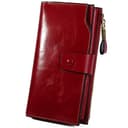
- Then capacity and format. A stated card count beats “plenty of slots”. Three picks publish one: 12 slots plus an ID window on the Serman, a 1–12 card range on the Swear Brands slim bifold, and 21 slots plus an ID window on the Yaluxe.
- Currently purchasable. Every pick had a live listing when we built this page. A roundup of dead links is worse than no roundup.
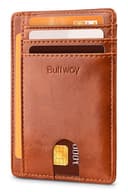
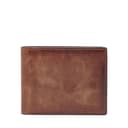
Below the four full-grain wallets come the two that state genuine leather — a real but low grade — and then the one that states no grade. The Yaluxe earns its place with the most organized layout here and because the “for women” version of this search deserves a real answer. The Buffway is the low-cost way into a slim front-pocket wallet with a lining. The Fossil sits last on grade alone; it is on the page as the name-brand, gift-safe option with a flip-ID window, and the ranking is honest about what its listing leaves out.
One detail before you read the spec tables: the Swear Brands and Runbox wallets put RFID in the product name without describing the lining itself, so their Hardware row reads “Not published”. The claim is in the listing; the listing just doesn’t say more about it. The other five describe an RFID-blocking lining.
What RFID blocking actually is — and what it isn’t
It is a lining, nothing more. A layer of metal foil or conductive fabric sits between the leather panels, usually sewn in where you will never see or feel it. The leather contributes nothing to the shielding: a full-grain wallet with no lining lets a signal through exactly as a thin fabric one does. That has four practical consequences.
- You can’t verify it from a photo. Two wallets can look identical, use the same leather and differ only in whether a lining was sewn in. The listing’s word is all you have before it arrives, which is why this page includes only wallets that give it.
- It doesn’t age. The lining will never patina, soften or improve. All of the aging happens in the leather wrapped around it, so the lining contributes nothing to how the wallet looks in five years.
- It adds a layer. An extra layer is a little extra thickness, which is one more reason “slim” on a wallet listing is a relative word.
- It is not a substitute for grade. A full-grain wallet without a lining will outlast a coated genuine-leather wallet with one. If you have to choose one feature, choose the leather.
How real is the skimming risk?
AARP’s consumer reporting on RFID wallets says documented real-world cases of RFID card skimming are very rare. That doesn’t make the feature useless; it makes it insurance against an unlikely event, and insurance against an unlikely event should be cheap. The fuller argument — including the kinds of card where shielding makes more sense than it does for an ordinary chip card — is in are RFID-blocking wallets worth it?
It is also worth noticing how common the feature has become. Every pick in our men’s, women’s, slim and full-grain wallet roundups states RFID blocking. It is no longer an upgrade you hunt for; it is close to standard equipment, and a listing that charges a noticeable premium for it is charging for something its competitors include.
Who genuinely wants it
- Anyone who simply wants the peace of mind. That is a fine reason on its own. The lining needs no care, and it is common enough that you should not have to pay much to get it.
- Anyone already buying a full-grain wallet. All four full-grain picks above state RFID, so you do not have to trade grade for it. Take the lining and move on.
- Anyone who carries a stack of contactless cards. If your wallet holds several tap-to-pay cards and it would bother you to think about them in a crowded station, the lining settles the question for very little.
Who shouldn’t pay extra for it
- Anyone who taps the whole wallet at a gate. A lining that blocks a thief’s reader blocks the subway turnstile and the office door too. If you currently tap your wallet without taking the card out, an RFID wallet ends that habit.
- Anyone choosing between grades. If the choice is full-grain without RFID or genuine leather with it, buy the full-grain. The leather decides whether the wallet is still worth carrying in five years; the lining doesn’t.
- Anyone who really wants the thinnest possible carry. If maximum shielding in a minimum profile is the real goal, a metal cardholder is the other route, with its own trade-offs in comfort and aging. Our leather vs. metal wallet comparison lays them out.
Grade still decides how long it lasts
A wallet almost never fails structurally. It fails cosmetically, at the fold and the corners, because it is flexed and rubbed against a pocket lining all day. On full-grain, the fold darkens and the corners burnish into a patina. On a finished genuine-leather wallet, the fold can crack and the corners go pale where the finish wears through. Our full-grain vs. genuine leather guide explains why, and how long a leather wallet lasts covers the order in which wallets actually wear out.
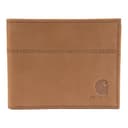
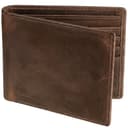
Two wording details are worth reading closely on this page. Carhartt describes its leather as full-grain saddle leather but states no tannage, so read “saddle” as a style word rather than a tannage claim. Runbox pairs full-grain with a crazy-horse finish, a hot-waxed surface that scuffs into character on purpose — our crazy horse leather explainer covers who that suits. And a well-known name is no guarantee of a stated grade: the FTC’s leather guides govern how a product may be described as leather and when imitation or backing material must be disclosed, but nothing compels a seller to name the layer of the hide, which is how the Fossil listing can call its wallet leather without ever naming a grade.
If vegetable-tanned leather matters to you as well, three wallets in our veg-tan roundup also mention RFID blocking, including one that states full-grain, vegetable-tanned leather and a 12-month warranty.
Pick the format first: bifold, slim or long
Format is a personal call, not a quality one, and it matters more to daily comfort than the lining ever will. Our bifold vs. slim wallet guide covers the decision in full; the short version for this page:
- Bifold. The Serman, Runbox and Fossil are all bifolds. The Serman is the one that publishes a card count, 12 slots plus an ID window; the Runbox trades slimness for a rugged finish; the Fossil adds a flip-ID window.
- Slim. The Swear Brands wallet is a slim bifold that still states a card range, and the Buffway is a front-pocket minimalist. Every pick in our slim & minimalist roundup states RFID too, including a magnetic-closure option and two money-clip designs.
- Long wallet. The Yaluxe is a long wallet with 21 card slots, which means it lives in a bag rather than a pocket. If that is more than you carry, our women’s wallet roundup has a compact card holder at the budget end and a multi-compartment wallet at the premium end, and every one of its picks states RFID blocking.
Caring for an RFID wallet
The lining needs nothing from you; the leather needs very little. Wipe it down and clean it properly when it gets grimy, condition it rarely and lightly, and resist overstuffing it — overloading a wallet is what splits corner stitching, and neither a lining nor a grade protects against that. A note on how we work: nothing above is a lab test, which our methodology page explains in full. Prices are never written into this page; they render live from the retailer, or the buy button sends you to the listing to check the current one.