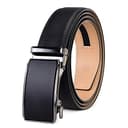
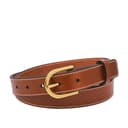
The four, side by side
Every cell below is read from the listing or marked “Not published.” Read the grade column first and the width column second — between them they decide whether a belt is a dress belt at all.
| Belt | Grade as stated | Width as stated | Buckle |
|---|
| WOLFANT Italian | Full-grain | 1.5 in | Pin buckle |
|---|
| Fabio Valenti | Genuine leather | Not published (slim dress profile) | Pin buckle |
|---|
| PlusZis dress ratchet | Not published | Not published (stated range 28″–68″) | Automatic ratchet |
|---|
| Fossil D-Link | Not published (“Material: Leather”) | Not published | D-ring, gold-tone |
|---|
Three of the four do not publish a width, which is remarkable in a category where width is the single spec that decides whether a belt reads as formal. Where a listing is silent, measure a belt you already own and compare, or buy from the one that prints a number.
What actually makes a belt a dress belt
Four things, in this order. None of them is the price.
- Width, 1 to 1.375 inches. A dress belt is narrow because dress trouser loops are narrow. Anything at 1.5 inches and up is a jean belt that happens to be smooth, and anything above that will not pass through formal loops at all. Our belt width guide has the measurements by trouser type. The WOLFANT at 1.5 inches sits right on the boundary, which is exactly why we call it the dress-and- everything-else belt rather than a formal one.
- A smooth, even finish. No contrast stitching, no distressing, no visible pull-up effect. This is the one place on this site where a plain, quiet finish beats a characterful one, because a dress belt is supposed to disappear. If you like a hide that lightens and darkens as it flexes, you want that on a casual belt — see what pull-up leather is.
- A small, flat buckle. A dress buckle sits flush under a jacket and does not print through a shirt. A plate buckle, a heavy roller or a thick ratchet housing all break the line. This is where the D-ring and ratchet picks each make a different compromise, and we say so on their cards.
- Then the grade. It comes fourth here, not because it matters least but because a belt that fails the first three is not a dress belt whatever it is made of. Once a belt passes them, the grade decides how long it keeps looking right — and full-grain vs. genuine leather explains the difference that makes.
Why dress belts crack before work belts do
It looks backwards: the belt that gets gentle office use fails sooner than the thick strap holding tools. The reason is thickness. A dress belt is split thinner to stay flexible and sit flat, so there is less hide between the finish and the fibre, and a thin strap carries proportionally more stress at the two places that fail — the hole you always use, and the fold where the strap turns through the buckle.
That is also why a dress belt gives away its grade in the end whether the listing does or not. A genuinely full-grain thin strap creases and darkens at the fold; a split hide with a finish sprayed on top develops fine cracks in that finish and then flakes. If you have owned a cheap dress belt that looked perfect for a year and then suddenly looked terrible, that was the coating failing, not the leather wearing. Our guide to peeling leather covers why that failure is cosmetic damage you cannot really repair, and how long a leather belt lasts sets out the failure order in full.
The holes problem, and two ways around it
A dress belt has five holes an inch apart, you use one of them, and over a few years that hole stretches into a slot. On a thin strap it can tear. It is the most common way a dress belt stops looking smart while the rest of it is fine.
Two picks here avoid the problem entirely. The PlusZis uses a ratchet track on the underside of the strap, which clamps in small steps and has no holes to stretch at all — the full argument for that format is in our ratchet belt roundup. The Fossil uses a D-ring, where the strap doubles back through two rings and holds by friction, so it can sit anywhere along its length. Both solve the holes problem and both introduce a different one: a ratchet buckle is a proprietary mechanism you cannot replace with a generic part, and a D-ring holds by friction, so it loosens under a heavy load. Neither is a reason to avoid them; both are reasons to buy them for the right wardrobe.
The traditional answer is simpler and still works: buy the right size, measured through the loops of the trousers you will wear it with rather than from your jean size — see how to measure belt size — and a pin buckle on snaps so the strap can be shortened rather than replaced.
Dress belt or casual belt?
If you are not sure which of the two you are shopping for, read dress belt vs. casual belt first — it compares the two categories rather than the belts inside one of them. The short version: a dress belt is narrow, smooth and quiet and matches your shoes; a casual belt is wider, more textured and allowed to have character. One belt genuinely cannot do both ends of that range, but a 1.25-to-1.5-inch smooth brown strap covers more of the middle than people expect, which is why the WOLFANT leads this page.
Who should skip each pick
- WOLFANT. Skip it if you need a strictly formal belt. At 1.5 inches it is at the top of the dress range and will look heavy with a suit, and a solid full-grain strap is stiff until it breaks in.
- Fabio Valenti. Skip it if you want the hide to last a decade. It states genuine leather at a budget price, which is an honest trade for a belt worn a few times a week, not a lifetime buy.
- PlusZis. Skip it if you want a buckle you can replace, or if a visibly modern buckle bothers you with formal wear. Also note the strap is trimmed at home and the cut is permanent.
- Fossil D-Link. Skip it if the belt has to hold heavy trousers or if a published grade is non-negotiable. “Material: Leather” is the entire material disclosure.
Keeping a dress belt looking like one
Hang it, do not coil it. A dress belt rolled tight in a drawer sets a curve into a thin strap, and that curve shows under a jacket. Wipe it when it comes off, condition it two or three times a year and no more — over-oiling a thin strap makes it limp, which is the one thing a dress belt must not be. The amounts are in how to care for a leather belt, and how often to condition leather explains why less is more on thin hides.
One closing note on method, because it is the basis of everything above: we do not own or test these belts. This page compares what four listings publish and argues about which of those facts decide a dress-belt purchase — the full version is on our methodology page.