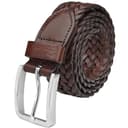
The three mechanisms, and why the difference matters
1. Quarter-inch punched holes.The strap is woven, but it is also punched, exactly like a conventional belt — just four times as often. This is the most conservative of the three and the easiest to live with: the prong sits in a defined hole, so the belt stays where you put it and the tip does not creep. Two of our five are built this way, and both state the spacing in their own copy, which is the one number this category is genuinely sold on. If a listing claims a braided belt is “fully adjustable” and then mentions holes, this is what it means.
2. Prong-anywhere through the weave.No holes at all: the prong pushes between the woven strips, which part to take it and close again behind it. This is the true braided mechanism and it gives essentially stepless fit — you can land on the half inch that a holed belt cannot reach. Two of our picks work this way. The cost is twofold. The prong leaves a small permanent opening wherever you habitually set it, so a braid used at one setting for years develops its own visible “hole” anyway, and a prong forced through a tight weave puts a point load on the strips around it. Neither is a dealbreaker; both are reasons to buy a stated full-grain strap rather than an unspecified one.
3. Elastic stretch.One pick on this page adjusts by stretching rather than by hole position: the leather strips are woven over an elastic core, so the belt gives when you sit and pulls back when you stand. For comfort, this is the best of the three and it is not close — it is the only mechanism here that responds to your waist changing over the course of a day. It is also the only one with a consumable in it. Elastic takes a permanent set after a few years of load cycles, and when it relaxes the belt is finished even though the leather is perfectly fine. Buy it knowing that the leather will outlive the stretch.
None of the three is better in the abstract. The question is which failure you would rather have: a braid that marks where you always set it, a belt with a part that wears out, or the same one-inch-granularity compromise you already have, slightly improved. For what a conventional belt costs you by comparison, our ratchet vs. traditional belt comparison covers the third way of solving the same problem, and our ratchet belt picksare where to go if quarter-inch adjustment is not fine enough for you — a ratchet track steps about every quarter inch too, but it hides the mechanism behind the buckle instead of showing it.
The honest structural problem with a braid
Everywhere else on this site we treat a one-piece strap as a quality marker. A belt cut as a single length from one hide has no joins to fail, which is why our work belt and gun beltpicks lean on it so heavily. A braided belt is the opposite by definition: it is three or more narrow strips woven together, usually stitched or riveted into a solid tab at each end. That is not a defect, it is the construction — but it does mean the belt has a failure mode a solid strap does not.
Expect it in this order. The tip frays first, because the ends of the strips are the most exposed cut edges on the belt. Then the weave loosens at the setting you use most, where the prong has been parting the same strips for years. Then, if anything, a strip stretches unevenly and the braid starts to look sloppy rather than tight. What essentially never happens is the catastrophic single-point break you get when a thin one-piece strap finally tears at a hole — a braid has redundancy, which is the quiet advantage of the construction. Our belt lifespan guide sets out the general failure order; in a braid, read it with the tip and the weave moved to the front.
Two consequences for buying. First, burnished or sealed edges are worth more on a braid than on a plain belt, because a braid has many times the cut edge — the premium pick here is the only one that states burnished edges. Second, the stated grade does real work: a full-grain strip keeps its dense outer fiber layer and holds its width under the point load from a prong, while a corrected or split strip has less to resist with. That is the argument in full-grain vs. genuine leather belts, and it applies with more force here than on a wide one-piece strap.
The five, side by side
Every cell is read from the listing or marked “Not published.” The mechanism row is the one to read first; the grade row is the one that decides how long the thing holds its shape.
| | F&L Classic | Brooks Brothers | Johnston & Murphy | Tommy Hilfiger | Falari |
|---|
| Adjustment mechanism | Prong anywhere on the strap | Roller buckle, holes | Elastic stretch | Holes at 1/4 in | Between hole positions, per the listing |
|---|
| Grade as stated | Full-grain cowhide | Full-grain cow | Full-grain | Not published | Not published (“100% genuine leather”) |
|---|
| Width published | 1.5 in | Not published | 1 3/8 in | 1.25 in | 35 mm (about 1.38 in) |
|---|
| Buckle detail stated | Locks anywhere on the belt | Light gold roller buckle | Not published | Not published | Stainless steel |
|---|
| Edge finish stated | Not published | Burnished | Not published | Not published | Not published |
|---|
| Sizing rule published | One size up from pants | Not published | One size up from pants | Two inches up from pants | Sold in waist ranges |
|---|
| Warranty stated | Not published | Not published | Not published | Not published | Not published |
|---|
| Country of manufacture | Not published | Not published | Not published | Not published | Not published |
|---|
Three things stand out. The first is the two blank bottom rows: not one of these five publishes a warranty or a country of manufacture, from the twenty-five dollar belt to the one that costs four times as much. Braided belts are a style category rather than a performance category, and the listings are written accordingly — which is exactly why we lead on the mechanism and the grade instead.
The second is that the premium pick is the one that will not tell you how wide it is. Width is not a detail on a belt; it is the measurement that decides whether the belt goes through your loops at all. Most dress trousers take 1.25 in comfortably, most jeans take 1.5 in, and a 35 mm strap will fight some slim-cut loops. Four of these five publish a width. The dearest one does not, and if you are ordering it for a specific pair of trousers, that is a real risk.
The third is the grade spread, which mirrors the pattern we keep finding across this site: a stated full-grain is available at the bottom of the price range and absent at the middle. The cheapest belt on this page states full-grain cowhide in three separate bullets. A belt costing more states “100% genuine leather,” which under the FTC’s leather guides means only that the material is leather — see full-grain vs. genuine leather. A name-brand belt in between states no grade at all. The same lesson turns up on our trifold wallet picks, where the best-known brand on the page claims “genuine Italian leather” and never names a grade either. Price is not a grade signal in either category.
Braided belts and dress codes
A braided belt reads as casual to semi-casual in almost every context, and no amount of burnishing changes that completely. The texture is the point: it breaks up the line of the waist and shows construction, which is the opposite of what a dress belt is doing. So the useful question is not whether a braid is “formal” but how close to formal the specific belt gets.
Three things push a braid toward dressier: a narrower strap (1.25 in rather than 1.5 in), a smaller and plainer buckle, and burnished edges, which make the many cut edges of the weave read as a finished surface rather than a bundle of strips. The premium pick here has two of those three. Three things push it the other way: a wide strap, a distressed or two-tone finish, and a chunky buckle. If you need a belt that works with a suit, buy a plain one-piece strap instead — our dress belt picks and the dress vs. casual belt comparison cover where the line actually falls. Where a braid genuinely excels is with chinos, denim and knitwear, which is also where it competes most directly with our jean belt picks.
One more fit note, because it causes more returns in this category than any other. Braided belts are usually sized by the strap length rather than by your waist, and the listings here disagree about the correction: two say order one size up from your pants size, one says two inches up, and one sells in waist ranges instead. Follow the listing you are buying from, not a rule you learned from a different brand, and if you are not sure of your actual waist measurement, measure it properly first with how to measure belt size. The belt width guide covers the other half of the question.
Care: a braid is not a plain strap
Two differences matter. First, a braid has gaps, and gaps collect dust, lint and whatever else lives in the bottom of a wardrobe. Brush it along the weave occasionally rather than against it. Second, conditioner behaves differently on a woven strap: applied generously it pools in the gaps and between the layers, where it does not dry evenly and can leave the strips tacky. Use noticeably less product than you would on a plain belt, work it in with a cloth rather than a brush, and let it dry fully before wearing. Our belt care guide covers the routine, and how often to condition leather covers the interval — for a braid, lean toward the longer end of it.
One thing not to do: do not try to re-tension a loose weave by pulling on the strips. A braid that has slackened at one setting has taken a set in the leather, and tugging it back only stretches the neighboring strips. If a braid has gone slack where you wear it, move the setting by one position and leave it there.
Which one for you
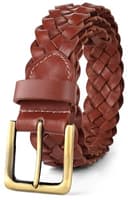
If you want the braided mechanism done properly, cheaply:F&L Classic. Stated full-grain cowhide, a 1.5 in strap and a buckle that locks anywhere along the belt. No warranty and no country of manufacture, which is the price of the price.
If the belt has to work with tailoring: Brooks Brothers. Stated full-grain cow leather, burnished edges and a roller buckle, which turns rather than drags. Order it knowing the listing never publishes a strap width.
If you sit for a living:the Johnston & Murphy stretch braid. The most comfortable belt here by a clear margin, in stated full grain, with the honest caveat that the elastic is a wear part and the leather will outlast it.
If you want the fit improvement and nothing else: Tommy Hilfiger. A quarter-inch hole spacing is a genuine four-times improvement over a conventional belt and it is published in plain language. There is no grade claim at all, so buy it for the fit rather than the hide.
If you want a buckle that outlives the strap:Falari, the only pick here that names its buckle alloy. Check your loops first — 35 mm is the widest strap on this page.
A closing note on method: we have not worn these belts. Every specification above is read from a live listing on the date shown on each card, every price renders from the live price layer rather than from a number typed into this page, and claims the listings do not make are not made here either. The rules are on our methodology page.