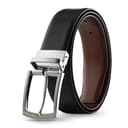
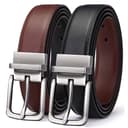
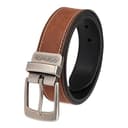
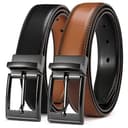
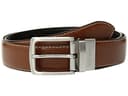
How the mechanism works, and why it is the thing to judge
A reversible belt is not a belt with two colors printed on it. The buckle hinges open, the strap rotates a half turn inside the buckle frame, and the buckle seats again against the new face. One listing on this page describes that action in plain words — pull the buckle up at the hinge, rotate it, put it back — and that is worth more than any other sentence in the category, because the rotating buckle is the only moving part on a belt, and it is where a reversible belt fails. A conventional belt’s buckle is a fixed frame and a prong; there is nothing to wear out. A reversible buckle has a hinge and a latch that are operated deliberately, which means they are operated badly sometimes, and a hinge worked loose cannot be tightened.
Two practical consequences. First, prefer a listing that describes the mechanism over one that just says “2-in-1”, because a maker that explains the action has at least thought about it. Second, prefer a named buckle metal. Exactly one belt here names one — coated zinc alloy, which is a cast metal where the coating does the scratch resistance and coatings wear through at the hinge first. That is not a glowing spec, but it is a real one, and it is more than the other four offer. For how buckle styles differ generally, see leather belt buckle types.
One more thing the mechanism costs you: a reversible buckle is proprietary to its strap width and its latch design. You cannot swap in a better buckle the way you can on a plain strap with a screw post, and if the hinge goes, the belt goes. If buckle replaceability matters to you, the format is wrong and a one-piece strap is right — our full-grain belt picks are where to look instead.
The grade ceiling, in detail
This is the part of the page worth reading twice, because it explains every blank in the table below.
Leather has a structure. The grain layer at the outside of the hide is tight and dense; below it the fibers get progressively looser. Full-grain leather keeps that outer layer intact, which is why it resists abrasion and burnishes instead of flaking — the full argument is in full-grain vs. top-grain leather. Top-grain has the very surface sanded and a finish applied: smoother, more uniform, less durable, and — crucially for this page — a process that can be applied to a face that was not originally the grain side.
That is why top-grain is the realistic top of this category and full-grain is not available in it. To show two wearable faces, a maker either laminates two thin layers with the grain outward on each (which adds a glue line, and a glue line is a delamination risk), or takes one layer and corrects the flesh side into something presentable (which means at least one face of your belt is a finished surface over loose fiber), or uses bonded material throughout. The cheapest honest version of this category is the second option, and the Prospero belt’s top-grain claim is consistent with it.
Worth knowing because it is the floor rather than the ceiling: while assembling this page we read a mainstream reversible dress belt from a well-known apparel brand whose own lead bullet says, in capitals, “BONDED LEATHER” — “a premium blend of real leather and other quality materials”. Bonded leather is shredded leather fiber mixed with adhesive and spread on a backing; it is the lowest tier there is, and it is the one material we will not put a buy button on, because in a belt it delaminates and peels rather than wearing. We have left it off this page entirely, and we are telling you it exists because a recognizable brand name at a mid price is not protection against bonded material in this category. Read the material bullet before you buy any reversible belt, from anyone. What bonded leather is and how to spot it is in what is bonded leather, and why it fails specifically in belts is in full-grain vs. genuine leather belts.
The five, side by side
Every cell is read from the listing or marked “Not published.” The grade row is nearly empty, and the section above explains why that is expected rather than scandalous.
| | Prospero | BULLIANT | Columbia | CHAOREN | Steve Madden |
|---|
| Grade as stated | Top-grain | Not published (“genuine leather”) | Not published (“genuine leather”) | Not published (“premium genuine leather”) | Not published |
|---|
| Hide origin stated | Italian | Not published | Not published | Not published | Not published |
|---|
| Width published | 35 mm (1.38 in) | 1.25 in | 1.5 in | 1.25 in | Not published |
|---|
| Buckle metal named | No (“stain resistant”) | Coated zinc alloy | No (harness style) | No | No |
|---|
| Mechanism described | “A twist of the buckle” | Yes, step by step | Yes, rotate at the hinge | No | No |
|---|
| Holes / adjustment | Not published | 7 holes over 6 in | Not published | Trim to fit | Not published |
|---|
| Size range | Single waist sizes | 15 sizes, 24-58 in | S (30-32) to XL (42-44) | Adjustable ranges | Single waist sizes |
|---|
| Edge treatment stated | Not published | Double-edge stitching | Stitched two-tone edges | “21 layers of edge coloring” | Feather edge (in colorway) |
|---|
| Warranty stated | Not published | Not published | Not published | Not published | Not published |
|---|
Three things to take from that. The first: four of five say something about the edge, and that is the most encouraging row in the table. On a two-faced strap the perimeter edge is the seam between the layers, and it is where delamination starts — so double-edge stitching, a stitched two-tone edge and even an unverifiable claim about layers of edge paint are all aimed at the correct failure point. A reversible belt with a raw glued edge and no stitching is the one to avoid, and all five of these say they have done something there.
The second: not one publishes a warranty, from the ten-dollar belt to the thirty-five-dollar one. In a format whose single moving part is a hinge that cannot be repaired, that absence is worth more weight than it would be on a plain strap. Buying a recognizable brand here is, in practice, buying a returns department rather than a warranty.
The third is the Steve Madden listing, which deserves its slot precisely because of what it does not say. Five bullets rearrange the phrase “belt for men” roughly a dozen ways and publish no grade, no width, no buckle metal, no hole count and no adjustment range. It is the cheapest belt we verified as live, and it is from a label people trust. Both of those things are true at once, and the page is more useful for showing you what a brand name actually buys in this category. The same split shows up on our leather belt bag picks, where the listing that publishes the most measurements is the one that will not state a grade — precision in one spec predicts nothing about another.
Width, and the mistake that causes most returns
Reversible belts cluster at 1.25 inches because the format is sold as a dress belt, and 1.25 in is the dress width. If you are buying it to wear with jeans, that is too narrow: denim loops are cut for about 1.5 in and a 1.25 in strap sits loose in them and looks apologetic. Exactly one belt here publishes 1.5 in, and one publishes 35 mm, which is about 1.38 in and splits the difference usefully. One publishes nothing at all, which is the single most likely reason you would send it back. Our belt width guide covers which loops take which width.
Sizing is the other half, and in this category it is unusually messy because the listings use three different systems. Two sell single waist numbers and tell you to size up two inches from your trouser size. One sells lettered ranges. Two are trim-to-fit: the strap detaches from the buckle, you cut it and reseat it, which gives an exact fit and is irreversible, so measure twice. Follow the specific listing rather than a rule you learned from another brand, and if you are not confident of your actual waist measurement, take it properly first with how to measure belt size.
When a reversible belt is the right buy
It is genuinely the right answer in two situations, and the wrong answer in a third.
Travel. This is the strongest case. One belt covering black and brown means one belt in the bag for a week of mixed dress codes, and a belt is awkward to pack. If that is why you are buying, the practical priorities shift: a trim-to-fit strap is an advantage, because you can get an exact fit and nothing flaps, and width matters less than the color pairing matching the two pairs of shoes you are taking.
A first dress belt. If someone owns no dress belt at all, a reversible one at this price covers both formal palettes for less than a single plain belt would cost, and it buys time to learn what they actually wear. That is a sensible purchase, and the honest version of the advice is that they should replace it with a one-piece strap when it wears out rather than buying another one.
And the wrong case: a belt you expect to keep.Everything we have said about the grade ceiling, the glue line, the unrepairable hinge and the missing warranties points one direction — a reversible belt is a convenience product, not a buy-it-for-life one, and it is the one belt category on this site where we would not describe any pick as an heirloom. If the goal is a belt that outlasts a decade, buy a stated full-grain one-piece strap in one color: the dress belt picks for formal, jean belt picks for casual, and how long a leather belt lasts for what you are actually buying with that money. Two belts that each last fifteen years beat one belt that does both jobs for three.
Care: do not treat it like a plain belt
Two differences. First, go very light on conditioner. If the belt is two layers bonded together — and in this format it often is — oil that works into the edge migrates into the glue line, and softening an adhesive is how you cause the delamination you were trying to prevent. Wipe with a barely damp cloth, let it dry, and use a small amount of product on the faces only, never worked into the edge. The general method is in how to care for a leather belt.
Second, rotate it on purpose. A belt worn on one face for a year sets a crease at the buckle on that face only, and when you flip it the crease shows on the outside. Swapping faces every few weeks keeps the strap even, and it is free. If the belt has already taken a one-sided set, the fix is time rather than force — flip it and wear it, do not try to bend it back.
Which one for you
If you want the best hide the format allows:Prospero Comfort. The only grade claim in the category, top-grain, with a stated Italian hide origin and a 35 mm width that works in both dress and casual loops. It will not tell you where it was made, and “Italian” refers to the leather rather than the belt.
If fit is the problem: BULLIANT. Fifteen sizes from 24 to 58 inches, seven holes across a six-inch range, a trim-to-fit strap and the clearest published description of the buckle mechanism on this page. It states genuine leather and no grade, and the trimming is permanent.
If it is going in jean loops: Columbia. The only 1.5 in strap here, with stitched two-tone edges and a published size ladder. No grade claim, no buckle metal named.
If you want to spend as little as possible:CHAOREN, and note that it is the only listing on the page that talks about the edge — which is the right part of a reversible belt to be talking about, even if nobody can verify “21 layers”. “Anti-crack technology” names no coating or process and publishes as nothing.
If a familiar label matters more than specifications: Steve Madden, with open eyes. You are buying recourse if it fails and no information at all about what it is made of or how wide it is.
One closing note on method. We do not own these belts, and we have not worn, flexed or reversed any of them. Every specification above was read from a live listing on the date shown on each card, every price renders from the live price layer rather than from a figure typed into this page, and the grade ceiling argument is made from how leather is structured rather than from any test we ran. The full rules are on our methodology page.