How Long Does a Leather Wallet Last?
Longer than most people keep one, and rarely for the reason they expect. Wallets don't wear out evenly — they fail in a predictable order.
How this is funded: we earn a commission if you buy through our links, at no extra cost to you. It never changes which product we recommend, and we’ll tell you when we’d skip one. Full disclosure.
A leather wallet almost never wears out. It fails, in a specific order: stitching first, then the mouths of the card slots, then the fold. How long that takes is decided by the grade, by how much you cram into it, and by whether you sit on it — roughly in that order. We are not going to print a number of years, because any number we gave you would be invented.
The failure order
- Stitching at the corners and slot tops. This is the first thing to go on most wallets, and it is almost always a load problem rather than a quality one. Every extra card increases the tension the thread carries when the wallet folds. Thread is strong in a straight pull and weak against a repeated flexing shear, so the corner where the fold meets the seam is where it lets go.
- Slot mouths. The top edge of a card slot is where your thumb pushes and pulls a card thousands of times. On full-grain this compacts and darkens; on a coated split the finish rubs off and exposes a pale, fuzzy layer. The slot still works, but the wallet starts to look shabby from the inside out.
- The fold. The last to go, and the only genuinely structural one. Leather that has dried out cracks at the fold; leather that has stayed supple simply creases deeper and darker. This is the failure that a small amount of care actually prevents.
Notice that only one of those three is about the leather being worn away. The wallet is usually killed by tension, not by abrasion — which is why the biggest lever you have is what you put in it.
What decides the timeline
- Grade. The dominant factor for how the wallet looks over time. Full-grain is leather all the way through, so friction polishes it; a coated split has a film standing in for grain, and friction removes film.
- Load. The dominant factor for how long it lasts. A wallet designed for eight cards and carrying fourteen is being asked to fold around a spine it does not have. This is the single most common reason a good wallet dies young.
- Pocket. Back pocket means body weight on the fold several hours a day, plus a permanent wedge shape. Front pocket removes both. If you want one habit change that adds years, it is this one.
- Construction. Stitch density, whether corners are reinforced, whether slot edges are skived thin so the wallet folds without fighting itself. You can judge most of this from a close photo.
- Care. The smallest factor, genuinely. Wallets get oils from your hands daily and rarely get soaked. Occasional, very light conditioning is enough — see how often to condition.
What “worn out” actually looks like
Two wallets can be the same age and tell completely different stories, and the difference is worth naming because people often mistake one for the other.
A full-grain wallet that has aged is darker at the corners than in the middle, has a glassy sheen where fingers land, shows a deep even crease at the fold and has scratches that mostly vanish when rubbed. None of that is damage. It is patina, and it is the reason to have bought full-grain in the first place.
A coated split that has failed is pale where it should be dark, fuzzy at the slot mouths and the corners, and crazed along the fold in a fine network of cracks. That is a surface coming off a substrate, and no conditioner reverses it.
How to make yours last
- Carry fewer cards than the wallet claims to hold. Stated capacities are maximums, not targets. Two slots of headroom takes real tension off the stitching.
- Move it to a front pocket. The cheapest durability upgrade available, and it costs nothing.
- Take the receipts out. Paper wedged behind cards forces the wallet open against its own fold all day.
- Let it dry naturally if it gets wet. Never on a radiator. Heat drives out the oils that keep the fold flexible, and a dry fold is a cracking fold.
- Condition rarely and thinly. A wallet needs far less than a bag. If it feels dry, a very small amount, worked in and buffed back — our conditioning routine scales down fine.
- Fix stitching early. One popped stitch is a five-minute job for a leatherworker. Six popped stitches is a new wallet.
- Clean it before it looks dirty. Pocket grime and body oil collect at the fold and the slot mouths first. Our guide to cleaning a leather wallet covers the gentle way to lift it without soaking the leather.
Wallets built to be kept
Both state full-grain, which is what makes the difference between a wallet that ages and one that fails. One is built for a bigger card load, which matters more than most people expect.
- Best for a big card load
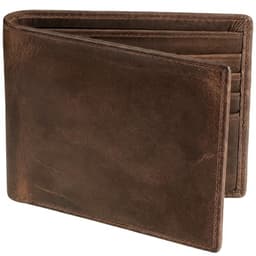
RUNBOX Full Grain Crazy Horse RFID Bifold
Leather grade: Full-grain
Twelve card slots and dual cash pockets, stated full-grain. Buying capacity you actually need is the single best thing you can do for stitching life — an overstuffed small wallet fails years earlier.
$39.99 · View on AmazonPrice as of October 20, 2026. #ad How we’re funded
- Best value keeper
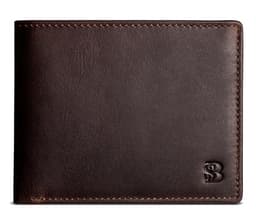
SERMAN BRANDS Full Grain Leather RFID Bifold
Leather grade: Full-grain
A stated full-grain bifold at a price where coated splits are the norm, so the surface polishes instead of rubbing off. If it ever pops a stitch, it is worth paying someone to resew.
$34.95 · View on AmazonPrice as of October 20, 2026. #ad How we’re funded
Bottom line
A leather wallet’s lifespan is set by tension, not by mileage: stitching gives up first, and it gives up because the wallet was carrying more than it was built for. Buy the capacity you actually use, buy a stated full-grain hide so the surface polishes rather than peels, keep it out of your back pocket, and the wallet will almost certainly outlast your interest in it. For the grade decision, see what leather is best for a wallet; for the format decision, bifold vs. slim.
How we know this. Veg Tan Club is written by an enthusiast, not a master leatherworker or a test lab. We compile each product’s published specs — grade, tannage, hardware — and reason from there. We say plainly when a listing doesn’t state a grade, and we haven’t physically handled every item we compare.
Frequently asked questions
How long should a leather wallet last?
We won't give you a number, because the honest answer depends on three things we can't see: the grade, how hard you load it, and whether it lives in a back pocket. What we can say is the order of failure — stitching first, then slot mouths, then the fold — and that a stated full-grain wallet carried sensibly usually outlasts the owner's interest in it.
What fails first on a leather wallet?
Stitching, almost always at a corner or at the top of a card slot. It fails because the wallet is overloaded and the thread takes tension the leather was meant to share. On coated splits the finish at the slot mouths also rubs off early, which looks like failure long before anything structural gives.
Does sitting on your wallet damage it?
Yes, and more than daily handling does. Body weight compresses the fold and forces cards against stitching from the inside, which is exactly the load that splits corner seams. It's also the reason back-pocket wallets deform into a permanent wedge shape. A front pocket roughly halves the abuse.
Can a leather wallet be repaired?
Split stitching can be resewn by a cobbler or leatherworker, and it is usually worth it on a full-grain wallet. What cannot be repaired is a worn-through coating on a split-leather wallet, because the surface that failed was never leather — there is nothing underneath to restore.
Does conditioning make a wallet last longer?
A little, and only if done sparingly. A wallet already picks up oils from your hands every day, so it dries out far more slowly than a bag does. Over-conditioning makes a wallet limp and permanently darker, which is a cosmetic loss rather than a durability gain.
Sources
- Wikipedia — Leather — Overview of leather, grain layers and the full-grain / top-grain / split hierarchy (accessed July 18, 2026)
- Canadian Conservation Institute — Caring for leather, skin and fur — CCI preventive-conservation guidance on cleaning, dressing and storing leather (accessed July 18, 2026)
- Wikipedia — Patina — Patina as the surface change materials develop with age, handling and exposure (accessed July 18, 2026)
Keep reading
How long does a leather bag last?
The same question in a bigger format, where five failure points arrive in a predictable order.
Read the guideBest full-grain leather wallets
The grade that decides whether the surface burnishes or wears through, applied as a filter.
See the picksWhat leather is best for a wallet?
Grade, thickness and tannage for the leather good you handle most.
Read the guideIs full-grain leather worth it?
The cost-per-year case for buying once — the arithmetic behind this page.
See the mathLeather patina: what it is and how it forms
The change people mistake for wear — and why a wallet develops it faster than anything else you own.
Read the explainerHow to clean a leather wallet
The gentle routine for pocket grime, dirty slot mouths and odor — and when to stop.
See the method