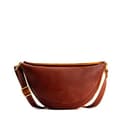
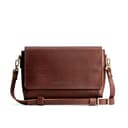
Crossbody or sling?
The words get used interchangeably and they describe different bags. A crossbody hangs at the hip on a long strap and is worn front-to-back; it is the classic small purse or pouch format. A sling sits high across the chest or on the back, usually with a wider, contoured strap, and is designed to be swung round to the front without taking it off.
The practical difference is what each does to your day. A crossbody is easier to reach into and better for a bag you open constantly. A sling distributes weight better and stays put when you move quickly, which is why it wins on a bike, on transit or when you are carrying more than a phone and a wallet.
If you are still deciding between a crossbody and a bag worn on one shoulder, our crossbody vs. shoulder bag comparison covers weight, security and formality. And if the crossbody is for a trip, the leather handbags for travel roundup ranks these bags for sightseeing days rather than everyday errands.
What to check before you buy
- Stated grade. The same rule as everywhere on this site: look for the word full-grain in the listing. Where it is absent, assume a lower grade rather than hoping. See full-grain versus top-grain for what each layer means.
- Strap construction. A strap that is one continuous piece of leather beats a strap made of two glued layers, which delaminates. Adjustability matters more on a crossbody than on any other bag — the difference between comfortable and irritating is a couple of inches.
- Anchor hardware. Rings, clips and rivets take all the load. A named hardware finish is a good sign; unnamed hardware on a bag priced under a decent wallet is not.
- Size honesty. Small crossbodies are genuinely small. Check whether a phone in a case actually fits the main compartment rather than assuming, because plenty do not.
Why the strap wears before the bag does
On a crossbody, the strap is doing something no other part of a leather good does: it runs over the same few inches of shoulder and chest all day, under load, against fabric. That is continuous low-grade abrasion in one narrow band.
On full-grain, that abrasion is basically polishing. The tight grain compacts and darkens, and the strap develops a distinct burnished stripe where it sits — one of the more attractive things patina does. On a coated split, the same friction wears through the surface finish and exposes the fuzzy layer underneath, which then frays. Same bag shape, same use, completely different outcome, decided at the tannery.
If you want the strap to last regardless of what you buy, the useful habits are unglamorous: wipe it down occasionally, let it dry naturally if you get caught in rain, and condition the strap along with the body of the bag rather than treating only the panel you can see. Our conditioning routine takes about ten minutes.