Crossbody vs. Shoulder Bag: Which Should You Carry?
A crossbody is the hands-free, stays-put carry for walking and crowds; a shoulder bag is quicker to open, holds more and looks dressier. How the two compare on weight, security, capacity and style, and what each asks of the leather.
How this is funded: we earn a commission if you buy through our links, at no extra cost to you. It never changes which product we recommend, and we’ll tell you when we’d skip one. Full disclosure.
For walking, travel and crowded places, a crossbody is the better carry: the strap runs diagonally across your body, so the bag can’t slip off, sits in front where you can see it and leaves both hands free. A shoulder bag is the better choice when you carry more, open the bag often and want something that reads dressier — at the cost of a load that hangs from one shoulder and has to be held in a crowd.
Plenty of people who carry a bag every day end up owning one of each, and that is a sensible place to land. If you are buying one, choose by the day you have most often. On your feet, on transit or on a trip: crossbody. At a desk, in a car or out to dinner: shoulder bag. The rest of this page explains why, and what each format asks of the leather it is made from.
Crossbody and shoulder bag, side by side
| Factor | Crossbody | Shoulder bag |
|---|---|---|
| How it's worn | Long strap diagonally across the body, bag at the hip or front | Shorter strap or handles over one shoulder, bag at your side |
| Weight | Pulls diagonally; the bag rests against the body | Hangs straight down from one shoulder |
| Stays on when you move | Yes — can't slide off when you bend or lean | Slips unless you hold it or lift the shoulder |
| Security in crowds | Can be worn in front, in sight | Needs holding under the arm |
| Access | Swing it round and open; usually a smaller opening | Open at your side; wider mouth, easier to see into |
| Typical capacity | Small: phone, wallet, keys, a few extras | Small up to tote size |
| Formality | Casual to smart-casual | Casual to formal, especially when structured |
| Where the leather works hardest | Strap band across the chest and the two strap anchors | Handle roots and the base corners |
| Best for | Travel, sightseeing, transit, errands on foot | Work, dinners, driving, days with a bigger load |
How each one carries weight
A crossbody’s strap runs from one shoulder across the chest or back toward the opposite hip, so the load pulls diagonally rather than straight down on one side, and the bag rests against your body instead of swinging free. The result is a bag that stays put. It can’t slide off when you bend to tie a shoe, and the diagonal gives your shoulder something to hold against rather than something to balance.
A shoulder bag hangs straight down from one shoulder. With a light load you won’t notice. With a heavier one, you will find yourself lifting that shoulder slightly to keep the strap from sliding — a small, constant effort that adds up over a day on your feet. Swapping sides helps, and so does carrying less.
Neither is a heavy-load format. Both put the weight on one shoulder; the crossbody just anchors it better. If your everyday load includes a laptop, both are the wrong bag, and our backpack vs. messenger bag comparison covers the formats built for that.
Security in crowds
This is where the crossbody wins most clearly, and it is the main reason it is the default travel bag. The U.S. Embassy in France’s safety advice for Paris notes that pickpockets work tourist areas, museums, subways and stations, and that a handbag with a zipper or clasp is no protection if it dangles out of sight or sits on the floor.
A crossbody worn with the bag at the front deals with the “out of sight” half by default: it sits under your hand. A shoulder bag hangs at your side or slightly behind you, which is why the same advice tells you to hold a purse or shoulder bag under your arm in crowds. That works. It just depends on you remembering, in the moment, while you are also reading a map or tapping a transit card.
Two caveats. A crossbody pushed round to your back to get it out of the way loses its advantage completely. And neither format is anti-theft on its own — the embassy’s other advice, to carry your passport separately from your wallet or handbag, applies whichever bag you choose. Our leather handbags for travel roundup goes further into what a travel day bag actually needs.
Access and capacity
A shoulder bag is the quicker bag to use. It hangs at your side with its opening facing up, it is usually wider at the mouth, and you can see into it without taking it off. A crossbody has to be swung round or reached into at the hip, and on the smaller ones you find things by feel.
Capacity follows shape. Crossbodies are mostly small by design, because a heavy bag on a long diagonal strap bounces and drags with every step. Shoulder bags run from small up to tote size. If your day includes a water bottle, a notebook, a sweater and lunch, a crossbody will frustrate you, and the honest answer is a shoulder bag or a leather tote. If you are between sizes, the format definitions in types of leather bags are worth a look — the sling, hobo, satchel and bucket bag all sit somewhere on the line between these two.
Formality and what you’re wearing
A structured leather shoulder bag is the more formal object. It pairs with tailoring, it sits on a desk or a restaurant chair looking like a bag rather than gear, and it is what most people picture when they hear the word handbag. A crossbody reads casual to smart-casual. A small, sleek one can dress up, but a strap across the chest always looks a little more practical than a bag on the shoulder.
Clothes change the calculation too. Over a winter coat, a crossbody strap needs enough adjustment to clear the extra bulk; a strap that sits right over a T-shirt can be uncomfortably short over a parka. Most listings don’t publish a strap drop, which is why an adjustable strap is worth checking for specifically rather than assuming.
Why the strap and the leather grade matter differently
The two formats wear out in different places, and that should change what you check before you buy.
On a crossbody, one strap carries the whole load at an angle, and the bag bounces at the hip with every step. That puts a constant, repeated pull on the two points where the strap meets the bag. Meanwhile the strap itself runs over the same band of shoulder and chest all day, rubbing against whatever you are wearing. So the crossbody questions are about the strap: is it one continuous piece of leather, or two layers glued together that can separate? Is it adjustable? Are the anchors stitched and riveted, with hardware the listing is willing to name?
On a shoulder bag, the load hangs more steeply from shorter straps or handles, so the stress concentrates where the handles root into the body of the bag. Handles also take grip and hand oils, and a shoulder bag gets set down far more often — on desks, chairs and car seats — so the base corners wear. The shoulder-bag questions are about structure: does the body hold its shape when loaded, and are the handle roots reinforced?
The grade matters to both for the same underlying reason: the high-wear areas are friction areas. Full-grain keeps the hide’s intact outer layer, so a strap band or a handle burnishes and darkens into a patina rather than wearing through. A coated split, usually sold as “genuine leather”, has a sprayed finish, and friction takes that finish off exactly where you touch the bag most. Our full-grain vs. genuine leather comparison explains the difference in detail. If anything, grade matters most on the strap of a crossbody, because it is both the part carrying the load and the part under constant friction.
What to look for in either
- A stated grade. Full-grain in the listing’s own words. Where a listing says nothing, assume a lower grade rather than hoping. Our guide to choosing a leather bag covers how to read a listing that sidesteps the question.
- An adjustable strap, on a crossbody. The right drop changes with your clothes and with whether the bag sits at the hip or on the chest. A couple of inches either way is the difference between a bag you reach for and one you don’t.
- Anchors you can see. Stitched and riveted strap attachments, and a hardware finish the maker is prepared to name. “Durable hardware” is not a spec.
- A closure that suits how you’ll carry it. A zip top for crowds and travel. A magnetic flap is fine on a bag that stays in front of you or on a desk, and weak on one hanging behind you.
- Structure, on a shoulder bag. A structured body holds its shape and stands up on a desk; an unstructured one slumps as it empties. Neither is wrong, but know which you are buying.
- Honest size. Check stated dimensions against what you actually carry. Many listings don’t publish them, and a small crossbody is often smaller than its photos suggest.
Picks for each side of the decision
Two crossbodies and two shoulder bags whose listings state a leather grade. None publishes every check above, so each card shows what is stated and the rest is yours to confirm on the listing.
- Crossbody: best overall
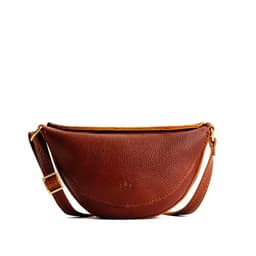
Portland Leather Goods Koala Sling Bag (Medium, Full-Grain)
Leather grade: Full-grain
A named-brand sling whose listing states full-grain, the grade that burnishes along the strap band instead of flaking. Medium size only, so it suits the small-load crossbody day, not a laptop.
- Crossbody: full-grain value
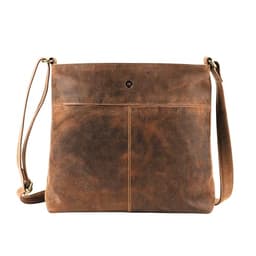
moonster Handmade Full Grain Buffalo Leather Crossbody
Leather grade: Full-grain
The budget route to a stated full-grain crossbody, and the listing names the hide as buffalo, which runs thicker than cowhide. It does not state dimensions or hardware, so study the strap anchors in the photos.
$56.14 · View on AmazonPrice as of September 20, 2026. #ad How we’re funded
- Shoulder bag: full-grain
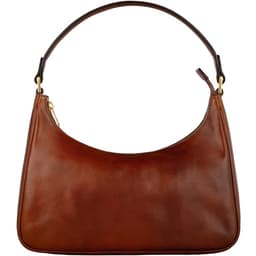
Time Resistance Full-Grain Leather Shoulder Handbag
Leather grade: Full-grain
A structured shoulder bag whose listing states full-grain: the shape-holding body the shoulder-bag side asks for, in the grade that ages rather than wears. The premium pick of the four, in one classic silhouette.
$220.00 · View on AmazonPrice as of September 20, 2026. #ad How we’re funded
- Shoulder bag: bigger load
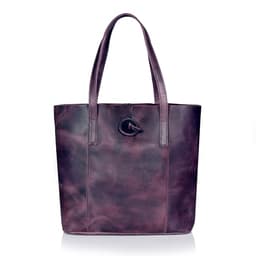
Leather Farm Genuine 13" Leather Shoulder Tote
Leather grade: Genuine leather
An everyday shoulder tote sized around a 13-inch work load, which is the capacity case for a shoulder bag. It states genuine leather, not full-grain, so it will not age the way the full-grain picks do.
$115.00 · View on AmazonPrice as of September 20, 2026. #ad How we’re funded
Who should carry which
Carry a crossbody if you spend the day on foot, ride transit, travel often, carry a light load, or want both hands free for a phone, a coffee or a child. It is also the better bag for anyone who knows they will forget to hold a shoulder bag under their arm in a crowd. The crossbody roundup ranks the options on grade and strap build.
Carry a shoulder bag if you carry more than a crossbody holds, spend most of the day at a desk or in a car, get in and out of the bag constantly, or need it to look right with tailoring. The leather handbag roundup covers shoulder bags, satchels and totes.
Carry neither if your daily load is heavy. One shoulder is the wrong place for a laptop, a charger and lunch, whichever strap it hangs from.
Can one bag do both?
Some shoulder bags ship with a second, longer strap, and some crossbodies can be shortened enough to wear on the shoulder. A convertible bag is a reasonable compromise if you will only buy one, with two checks. First, that the long strap is actually included rather than sold separately. Second, that the clips attach to hardware sturdy enough for a diagonal load — a small ring sized for a decorative strap becomes the weak point once the bag is bouncing at your hip. None of the four picks above states a detachable or second strap in the records we keep, so don’t assume one; check the listing.
Bottom line
Choose a crossbody for days on your feet, in crowds and on trips; choose a shoulder bag for days with more to carry, a desk at the end of them, or a dinner. Whichever you pick, buy the grade for the place the leather works hardest — full-grain on the strap of a crossbody, a structured full-grain body on a shoulder bag — and check the strap and closure yourself, because most listings won’t tell you. Keep it supple with our conditioning routine, and condition the strap along with the body rather than only the panel you can see.
How we know this. Veg Tan Club is written by an enthusiast, not a master leatherworker or a test lab. We compile each product’s published specs — grade, tannage, hardware — and reason from there. We say plainly when a listing doesn’t state a grade, and we haven’t physically handled every item we compare.
Frequently asked questions
Is a crossbody or shoulder bag better?
Neither in the abstract. A crossbody is better for walking, travel, transit and crowds, because the diagonal strap keeps the bag on your body and in front of you. A shoulder bag is better when you carry more, open the bag often and want a dressier look. If you are buying only one, choose by the kind of day you have most often.
Is a crossbody or shoulder bag better for travel?
A crossbody, for most travel days. The U.S. Embassy in France's safety advice for Paris notes that pickpockets work tourist areas, museums, subways and stations, and that a zipper or clasp is no protection on a bag that dangles out of sight. A crossbody worn in front stays in sight by default; a shoulder bag needs holding under the arm in crowds.
Is a crossbody easier on your shoulder than a shoulder bag?
It usually feels steadier, because the diagonal strap holds the bag in place and you are not hiking one shoulder to stop it slipping. But the load still sits on one shoulder either way. The bigger factors are how much you carry and how wide the strap is. If your everyday load is heavy, a backpack is the format actually built for it.
What's the difference between a handbag and a shoulder bag?
Handbag is the umbrella word for a purse carried in the hand, in the crook of the arm or on the shoulder. A shoulder bag is a handbag whose strap or handles are long enough to sit on the shoulder. A crossbody is a handbag with a strap long enough to run across the body. So every shoulder bag is a handbag, but not every handbag is a shoulder bag.
Can you wear a shoulder bag as a crossbody?
Only if the strap is long enough to cross your body with the bag resting at the hip, which usually means an adjustable or detachable long strap. Check the listing for a stated strap drop rather than judging from photos. Worn diagonally, the bag puts a different, repeated pull on its strap anchors, so small decorative rings are the part to look at closely.
Which looks more professional, a crossbody or a shoulder bag?
A structured leather shoulder bag. It sits on a desk or a restaurant chair looking like a bag rather than gear, and it pairs naturally with tailoring. A small, sleek crossbody can work in a smart-casual office, but a strap across the chest always reads a little more practical. For client meetings, the shoulder bag is the safer choice.
Sources
- U.S. Embassy & Consulates in France — Safety Advice for Paris — Pickpockets work tourist areas, museums, subways and stations; a handbag with a zipper or clasp is no protection if it dangles out of sight or sits on the floor; hold a purse or shoulder bag under the arm in crowds; carry the passport separately from the wallet or handbag (accessed September 18, 2026)
- Wikipedia — Leather — Overview of leather, grain layers and the full-grain / top-grain / split hierarchy (accessed July 18, 2026)
Keep reading
Best leather crossbody bags
If the crossbody won — slings and crossbodies ranked on stated grade and strap build.
See the crossbody picksBest leather handbags
If the shoulder bag won — shoulder bags, satchels and totes compared on grade.
See the handbag picksBest leather handbags for travel
The same decision made for a sightseeing day, with the pickpocket advice that drives it.
See the travel picksTypes of leather bags
Sling, hobo, satchel, bucket and tote — where every format sits between these two.
Read the guideLeather backpack vs. messenger bag
The same one-strap-or-two question, for loads heavy enough to include a laptop.
Compare the formatsBest full-grain leather bags
Only bags whose listings state full-grain, across every format.
See the full-grain picks