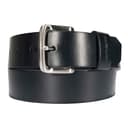
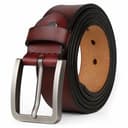
Belt size is not your pant size, and the gap gets expensive here
A belt’s size is the distance from where the leather folds around the buckle bar to the hole you actually fasten. That is typically one to two inches longer than the waist measurement of the trousers you wear it with, because the belt has to travel around your trousers rather than around you. Order a belt in your pant size and you will often find yourself living on the very first hole, with the tip barely reaching the keeper.
The complication specific to this end of the range is that sellers are not consistent about which number they print. Some list the belt length. Some list the waist the belt fits. Some print a band — a belt sold as “58″–60″” may mean a strap that measures 60 inches and fits a 58-inch waist, or a strap sold to cover both. Two listings showing the same number can mean measurements two inches apart, and at this size two inches is the difference between a belt you wear and a belt you return.
The fix is boring and it works: measure a belt you already own, from the fold at the buckle to the hole you use, and buy to that number. Our guide to measuring your belt size walks through it in about two minutes. Then read each listing carefully enough to work out whether its number is a strap length or a waist — if it genuinely does not say, size up, because a belt that is slightly too long can be shortened and one that is too short cannot be fixed at all.
How we chose these
The criteria below are in order of how much each one predicts the outcome. This is the same method used on every roundup here: read the listing, rank on what it commits to, and mark what it leaves out rather than filling the gap with a plausible guess.
- Does it come in your size, and does it say so. This is first only in this category. A belt that stops at 48 inches is not a worse belt than one that reaches 70; it is simply not an option. The listings that publish a full stated range — one of the belts below states 36″ to 70″ — are the ones you can actually shop from without guessing.
- Stated grade, second. A belt takes tension at the same fold thousands of times, which is why grade shows up faster here than on any other leather good. Full-grain keeps the hide’s dense outer surface and holds that tension; a coated split stretches and then creases. If a listing does not say full-grain, assume it is not — full-grain vs. top-grain leather explains what each layer actually is.
- One piece, or several. A long strap is the easiest place in leatherwork to hide a splice, because a maker who has 40-inch offcuts and needs a 58-inch belt has an obvious temptation. “Solid one-piece leather” is a real and checkable claim, and at this length it is worth more than most brand names.
- Width, and what your loops will take. A wider strap spreads the load and resists rolling, which is genuinely useful on a long belt. It is also the spec most likely to make the belt unwearable with the trousers you bought it for: 1.75″ will not thread most dress loops. Our belt width guide covers how width reads across dress and casual wear.
- The buckle, and how it carries the load. Everything the belt does passes through one fastening point. A double prong shares that pull across two holes; a roller bar turns as you cinch so the strap abrades less; a ratchet removes punched holes from the equation altogether. Our guide to belt buckle types explains how each attaches and where each one wears out.
Why grade disclosure thins out above 50 inches
There is no conspiracy here, just economics. A belt strap has to be cut in one straight run along a hide, and hides are not infinitely long. The longer the strap, the fewer usable cuts a maker gets from each hide and the more of the hide is wasted — so long belts cost more to make from good leather and proportionally more of the market moves to cheaper material, laminated constructions and unbranded sellers who describe nothing.
Nothing requires a seller to name the layer of hide a belt is cut from. The FTC’s leather guides govern how a product may be described as leather and when an imitation or a backing material has to be disclosed, but no rule compels anyone to print “full-grain,” “top-grain” or “split.” So the absence of a grade is not an offense — it is information. Makers who cut from full-grain almost always say so, because it is the strongest true thing they can say about the product.
Two of the six belts below state full-grain. One states genuine leather, which sounds reassuring and is in fact the trade’s name for the lower splits of a hide, well below top-grain — full-grain vs. genuine leather is worth five minutes if that wording is new to you. The remaining three say nothing at all, and we have listed them anyway with the gap marked, because a belt that fits and lasts three years beats a belt that would last twenty and does not come in your size.
One strap, or several glued together
Cheap belts of any length are frequently built from thin layers of leather or leather fiber bonded with adhesive and finished with a coating, so the surface looks like one continuous piece. They fail in a specific and recognizable way: the fold at the buckle works the glue line back and forth every time you fasten it, the bond gives, and the belt starts to delaminate and peel from that point outward. Once it starts, it does not stop — the same thing that happens on peeling leather elsewhere on a bag or a jacket.
At big-and-tall lengths there is a second version of the same problem: a strap spliced end to end from two shorter pieces. A splice is usually skived, glued and stitched, which makes it nearly invisible in a photograph and a fair bit weaker than either piece it joins. It sits wherever the maker happened to put it, which may be exactly where the belt bends around your hip.
You cannot see either construction in a listing image. You can only read for the claim. “Solid one-piece,” “single piece” and “full grain” are the words that rule them out; silence rules nothing out. That is why the belt at the top of this page is the one that states both.
Width, buckles and the leftover tail
Width does more work on a long belt than a short one. A wider strap distributes the load over a larger area, sits flatter in the loops, and is much less prone to rolling over on itself under the weight of a full pocket or a phone clip. 1.5″ is the practical default for jeans and business casual, and it will thread most loops that are not cut for a suit. 1.75″ is a work-belt width — noticeably stronger, and noticeably fussier about what it will fit through.
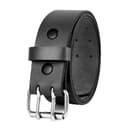
The buckle deserves more attention than it usually gets, because on a long belt the fastening point takes the whole load through one or two small holes. A double-prong buckle divides that pull across two holes side by side, which is exactly why it is standard on work belts. A roller-barbuckle puts a rotating bar where the strap folds, so the leather rolls over it instead of dragging across a fixed edge — a small detail that shows up as less wear at the fold years later. A removable buckle, attached with a snap or screws, means a broken buckle costs you a buckle rather than a belt.
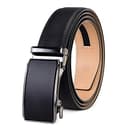
Then there is the tail. A 60-inch belt fastened near its middle holes leaves a long free end, and most belts ship with one keeper loop. Anything past the keeper flaps, curls and eventually creases permanently. Two of the belts here answer that directly: a ratchet is trimmed to your exact length so there is barely a tail at all, and a traditional strap can be shortened at home — which brings us to the most useful trick in this category.
Buying long and cutting down
When you are between sizes, or when the only belt that states full-grain comes in a length two inches past what you need, the answer is usually to buy the longer one and shorten it. A leather belt is shortened from the buckle end, not the pointed tip: the tip is the finished, shaped end everybody sees, while the buckle end disappears into the fold. Our guide to shortening a leather belt covers the measuring, the cut and re-punching the fastening holes.
Two cautions. First, the belt has to have a removable or re-attachable buckle — a snap, Chicago screws or set screws. A buckle stitched permanently into the fold cannot be taken off without destroying the fold. Second, a ratchet belt is the one exception to the buckle-end rule: ratchets are trimmed at the tail, by design, because the whole strap is a track. Cut a ratchet at the buckle end and you have removed the part that engages the mechanism.
Buying long and trimming also gives you a hedge against your own measurements changing. It is a real consideration in this size range, and a strap you can take two inches out of is more useful over five years than one sized exactly right on the day it arrived.
Making a long belt last
The failure points are predictable, so the maintenance is too. The fold at the buckle is where the leather works hardest; the holes are where it stretches; the keeper area is where the tail creases. All three respond to the same thing: keeping the strap supple enough to flex instead of crack, without soaking it soft enough to stretch.
That means an occasional light conditioning — how to care for a leather belt covers the routine and the frequency — and, if you wear a belt every day, owning two and alternating them. Leather recovers from a day of tension if it is given a day off; a belt worn every single day for years is a belt permanently deformed to one shape. Rotation is the single cheapest thing you can do for any strap, and it matters more when the strap is long and expensive to replace.
A new full-grain belt at this length will also feel stiff and unwilling for the first week or two, and that is the property you paid for rather than a defect. It softens along the lines where it actually flexes — breaking in a leather belt covers how to speed that up without cooking the fibers you are relying on for structure.
What we can’t tell you
We have not worn any of these belts and we do not run a test lab. Everything above is read from what each listing publishes, on the date stamped on each card, and ranked on how much of it is checkable. Where a listing does not state a grade, a thickness, a country or a warranty, the spec table says “Not published” rather than filling in a number that would look better.
In this category that means the spec tables are noticeably emptier than on the rest of this site, and that is the finding, not a gap in the research. Half the belts here decline to describe their own leather. What we can tell you is which ones committed to something in writing before you spent your money, and which ones are asking you to take the photograph on trust. Our methodology explains how every pick on this site is built, and what we will and will not claim.