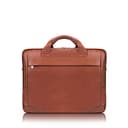
What $100 actually buys in leather
Leather is priced by hide area before it is priced by grade, and a briefcase needs large, clean, unmarked panels — the most expensive part of any hide to cut from. That is why stated full-grain is common in a wallet at this money and almost absent in a bag. A maker working to a sub-$100 landed price has three levers: use a thinner split or a corrected hide, use less of it with a softer unstructured shape, or stay quiet about the grade. Most of this page pulls the third lever, and the quiet is informative rather than sinister. The argument in full is in how much a leather bag should cost.
So judge this band on the two things a listing at this price will tell you, both of which are checkable and neither of which is the grade: the laptop size it commits to and how it carries. Those are the specs that decide whether the bag works on a Tuesday morning, and they are stated here more consistently than anything about the hide.
The five, side by side
Every cell below is read from the listing or marked “Not published.” Use the Check price button on each row in the table above to see the current figure — the number lives in the price layer, not in this page.
| | KomalC | McKlein | Blofinche | Kattee | RAINSMORE |
|---|
| Grade as stated | Not published | Top-grain calfskin | Genuine leather | Genuine leather | Not published |
|---|
| Laptop fit published | 16 in | 13 in + tablet | 15-16 in | Not published (stated large capacity) | 16 in |
|---|
| Carry style | Handle, shoulder, cross-body satchel | Slim top-handle briefcase | Cross-body sling satchel | Top-handle work bag | Shoulder messenger |
|---|
| Tannage stated | Not published | Not published | Not published | Not published | Not published |
|---|
| Thickness stated | Not published | Not published | Not published | Not published | Not published |
|---|
| Hardware named | Not published | Not published | Not published | Not published | Not published |
|---|
| Warranty stated | Not published | Not published | Not published | Not published | Not published |
|---|
| Country of manufacture | Not published | Not published | Not published | Not published | Not published |
|---|
Three things fall out of that table, and the blank rows are the finding. First, not one bag in this band publishes a thickness, a hardware spec, a warranty or a country of manufacture. Four rows, five bags, zero disclosures. Above $150 those rows start filling in; here they are uniformly empty, and a buyer who understands that is a buyer who will not be disappointed.
Second, the grade column is the only one with any spread, and it runs exactly the way the price does not. The cheapest bag here and one of the dearest both decline to name a grade; the one in the middle names top-grain calfskin. Price is not buying you disclosure in this band. If you want the vocabulary for what those labels do and do not promise, start with full-grain vs. genuine leather and full-grain vs. top-grain.
Third, laptop fit is the one spec everybody commits to, which makes it the spec to buy on. Four of five publish a number, and the numbers are real commitments rather than adjectives — a bag sold as 16-inch and returned for not fitting a 16-inch laptop is a bag the seller eats. Measure the machine rather than trusting its marketing name, per what size laptop bag you need.
“Genuine leather” and silence are different claims
Two of these bags say “genuine leather” and two say nothing about the grade, and it is worth being precise about the difference, because it is not the one most buyers assume. “Genuine leather” is a realclaim: it means the material is leather rather than a coated synthetic, and it is a label the FTC’s leather guides govern. It is also the lowest rung that still means leather, and it says nothing about which layer of the hide you are getting. Silence, by contrast, is not a claim at all — the bag may be full-grain or it may be a corrected split, and the listing has simply declined to say. On a page like this the honest ranking treats a stated low grade and an unstated grade as roughly equivalent risk, and neither as a reason to avoid the bag; it is a reason to buy it for its format rather than its lifespan. The checks you can run on the bag once it arrives are in how to tell real leather from fake.
What wears out first at this price
The hide is rarely what fails on a sub-$100 leather bag. In order: the zipper, the strap hardware, the stitching at the strap anchors, the lining seams, and only then the leather. Not one of these listings names its zipper brand or its hardware metal, which is exactly why those parts go first — an unnamed zipper is an unbranded zipper. Two habits buy years: do not carry the bag by a single anchor when it is loaded past comfort, and condition the flex points — the strap fold and the gusset corners — two or three times a year rather than the whole bag heavily. Our conditioner picks cover which products state what is in them, and how to care for a leather briefcase covers the routine.
Which one for you
If you carry a 16-inch laptop and want one bag for everything: KomalC. The largest published laptop fit here, three carry positions, and the longest-running reputation of anything in this band. It publishes no grade, so buy it as a handsome, functional everyday bag rather than an heirloom.
If you want a stated grade and a slim profile:McKlein Montclare. Top-grain pebble-grain calfskin, cut for a 13-inch laptop plus a tablet, from an established laptop-bag brand. Top-grain is sanded smoother than full-grain, so it looks cleaner for longer and will not develop the same patina — and the capacity is genuinely small.
If your commute involves walking or stairs: Blofinche. A cross-body sling sits against the back and leaves both hands free, which is a different bag from a top-handle case even when the leather is the same. Genuine leather, a stated 15-16 inch fit, and one-shoulder loads get heavy when it is packed full.
If you need the most room for the money:Kattee. A large-capacity work bag for a laptop plus files and a day’s kit, at the lowest price of the three stated-leather picks. It states genuine leather and will not patina the way a full-grain bag does.
If the budget is the budget: RAINSMORE. The cheapest bag on this page that still takes a 16-inch laptop and still looks like leather in a meeting. No grade published at this price, thinner leather than anything above it, and a perfectly reasonable first leather bag. If you would rather put the same money into a stated grade in a smaller format, a leather laptop sleeve buys more disclosure for less hide.
And if reading all of this has convinced you the cap is the problem rather than the bags: that is a legitimate conclusion. The next tier up is where thickness, hardware and warranty rows start filling in, and our main leather briefcase picks are where to look. Every rule we follow in choosing and writing these pages is on our methodology page.