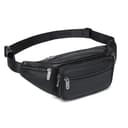
What counts as a belt bag here
One test: the listing’s stated primary carry is on the body — around the waist or high across the chest — on a strap that belongs to the bag. A bag that also converts to a crossbody qualifies, because almost all of them do and the extra mode costs nothing. A bag whose stated primary carry is from the shoulder does not qualify, however small it is, and nor does a sling designed to hang at hip level: both of those are crossbodies, they hang clear of the body, and they live on the crossbody page with no picks shared with this one.
That rule matters because this category has the messiest naming on Amazon. The same product is sold as a belt bag, a waist pack, a fanny pack, a bum bag, a hip bag, a chest bag and a sling, often all seven phrases in one title. We selected on the stated carry and the published geometry rather than the noun, and where a listing is honestly dual-purpose we say so on the card. For the broader map of bag formats and which one suits which day, see types of leather bags.
Depth is the spec, and nobody leads with it
Here is the whole argument for this page. A belt bag sits between your clothing and the world, pressed flat by a strap. Every inch of depth pushes the bag outward from your waist, and past roughly three inches it stops reading as a bag you are wearing and starts reading as a lump. That is the single thing people return these for, and it is almost never the thing a listing puts first — the listings lead with pocket counts, which is the spec that makes a bag deeper.
The good news is that all five of these publish real dimensions, so the comparison is possible. The spread is larger than you would guess: 1.5 inches to 3.15 inches of published depth, more than a factor of two across a category where every product looks about the same in a photograph. And the correlation runs exactly where you would expect: the deepest bag has five compartments and weighs 1.1 pounds empty, the shallowest has two compartments and weighs 0.55 pounds. You are not choosing between good and bad bags here. You are choosing where on that line you want to sit.
One caveat on every depth figure below, and it is the same caveat we put on laptop sleeve depths in our sleeve roundup: the published number is the empty bag. Leather does not compress the way nylon does, so a loaded leather belt bag is its published depth plus the thickness of whatever you put in it, with very little give. A phone is about a third of an inch; a passport with a cover is close to half. Treat the figure as a floor.
The five, side by side
Every cell is read from the listing or marked “Not published.” Read the depth row first and the grade row second — in this category they are the two that decide, and they do not move together.
| | Polare | Berliner Bags | Rustic Town | Handadsume | ZZNICK |
|---|
| Published depth | 3.15 in | 2.36 in | 2 in | 1.5 in | 2.5 in |
|---|
| Footprint (W x H) | 9.45 x 6.1 in | 12 x 4.33 in | 8 x 5 in | 9.5 x 6 in | 14 x 5 in |
|---|
| Empty weight | 1.1 lb | 0.66 lb | Not published | 0.55 lb | 9.5 oz (0.59 lb) |
|---|
| Grade as stated | Full-grain | Full-grain | Full-grain buffalo | Full-grain (crazy horse) | Not published (“genuine cowhide”) |
|---|
| Tannage as stated | Not published | Vegetable-tanned | Not published | Not published | Not published |
|---|
| Zippers named | YKK | YKK metal | YKK | Not published | Not published |
|---|
| Lining named | Not published | Cotton | Not published | Not published | Polyester |
|---|
| Zipped pockets | 5 | 2 | Main + hidden rear | Main + front slip | 7 total |
|---|
| Strap range published | 21.65-37.8 in | Adjustable, range not stated | Adjustable, detachable | Adjustable, detachable | 34-48 in waist |
|---|
| Warranty stated | 1 year | 1 year + 100-day returns | Not published | Not published | Not published |
|---|
Three patterns come out of that table. The first is the one worth paying for: four of five name YKK zippers or state a specific zipper type. On a bag with no frame, no buckle under load and no hardware except a strap adjuster, the zipper is the only moving part and therefore the only thing that can fail outright. A belt bag with a dead zipper is landfill; a belt bag with a scuffed hide is a belt bag with character. A named zipper brand is the single most useful disclosure in this category, and it is far more common here than it is in bags costing five times as much.
The second is that stated full-grain is the norm rather than the exception at this price — four of five, including two bags well under fifty dollars. That is not generosity. It is hide area: a belt bag uses a fraction of the leather a tote or a briefcase does, so a maker can state full-grain on a cheap product in a way it cannot on a big one. It is the same economics we set out in how much a leather bag should cost, running in the buyer’s favor for once. If you have been waiting for a stated full-grain bag you could actually afford, this format is where it happens first.
The third is the ZZNICK pattern, and it is a useful corrective to the assumption that disclosure is a single trait. That listing publishes its footprint, its weight in ounces, its waist range in inches, its lining material and a pocket-by-pocket count of all seven compartments — and will not say which layer of the hide it is cut from, offering only “high quality genuine cowhide”. “Genuine leather” is a label meaning the material is leather, not a grade; the distinction is in full-grain vs. genuine leather. A maker being precise about geometry tells you nothing about whether it will be precise about the hide. The same split shows up on our reversible belt picks, where the listing that publishes a hole count and a 24-to-58-inch size ladder states no grade at all.
Where the hide claims actually differ
Four full-grain claims are not four identical claims, and the differences here are genuinely useful.
One states a tannage. The Berliner Bags Turin says full-grain vegetable-tanned, which is the tannage this site is named for and the one that firms up, darkens and takes a patina from handling — see what vegetable-tanned leather is. On a bag held in the hand and pressed against clothing every day, that is a real difference in how it will look in three years. The same listing then calls the process “chemical-free”, which is marketing rather than chemistry: vegetable tanning works by means of tannins, which are chemicals. We record the overclaim and keep the tannage claim, because the two are separable.
One states a different animal.The Rustic Town bag says full-grain buffalo, a tougher and visibly coarser-grained hide than cowhide, which usually means better scuff resistance and a chunkier look for the money — what buffalo leather is covers the trade. On a bag that rubs against a jacket all day, scuff resistance is not a marginal virtue.
One states a finish. The Handadsume pouch says full-grain crazy horse, which is a waxed pull-up treatment rather than a tannage: it lightens where the leather bends and darkens back as the wax redistributes, so marks from a belt or a zip fade instead of accumulating. On the slimmest bag here, worn tight against the body where it will be rubbed constantly, that is arguably the most practical finish on the page. Our crazy horse leather explainer covers how it behaves, and what pull-up leather is covers the mechanism behind it.
And one states nothing beyond the species. That is the ZZNICK, and it is the honest reason it sits last rather than the reason it is excluded: the geometry is the best documented on the page and the pocket count is the highest, so if organization is why you are buying, it is a rational choice made with your eyes open.
Security: what a belt bag is and is not good at
Belt bags get sold as anti-theft, and the claim is half right in a way worth being precise about. Worn at the front, a belt bag puts your phone and passport under your own hands and in your own eyeline, which defeats the opportunistic bag-dip that gets people in crowds and on transit. That is a real advantage over a tote or an open-top crossbody.
What it does not do is resist a determined attempt, because the strap and the zipper pulls are both exposed and none of these five states a slash-resistant panel, a locking zipper or a steel-cored strap. So the useful distinctions are smaller and more practical: where the pockets are, and whether the main zipper faces up or out. Exactly one bag here places a pocket on the rear panel — the Rustic Town, whose hidden rear pocket sits against your body when the bag is worn at the front. That is the only genuinely unreachable pocket on this page, and it is where a spare card or a folded note belongs. Treat every other pocket as convenient rather than secure.
For travel specifically, the pairing we would actually suggest is a belt bag for the things you need in your hands at an airport and a separate document holder for what you only need at a desk — the logic is laid out in our travelers’ gift guide, which uses the top pick from this page for exactly that job, and our passport holder picks cover the other half.
Care, and the one thing that kills these bags
A belt bag has a specific failure pattern, because of where it is worn. The panel that faces your body absorbs sweat and body oil continuously and dries slowly, since it is covered whenever the bag is on. That is the panel that stiffens, darkens unevenly and eventually cracks, and it is the one nobody thinks to treat because nobody looks at it. If you only condition one part of a belt bag, condition the back.
Two notes on product. Use less than you think on a bag this small — the method is in how to condition leather and the interval in how often to condition leather. And if the bag is pale and you want it to stay pale, a protectant that states in writing that it will not darken the leather is the only thing to reach for; exactly two of the five on our protector spray pagemake that claim. On a veg-tan or crazy-horse bag, skip that entirely — darkening is what you bought.
The second failure is the strap, and specifically the adjuster. On four of these five the strap is webbing with a plastic or metal slide, and a slide that starts creeping under load does not get better. Check it when the bag arrives by loading it and walking for ten minutes; a slipping adjuster is a return, not a repair.
Which one for you
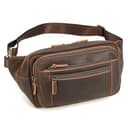
If you want everything in its own pocket:Polare. Five zipped compartments, stated full-grain, named YKK zippers, a published strap range and a warranty. Accept 3.15 inches of depth and 1.1 pounds empty — this is the one that reads as a bag you are wearing rather than a bag that disappears.
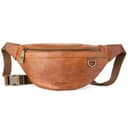
If you want the hide to get better and do not need pockets:the Berliner Bags Turin. The only stated vegetable tannage here, slim at 2.36 inches, with a named cotton lining and the longest return window. Two pockets, the highest price, and a “chemical-free” claim we would not repeat.
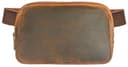
If you want stated full-grain and a secure pocket cheaply: Rustic Town. Full-grain buffalo, YKK zippers, and the only rear-panel pocket on the page. It publishes no weight and no warranty, which is the price of the price.
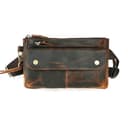
If bulk is the thing you cannot tolerate: Handadsume. At 1.5 inches it is less than half the depth of the Polare, it weighs 0.55 pounds, the crazy-horse finish will hide the rubbing a body-worn bag gets, and the strap comes off so it works as a clutch. Two compartments is all you get.
If you are buying it as an organizer:ZZNICK. Seven pockets, a published weight in ounces, a stated waist range and a named lining — and no grade claim, so assume a finished split and treat it as a few years of use rather than a keeper.
One closing note on method. We do not own these bags and we have not loaded, soaked or weighed any of them. Every specification above was read from a live listing on the date shown on each card, every price renders from the live price layer rather than from a figure typed into this page, and where a listing publishes nothing we say so. The full rules are on our methodology page.