Does Leather Stretch?
Yes - under sustained load, in the direction of the pull, and it does not spring back. That one-way behavior is why belts settle, straps droop and a new bag feels different after a month.
How this is funded: we earn a commission if you buy through our links, at no extra cost to you. It never changes which product we recommend, and we’ll tell you when we’d skip one. Full disclosure.
Yes — and the useful part of the answer is the shape of it. Leather stretches under sustained load, in the direction of the pull, by a small amount, early in its life, and then it mostly stops. It does not spring back. That one-way behavior is why a new belt settles onto a different hole after a month, why a shoulder strap gradually lengthens, and why a stiff bag that felt like a box eventually hangs properly.
It is also why “it will stretch” is bad advice when you are buying. The stretch is small, it is local, and it arrives where the load is — so it will not rescue a belt that is a size too small, and it will not fix a strap that is too short.
Why it happens
Leather is not a sheet of uniform material. It is the preserved fiber structure of a hide: a dense three-dimensional network of collagen bundles, woven more tightly near the outer grain surface and more loosely in the layers beneath. Tanning stabilizes that network so it does not rot, but it does not glue it rigid — the bundles can still slide and reorient relative to each other.
Put a steady pull on a piece of leather and three things happen in sequence. The slack in the weave takes up first, which is fast and feels like softening. Then the fiber bundles begin to straighten and align along the direction of the load, which is where the real dimensional change comes from. Finally the aligned fibers resist further movement, and the leather settles at its new size. Because the second stage is a rearrangement rather than an elastic deflection, it does not reverse when the load comes off.
That structure also explains why stretch is directional and uneven. The fiber weave on a hide varies from the back to the belly, and a belt cut from the soft belly region will stretch more than an identical strap cut from along the spine — which is one of the invisible quality differences between a cheap strap and an expensive one, and one no listing ever discloses. The anatomy behind it is in how leather is made.
Where it shows up on things you own
On a belt, at one hole.This is the clearest example and the most misunderstood. The strap as a whole barely changes; the hole you actually use carries all the tension, and it deforms from a circle into a slot while the leather around it thins. People read that as “my belt stretched” and it is really “one hole gave out.” Rotating between two adjacent holes genuinely helps, and it is the cheapest maintenance habit in leather. The ratchet format exists largely to dodge this problem — see ratchet vs. traditional belt.
On a bag, at the strap and its anchors. A shoulder strap under a daily load lengthens slightly and the holes or rivet points elongate. A thin strap on a heavy bag will do this fast enough to notice within a season. It is also the start of the failure sequence described in how long a leather bag lasts, because once the anchor point has deformed, the stitching there is carrying an uneven load.
On a wallet, at the fold.A wallet flexes hundreds of times a week, and the spine gradually relaxes and widens — which is why an old bifold sits open rather than snapping shut, and why card slots loosen over years. This is stretch doing exactly what it does elsewhere, just in a smaller radius.
On a new, stiff item, usefully.The same mechanism is what breaking in actually is. A rigid full-grain bag or belt is one whose fiber network has not been worked yet; using it aligns the fibers at the flex points and it becomes comfortable. That is the one case where you want the stretch, and the right way to get it is use rather than product — see how to soften stiff leather.
Water and heat: one helps the stretch, one destroys the leather
Water is the real accelerator. Moisture lets fiber bundles slide past one another more easily, so wet leather under load stretches further and faster than dry leather does — and critically, it sets in whatever shape it dries in. Shoemakers and saddlers exploit this deliberately. For everyone else it is a hazard: a soaked bag left hanging on a shoulder, or a wet belt left buckled tight, will adopt that geometry permanently.
Heat is not a shortcut. Warmth does make a hide momentarily more pliable, which is why people reach for hair dryers, but it also drives moisture out of the fiber network and leaves it hard. Hard leather does not stretch; it cracks at the fold. The same mechanism is why fast drying ruins a wet bag, which is covered in how to dry a wet leather bag and underpinned by the fact that leather is not waterproof in the first place.
What to buy if you want less of it
Three specs predict stretch resistance, and only the first two are commonly published.
- Thickness, in ounces or millimeters. A thicker strap spreads the same load across more fiber bundles, so each one is pulled less. This is the single best predictor and it is published by a small minority of listings; where it is, it is worth paying attention to. The units are decoded in leather weight and thickness.
- One-piece construction. A strap cut from a single piece of hide has no splice and no bond line. A laminate of two thin plies glued together behaves like the weaker ply under tension, and the glue line is where it eventually delaminates. “Solid one-piece” in a listing is a real construction claim, and it matters most on long straps, where splicing offcuts is most tempting.
- A stated grade — full-grain for preference. Full-grain keeps the hide’s densest outer layer, where the fiber weave is tightest. A split from deeper in the hide is looser, stretches more readily and has no dense grain layer to resist it. The distinction is in full-grain vs. genuine leather.
What is not a useful signal: tannage. Vegetable-tanned leather is often firmer than chrome-tanned leather of the same thickness, which makes it feel more stretch- resistant, but firmness and dimensional stability are not the same property and no listing publishes either as a number. Treat tannage as a decision about how the piece ages and looks, not about how far it moves.
The specs that resist stretch, in listings that publish them
Thickness and one-piece construction are the two claims above that a listing can actually make. These three make them - which is unusual, and is the only reason they are here. We have not handled any of them; every figure is read from the live listing.
- Publishes an actual thickness
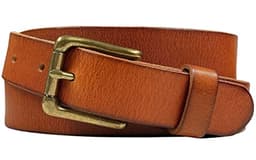
Belts.com Women's Solid Brass Roller Buckle Full-Grain Belt (1-1/8", 30mm)
Leather grade: Full-grain
The only belt in our registry that states one-piece full-grain cowhide and a measured 8-9 oz (4mm) thickness in the same listing - the two specs this page says to buy. The trade is exactly what the numbers predict: at 4mm in a 30mm width it is a stiff strap that needs breaking in.
$28.95 · View on AmazonPrice as of October 20, 2026. #ad How we’re funded
- One piece at a long length
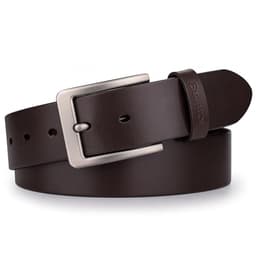
Buffway Full-Grain One-Piece Belt (1.5", 54")
Leather grade: Full-grain
States full-grain and solid one-piece construction at a 54-inch length, which is where it matters most - a long strap is the easiest place to hide a splice, and a splice is the first thing to give under tension. Thickness is not published, so you cannot compare its stiffness on paper.
$39.99 · View on AmazonPrice as of October 20, 2026. #ad How we’re funded
- Thick, for a load
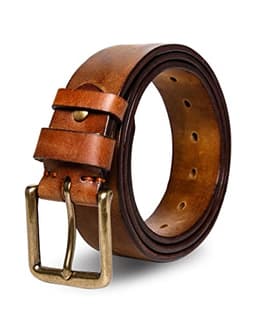
wolksprong Thick Full-Grain Heavy-Duty Work Belt
Leather grade: Full-grain
Sold as a thickened full-grain work strap, which is the right construction for a belt asked to carry tools or a holster rather than hold trousers up. It states the grade but not the ounce weight, so "thickened" is the maker's word and not a measurement - and expect a genuine break-in period.
The practical rules
Buy for the size you are, not the size you hope the leather will become — the method for belts is in how to measure belt size. Rotate between two holes rather than always using one. Do not leave anything leather under tension while it is wet, and do not dry it fast. Expect a stiff new piece to change shape in its first month and to settle after that. And treat any claim that a hide will “stretch to fit” as a sales line rather than a specification.
Everything above is read from published sources and from what listings state — we have not tested any of these products, and we say so on every page. The reasoning is on our methodology page.
How we know this. Veg Tan Club is written by an enthusiast, not a master leatherworker or a test lab. We compile each product’s published specs — grade, tannage, hardware — and reason from there. We say plainly when a listing doesn’t state a grade, and we haven’t physically handled every item we compare.
Frequently asked questions
Does leather stretch?
Yes, under sustained load and in the direction of the pull. Leather is a woven network of collagen fiber bundles, and tension gradually straightens and realigns them. Once they have realigned, they largely stay that way - so leather stretches mostly once, early in its life, and then stabilizes. It is not elastic: it does not spring back the way a synthetic does.
Does leather stretch over time?
It stretches early and then slows down. Most of the change happens in the first weeks or months of regular use, concentrated at whatever point carries the load - the hole you buckle a belt at, the anchor where a strap meets a bag, the fold of a wallet. After that the fibers are about as aligned as they are going to get, and further change is slow unless the load increases or the leather gets repeatedly wet.
Does leather stretch when wet?
Yes, noticeably, and that is when the risk is highest. Water lets the fiber bundles slide past each other more easily, so wet leather under load stretches further and faster than dry leather - and it sets in whatever shape it dries in. Which is why you should take a soaked bag off your shoulder before drying it, and why a wet belt should not be left buckled.
Does heat stretch leather?
Heat does not usefully stretch leather; it damages it. Warmth makes a hide temporarily more pliable, which is why warming is sometimes suggested for breaking something in, but heat also drives moisture out of the fibers and leaves them hard and brittle. Hard leather does not stretch - it cracks. Room temperature and patience do the job without the risk.
Does leather stretch or shrink?
Both, by different mechanisms. It stretches under load as the fibers realign. It shrinks when it loses moisture fast - which is exactly what happens when wet leather is dried near a radiator or in a hot car, and it is the single most common way leather goods are ruined. Dry it slowly and it will keep the dimensions it had.
How much does a leather belt stretch?
Enough that you notice, but not enough to change your size. The stretch is concentrated at the hole in use and the few inches of strap around it, so what usually happens is that the hole deforms into a slot rather than the strap growing. A thick, one-piece, full-grain strap resists this longest; a thin or bonded strap gives first, which is why stated thickness and one-piece construction are the specs worth paying for.
Can you stop leather from stretching?
You can slow it a lot. Buy thickness, because a thick strap distributes a load across more fibers. Buy one-piece construction, because a splice or a bonded laminate has a weak line down it. Avoid sustained overloading - the difference between a bag carried at its design weight and one carried half again over it shows up at the strap anchors. And never leave leather under tension while it is wet.
Sources
- Wikipedia — Leather — Overview of leather, grain layers and the full-grain / top-grain / split hierarchy (accessed July 18, 2026)
- Encyclopaedia Britannica — Hide (animal skin) — Britannica on hides and skins as the raw material for leather (accessed July 18, 2026)
- Encyclopaedia Britannica — Leather — Britannica on leather as chemically treated animal hide and its uses (accessed July 18, 2026)
- Wikipedia — Conservation and restoration of leather objects — How the field cleans and stabilizes leather; why oils oxidize and can harden leather over time (accessed July 18, 2026)
- Canadian Conservation Institute — Caring for leather, skin and fur — CCI preventive-conservation guidance on cleaning, dressing and storing leather (accessed July 18, 2026)
- Wikipedia — Tanning (leather) — The tanning process, vegetable vs. chrome tannage, and why ~90% of leather is chrome-tanned (accessed July 18, 2026)
Keep reading
Does leather shrink?
The other half of this question, by a different mechanism - and unlike stretching, it is damage.
Read the explainerHow to measure belt size
Measure for the belt you have now, not the one it becomes - the method that accounts for settling.
Get the size rightHow long does a leather belt last?
The failure sequence that starts with the hole stretch described here: hole, fold, edge, buckle.
Read the guideHow to soften stiff leather
What to do with a hide that is too rigid to use, and why heat is the wrong shortcut.
Read the guideHow to dry a wet leather bag
Wet leather sets in the shape it dries in. The hour after a soaking decides the next decade.
Read the guideLeather weight and thickness
Ounces, millimeters, and why thickness is the spec that resists stretch best.
Read the guideHow to break in a leather belt
Using the stretch deliberately instead of waiting for it to happen somewhere inconvenient.
Read the guide