Dress Belt vs. Casual Belt
Width, buckle, finish, edge. Four differences, all visible from across a room — and one of them decides whether a single belt can cover both.
How this is funded: we earn a commission if you buy through our links, at no extra cost to you. It never changes which product we recommend, and we’ll tell you when we’d skip one. Full disclosure.
A dress belt is narrow, smooth, plainly buckled and finished at the edges. A casual belt is wider, more textured, more heavily buckled and rougher at the edges. Those four differences — width, buckle, finish, edge — are the whole distinction, and width does most of the work. Everything else people say about the two categories follows from them.
The four differences
| Dress belt | Casual belt | |
|---|---|---|
| Width | Narrower — sits neatly in dress trouser loops | Wider — built for jean loops |
| Buckle | Small, plain, polished frame | Larger, chunkier, sometimes decorative |
| Finish | Smooth, often glossy, uniform color | Matte, pebbled, oiled or distressed |
| Edge | Painted and burnished, sometimes stitched | Left rawer, sometimes visibly stitched |
| Thickness | Thinner, often lined | Thicker, often a single solid strap |
Width is the one that actually decides it
Dress trousers have narrower belt loops than jeans. That is not a style rule, it is a physical constraint — a wide casual strap will not thread neatly through a suit trouser loop, and when it does it bunches the fabric. Conversely a narrow dress belt through wide jean loops slides around and looks lost.
So before deciding anything about buckles or finishes, check the width against the trousers you actually wear. Our belt width guide goes through the ranges in detail, but the short version is that the narrow end of the range is dress territory, the wide end is jeans and work wear, and the middle is where a single belt can credibly cover both.
Buckle: small and quiet, or big and present
A dress buckle is a small, plain frame in a polished finish, and its job is to be unremarkable. Anything with texture, a logo, a plate front or a heavy square profile reads casual immediately, regardless of the strap it is attached to.
This is also where ratchet belts sit awkwardly. The mechanism gives you fine adjustment, which is genuinely useful, but the buckle housing is usually chunkier than a classic dress frame. Plenty are sold as dress belts and look perfectly fine at an office; under a formal suit they are a compromise.
Finish and edge: the details people notice without noticing
A dress belt is smooth, evenly colored and usually has an edge that has been cut clean, painted and burnished so it looks like a single sealed line. That neat edge is a large part of why a good dress belt looks expensive.
A casual belt does the opposite on purpose. Pebbled, oiled or distressed surfaces, visible stitching, and edges left rawer are all signals of ruggedness — and, usefully, they hide scuffs. A distressed casual belt looks better after a year of abuse; a glossy dress belt looks worse.
One consequence worth knowing: casual belts more often come in stated full-grain, because the look tolerates natural grain variation. Dress belts want uniformity, which pushes makers toward sanded, corrected or coated surfaces — sometimes toward splits entirely. The formal belt is the one where you have to read the listing hardest.
Can one belt do both?
Mostly, if you buy for the middle and accept a compromise at each end. The specification that travels furthest is: mid-width strap, smooth or lightly grained finish, dark brown or black, plain metal buckle with no decoration.
That belt will look right with chinos, acceptable with jeans and passable with a suit. What it will not do is look as crisp as a proper dress belt at a wedding, or as at home as a thick casual strap with heavy boots. If you only wear a suit a handful of times a year, that is an easy trade. If you wear one daily, buy two — a belt is the cheapest item in the outfit. For the casual half of that pair, our best leather belts for jeans roundup ranks the wider, thicker straps on stated grade and construction.
One for each end, and one in the middle
A slim dress strap, a wide full-grain casual strap, and a mid-width belt that covers most of the ground between them.
- Dress end
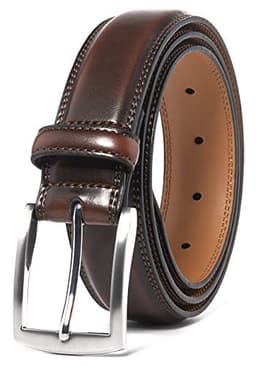
Fabio Valenti Genuine Leather Dress Belt
Leather grade: Genuine leather
A slim, plain dress profile for suits and uniforms. The listing states genuine leather rather than full-grain, which is the usual trade at the formal end — buy it for the look, not for a decade.
$16.99 · View on AmazonPrice as of October 20, 2026. #ad How we’re funded
- Casual end
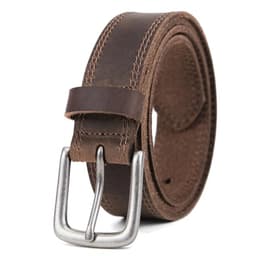
VATAN Full-Grain Leather Casual Jean Belt
Leather grade: Full-grain
Stated full-grain with a traditional pin buckle, cut for jeans. The casual end is where full-grain is easiest to find, because the look tolerates the natural grain variation a dress belt tries to hide.
- Covers most of the middle
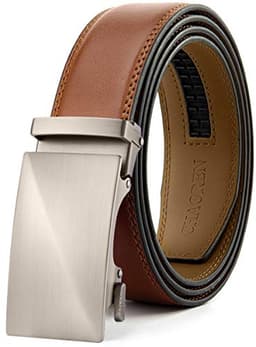
CHAOREN Full-Grain Leather Ratchet Belt (35mm)
Leather grade: Full-grain
A mid-width stated-full-grain strap with micro-adjustment instead of fixed holes. Fine at an office and with jeans; the ratchet housing is chunkier than a classic dress frame, so it is a compromise under a formal suit.
$14.99 · View on AmazonPrice as of October 20, 2026. #ad How we’re funded
Bottom line
Width tells you which category a belt is in, buckle tells you how loudly, and finish tells you how it will age. Buy narrow, smooth and plainly buckled for formal wear; wide, textured and solidly strapped for jeans; and if you want one belt, take the middle of all three and accept it will not be the best option at either extreme. Whichever you choose, check the grade before the styling — see full-grain vs. genuine leather belts for why a belt punishes a cheap grade faster than almost anything else you wear.
How we know this. Veg Tan Club is written by an enthusiast, not a master leatherworker or a test lab. We compile each product’s published specs — grade, tannage, hardware — and reason from there. We say plainly when a listing doesn’t state a grade, and we haven’t physically handled every item we compare.
Frequently asked questions
What's the difference between a dress belt and a casual belt?
Width first: dress belts are narrower, casual belts wider. Then buckle — a small, plain, polished frame on a dress belt against a larger, chunkier or more decorative one on a casual belt. Then finish: dress belts are smooth and often glossy, casual belts matte, pebbled, distressed or oiled. Edges tend to be painted and burnished on a dress belt and left rawer on a casual one.
Can I wear a casual belt with a suit?
You can, and it will read as a deliberate choice or a mistake depending on how far the belt is from dress conventions. A slightly wide, smooth, dark belt with a plain buckle passes almost anywhere. A distressed, stitched, 40mm belt with a large square buckle does not disappear under a suit jacket — it announces itself.
Can one belt do both jobs?
One belt can cover most of the range if you buy it in the middle: a mid-width strap, smooth finish, dark color, plain buckle. It won't be the sharpest option with a formal suit and won't look as at home with heavy jeans as a wide casual belt, but it will be acceptable in both places, which is often what people actually want.
Does the belt have to match the shoes?
The old rule is match the leather color and roughly match the metal to your other hardware. It is a convention rather than a law, and it applies far more strictly at the formal end. With jeans and boots almost nobody is checking; with a suit, a mismatched belt is one of the things people do notice.
Are dress belts thinner leather as well as narrower?
Usually, yes. A dress belt wants to lie flat and disappear under a jacket, so it is cut thinner as well as narrower, and it is often lined to keep it neat. A casual belt is typically a single thicker strap, which is part of why casual belts more often come in full-grain — there is more hide to work with.
Sources
- Wikipedia — Leather — Overview of leather, grain layers and the full-grain / top-grain / split hierarchy (accessed July 18, 2026)
- 16 CFR Part 24 — FTC Guides for Select Leather and Imitation Leather Products — The FTC guides on leather labeling: unqualified 'leather' claims, imitation-leather disclosure, backing material and misuse of trade names (accessed August 19, 2026)
- Canadian Conservation Institute — Caring for leather, skin and fur — CCI preventive-conservation guidance on cleaning, dressing and storing leather (accessed July 18, 2026)
Keep reading
Leather belt width guide
The measurement that does most of the work in this comparison, in detail.
Read the guideBest leather belts for men
The full roundup — full-grain, ratchet and name-brand picks compared on grade and buckle.
See the picksRatchet vs. traditional belt
The other belt format decision — micro-adjustment against fixed holes.
Compare the bucklesHow to measure belt size
Get the size right before you worry about the style — the mistake almost everyone makes.
Measure properlyBest leather belts for jeans
The casual end in practice: wide, solid straps compared on stated grade and buckle.
See the jean beltsBest leather dress belts
Once you have settled on the dress end, these four are compared on stated grade, published width and buckle.
See the dress picks