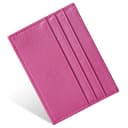
The four things people are usually replacing
Search traffic for Secrid alternatives splits into four fairly distinct wants, and knowing which one is yours decides the pick.
1. The leather, cheaper.The Miniwallet’s skin is a stated vegetable tannage, which is the spec that makes a card wallet darken and burnish with handling instead of staying the color it shipped in. It is also a spec you can buy for much less: three of the five picks below state a vegetable tannage, and two of those also state full-grain, which the Secrid listing does not. If this is your want, you are better served than you probably expect. The tannage itself is explained in what vegetable-tanned leather is.
2. More capacity.A rigid card housing has a hard ceiling, and “four embossed cards” is a genuinely small number if your bank still embosses. The alternatives here run from six to eight cards in a soft shell, and if you need more than that the honest answer is a different format entirely — see best wallets for lots of cards.
3. RFID shielding. Two picks below state it and the Secrid listing does not mention it. Our position has not changed and is set out in are RFID wallets worth it: contactless skimming is a real but uncommon attack, chip transactions are tokenized, and shielding is worth having when it is free rather than worth distorting a purchase for.
4. Cash. A card wallet does not take notes flat, and plenty of people discover that a week in. One pick below is a full bifold with two bill compartments and the strongest provenance claim on the whole site, for exactly that buyer.
The five alternatives, side by side
The Secrid column is the benchmark, read from its own listing on the date shown on its card in our veg-tan wallet ranking. Every other cell is read from that product’s listing or marked “Not published.” Current prices are on the Check price button in each row of the table above.
| | SECRID (the original) | HISCOW | FOXHACKLE | Bosca | ALBEPPE | URAQT |
|---|
| Grade as stated | Not published | Full-grain | Full-grain (contradicted later in the listing) | Full-grain | Full-grain | Not published |
|---|
| Tannage as stated | Vegetable-tanned | Vegetable-tanned | Vegetable-tanned | Vegetable-tanned (Italian hide) | Vegetable-tanned | Not published |
|---|
| Finish or tannery named | Not published | 100% aniline pull-up | Not published | Hand-stained | Conceria Monteverdi, Tuscany | Not published |
|---|
| Card capacity stated | 4 embossed or 6 flat, plus 4 in the wrap | 8 cards | 8-10 cards over 6 slots | 6 slots + 2 receipt wells | 8 slots | 6 slots + center pocket |
|---|
| Takes notes flat | No | No | Folded, in a center pocket | No | Yes - 2 bill compartments | Folded, in a center pocket |
|---|
| Size / weight published | 102 x 65 x 21 mm; 70 g | 4.3 x 2.8 x 0.6 in; approx. 1.3 oz | 4 x 3 x 0.2 in | 4.25 x 2.75 x 0.5 in | 4.4 x 3.7 x 0.8 in | 4.13 x 3.54 in; 0.7 oz |
|---|
| RFID stated | Not published | Not published | Yes | No | Yes | Yes (double layer) |
|---|
| Warranty stated | Not published | 1 year | 12 months | Not published | 12 months | Not published |
|---|
| Country of manufacture | Italy and Holland | Not published | Not published | China or India, per the listing | Not published (hide is Tuscan) | Not published |
|---|
Two rows decide this page. The first is the grade row: the original is blank and four of the five alternatives are not. That is the single strongest argument for shopping around here, and it is a disclosure argument rather than a quality one — the Secrid is plainly a well-made wallet, but a buyer who cares which layer of the hide they are getting can find that stated for much less money.
The second is country of manufacture, where the original wins outright. Secrid names Italy and Holland. Of the five alternatives, exactly one publishes a manufacturing country at all, and it hedges between two of them. “Italian leather” and “Tuscan hide” are hide-origin claims, not assembly claims, and we file them that way every time — the distinction is in what “Italian leather” actually means. If made-in-Europe is why you were looking at a Secrid, none of these replaces it, and you should buy the original.
Two claims we are correcting rather than repeating
FOXHACKLE’s listing contradicts itself.Bullet one says “100% vegetable-tanned full grain cowhide” and a later bullet says “crafted from genuine leather.” Those are not the same claim. We take the grade from the specific lead bullet and record the boilerplate one in the product’s cons, because a listing that says both has told you less than it appears to.
URAQT says “pure high-grade leather,” which is not a grade. The recognized terms are full-grain, top-grain, genuine leather and bonded; an invented adjective in capital letters is a non-disclosure. Its grade field on this site publishes as nothing, and at that price the hide is most likely a split with a sprayed finish, which lifts rather than patinas. It keeps a slot because it is an honest cheap test of the format, and the card says so.
What a rigid housing buys, and what it costs
The mechanical idea behind the Miniwallet is that cards should live in a protected structure rather than in leather pockets, because leather stretches and card slots do not recover. That is true, and it is the strongest functional argument for the original: a leather slot carrying two cards for a year stays loose when you go back to one, and a rigid housing never does that.
The cost is capacity and forgiveness. A leather card holder absorbs one extra card, a folded receipt and a hotel key; a fixed housing does not. If you have ever jammed a ninth card into an eight-card wallet, you want leather. If your actual complaint is that your wallet has stretched and gone floppy, you want the housing — and buying a leather alternative will reproduce the problem. The failure order for leather wallets is set out in how long a leather wallet lasts.
Which one for you
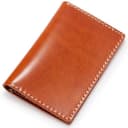
If you want the leather story, better documented and cheaper: HISCOW. Full-grain, vegetable-tanned and a 100% aniline pull-up finish — three separate checkable claims, where the original makes one — in a one-piece shell with raw edges and no bonded edge coat to crack. Eight cards is a hard ceiling, there is no bill compartment, and raw edges fuzz with wear where a burnished edge would not.
If you want precision plus shielding for much less: FOXHACKLE. States a vegetable tannage and full-grain in its lead bullet, publishes a 0.2-inch thickness and a 4 x 3 in footprint, six slots with a stated 8-10 card capacity and a center pocket for folded bills, RFID blocking and a 12-month warranty. Read the grade claim with the contradiction above in mind, and note the copy is written for search rather than for a buyer.
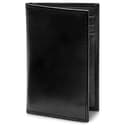
If you want cards filed rather than stacked:Bosca. Italian full-grain vegetable-tanned hide, hand-stained, six vertical slots plus two receipt wells and a published footprint and thickness — from a line sold under the same name for decades. It is the dearest alternative here, the glossy finish is a coating that will craze at the fold before an unfinished hide would, there is no RFID, and the listing will not commit to one factory.
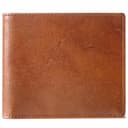
If you still carry cash: ALBEPPE. A full bifold rather than a card case, and the most thoroughly documented leather listing we have read in this category: full-grain and vegetable-tanned, with the tannery named (Conceria Monteverdi, Tuscany, in operation since 1955) and a numbered consortium authenticity certificate. Eight card slots, two bill compartments, a 12-month warranty. It is a bifold, so it is thicker than anything else here, and its polyester lining and RFID layer add bulk a leather-on-leather wallet would not.
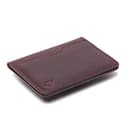
If you are testing whether cards-only works for you:URAQT. Double-layer RFID, six slots plus a center compartment, a stated 0.7 oz. No grade, no tannage, no country, no warranty — buy it as a spare, a travel case or a two-month experiment, and then buy properly. The whole field is on best leather card holders, and every rule behind these picks is on our methodology page.