How Much Should a Leather Bag Cost?
Five things move the price of a leather bag, and only two of them change how long it lasts. Here's how to tell which one you're paying for.
How this is funded: we earn a commission if you buy through our links, at no extra cost to you. It never changes which product we recommend, and we’ll tell you when we’d skip one. Full disclosure.
The honest answer is that a leather bag’s price is set by five things — grade, how much hide it uses, hardware, construction quality and brand — and only the first two reliably change how long the bag lasts. Learning to see which of the five you are being charged for is worth more than any specific budget number, which is also why we show live, dated prices on our picks rather than printing figures that would be wrong within a month.
The five things you are actually paying for
- Grade. The single largest driver, and the one most often hidden. Full-grain costs a multiple of a coated split, because it is the scarce outer layer of the hide and it cannot be manufactured. See full-grain vs. top-grain.
- Hide area. Bags are big. A large tote or weekender needs several square feet of the hide’s best sections, and those sections are limited on any animal. This is why a wallet in the same leather costs a fraction of a bag: it is mostly a material-quantity difference, not a quality one.
- Hardware. Solid brass, quality zippers and properly set rivets cost real money and are the second most common failure point after the leather itself. A listing that names its hardware is telling you it did not buy the cheapest available.
- Construction. Lining, edge finishing, reinforced stress points, stitch density, whether panels meet cleanly at corners. This is skilled labor, and it is the difference between a bag that ages and a bag that comes apart at a seam while the leather is still fine.
- Brand and design. Real, legitimate, and entirely disconnected from durability. There is nothing wrong with paying for it — just know that is what you are doing.
What changes as you move up
Rather than invent price brackets, here is what actually changes between tiers, in the order it changes:
| Tier | What the listing usually says | What you get |
|---|---|---|
| Entry | No grade stated, or "genuine leather" | A real leather bag that will look tired in a few years |
| Mid | Full-grain stated; hardware sometimes named | The jump that changes lifespan — the hide is the durable layer |
| Upper | Full-grain plus hardware, lining, warranty | Construction that keeps up with the leather |
| Premium | Tannage, thickness, tannery or consortium named | Traceability and finishing; diminishing returns on years |
The important line in that table is the second one. Moving from an unstated grade to a stated full-grain is the step that changes the answer to “how long will I have this?” Every step above it improves the bag in ways you will notice and enjoy, but the years were bought at the first jump.
The price signals that should make you suspicious
- A large structured bag priced like a small accessory. Hide area alone makes that arithmetic impossible for full-grain. Something in the material is not what the photos suggest.
- A steep “discount” from a list price nobody paid. Judge the bag on what it costs today against what it discloses, not against a struck-through number.
- Premium pricing with a silent spec sheet. If a bag costs like full-grain and the listing never says full-grain, the omission is the answer. We print “Not published” in that case rather than assuming.
- “Genuine Italian leather” at a mid price. Two vague words doing the work one precise one should. See what Italian leather means.
The same format at three tiers
Three leather backpacks — one entry-grade, two stated full-grain. Same format, same job, so the price gap is doing something visible. Prices are live and dated on each button.
- Entry tier
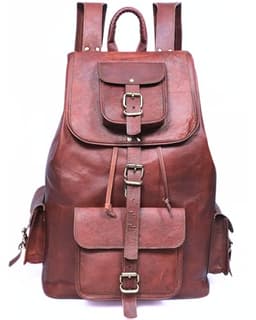
DEKVIO Genuine Leather Backpack (20", XL)
Leather grade: Genuine leather
Genuine leather, XL capacity, lowest price of the three. A real leather bag for someone stepping off coated synthetics — but the grade means it will look tired well before the others do.
$89.99 · View on AmazonPrice as of October 20, 2026. #ad How we’re funded
- The jump that matters
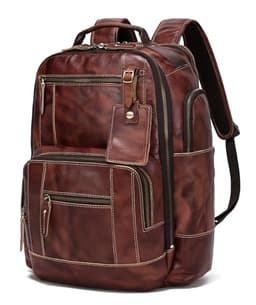
LANNSYNE Full Grain Leather Backpack (16")
Leather grade: Full-grain
The first tier where the listing states full-grain. This is the step that changes the lifespan answer; everything above it improves the bag without adding years the way this one does.
$149.99 · View on AmazonPrice as of October 20, 2026. #ad How we’re funded
- Upper tier
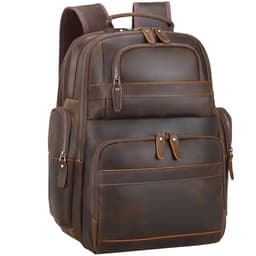
TIDING Full Grain Leather Backpack (15.6")
Leather grade: Full-grain
Also stated full-grain, with a larger laptop fit and more capacity. You are paying for hide area and construction here, not for a better grade than the pick above.
$169.99 · View on AmazonPrice as of October 20, 2026. #ad How we’re funded
How to set your own number
Work backwards from the bag, not from a budget:
- Decide the format. A weekender needs several times the hide of a small crossbody, so the same budget means very different grades in each. Types of leather bags covers the formats.
- Set the floor at a stated grade. Whatever the format, find the cheapest listing that states full-grain. That is your real entry point, not the cheapest listing overall.
- Add hardware and construction if the bag will be used hard. Zippers and strap anchors on a daily bag are worth more than another grade step you cannot get.
- Stop before you are paying for design alone. Once the spec sheet stops adding facts and starts adding adjectives, the price is going somewhere other than the leather.
Bottom line
There is no correct price for a leather bag, but there is a correct order to buy in: reach a stated grade first, then buy construction, then buy design. Most of the durability money is spent at one step — the move to full-grain — and most of the money above that step buys things you will enjoy rather than years you will use. For whether that first step pays for itself, see is full-grain leather worth it; for what to check once you have a budget, see how to choose a leather bag.
How we know this. Veg Tan Club is written by an enthusiast, not a master leatherworker or a test lab. We compile each product’s published specs — grade, tannage, hardware — and reason from there. We say plainly when a listing doesn’t state a grade, and we haven’t physically handled every item we compare.
Frequently asked questions
How much should I spend on a leather bag?
Enough to reach a stated grade, and no more than the format justifies. The jump that changes the outcome is from an unstated or 'genuine leather' grade to a stated full-grain one; jumps above that mostly buy design, hardware, finishing and brand rather than years of service. We show live prices on our picks rather than quoting figures that would go stale.
Why are leather bags so expensive?
A bag uses a lot of hide, and the panels have to come from the good parts of it. Add the tanning process, the hardware, the lining, and the skilled labor to cut and stitch panels that meet cleanly at corners, and the material cost is only part of the total. Bags are also the format where the leather has the most work to do structurally.
Is an expensive leather bag worth it?
It depends entirely on which part of the price you're buying. Paying more for a stated full-grain hide and named hardware buys years. Paying more for a logo, a season's silhouette or a boutique buys none. The two look identical on a price tag, which is why the spec sheet matters more than the number.
Can a cheap leather bag be good?
Yes, with an honest expectation. A well-made 'genuine leather' bag is a real leather bag that will serve for a few years and then look tired. That is a perfectly reasonable purchase if it's what you meant to buy. The problem is only ever paying full-grain money for it.
Why do two similar-looking leather bags have very different prices?
Usually the grade, and it is usually invisible in photos. An embossed coated split can be made to look exactly like full-grain on a screen. Other common causes are hide area — a larger bag needs more of the hide's best sections — solid versus plated hardware, and whether the bag is lined and edge-finished properly.
Sources
- Wikipedia — Leather — Overview of leather, grain layers and the full-grain / top-grain / split hierarchy (accessed July 18, 2026)
- Encyclopaedia Britannica — Tanning — Britannica on the three main tanning agents: vegetable tannin, chromium salts, and oils (accessed July 18, 2026)
- Leather Working Group — Standards & Certification — The leather industry's environmental audit standard for tanneries (Gold/Silver/Bronze) (accessed July 18, 2026)
- 16 CFR Part 24 — FTC Guides for Select Leather and Imitation Leather Products — The FTC guides on leather labeling: unqualified 'leather' claims, imitation-leather disclosure, backing material and misuse of trade names (accessed August 19, 2026)
Keep reading
How much does a leather briefcase cost?
The same three-band analysis for the one format where structure is the biggest line item.
Read the guideIs full-grain leather worth it?
The cost-per-year case for paying up once instead of replacing cheap leather repeatedly.
See the mathHow to choose a leather bag
The grade, format and construction checks to run before you look at the price at all.
Read the guideFull-grain vs. genuine leather
The one price jump that changes how long a bag lasts, and the label that hides it.
See the differenceTypes of leather bags
Which formats need an expensive grade to work, and which are more forgiving.
Compare the formats