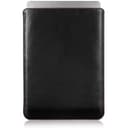
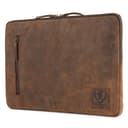
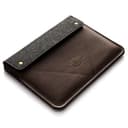
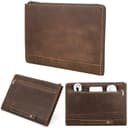
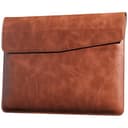
What counts as a sleeve here
One test: the stated job is to carry a laptop, and nothing structural is added to make it carry anything else. A slim outside pocket for a charger or a dongle is allowed, because it does not change the footprint. A shoulder strap, a set of organizer pockets, a document section or a handle is not allowed — add any of those and the thing is a laptop bag with a padded compartment, which is a different purchase with a different failure point.
That rule kept two whole categories off this page. Leather folios and padfolios that happen to have a laptop slot are organizers first, and they live on our portfolio and padfolio picks. Messenger-style leather cases with straps and front pockets are laptop bags, and they live on the laptop bag roundup. If you are still working out how big a carrier you need in the first place, what size laptop bag do I need does the measuring for you.
The three specs that decide a sleeve
1. How the fit is stated.This is the spec that gets returns, and there are exactly two ways a listing can state it. The honest way is a model list: “MacBook Pro 14 in, M1 to M5, 2021 to 2026,” sometimes with an outside dimension in millimeters for everything else. The lazy way is a bare inch number — “fits 14 inch” — which is a screen diagonal, not a measurement of your machine. A 14-inch screen sits in bodies that differ by nearly an inch of width depending on bezel and hinge design, and a snug leather sleeve has no give to absorb that. Four of these six publish a model list or a real external footprint. Two publish an inch figure and expect you to compare it yourself; both of those tell you to do exactly that, which is at least honest.
2. Whether the lining is named.The outside of a sleeve protects against knocks. The inside decides whether your laptop lid comes out scratched, and a listing that says “soft lining” has told you nothing. Named linings on this page run to wool (two picks), microfiber (one) and nothing identified at all (the rest). The distinction matters: wool felt is thick enough to be the padding as well as the lining, which is why the two wool-lined picks here make no separate padding claim and do not need one. Microfiber is thinner and smoother — fine against a screen, less help against a corner knock.
3. The closure, and what it leaves open. Three mechanisms appear here, and they fail differently. A zip-around runs the whole way round and seals the sleeve against dust and grit, which is the real enemy of a screen; the cost is that a zip is the one part of a leather sleeve that can break outright, which is why a named zip brand is worth something. A 90-degree zipopens two adjoining edges, so the laptop goes in flat rather than being pushed down a slot — easier on a thick machine, and it leaves two thirds of the sleeve closed. A magnetic flap is the fastest to use and leaves one long edge permanently open; for a laptop you open and shut all day that trade can be worth making, but a sleeve that lives in the bottom of a backpack will take grit along that edge.
A fourth factor is not a spec at all. Every published depth figure on this page is an empty depth. A sleeve quoted at 0.79 in does not become a 0.79-inch package with a laptop in it: the leather and the lining spread, and the whole assembly is whatever your machine measures plus roughly a quarter inch of material. If thinness is the reason you are buying, treat the published figure as a floor, never a result.
The six, side by side
Every cell is read from the listing or marked “Not published.” Read the grade row against the price band rather than down the column — on this page they run in opposite directions.
| | Casemade | Berliner Bags | Crazy Horse Craft | CataPurus | DAREhue | CPNVWA |
|---|
| Grade as stated | Full-grain | Full-grain buffalo | Not published | Top-grain | Full-grain | Not published (“premium leather”) |
|---|
| Tannage as stated | Not published | Not published | Vegetable-tanned | Not published | Not published | Not published |
|---|
| Lining named | Soft wool | Lined, material not named | 100% wool felt | Not published | Not published | Microfiber |
|---|
| Closure | Snug slip fit | YKK zip-around | Magnetic | 90-degree zip | Not published | Magnetic flap |
|---|
| Outside pocket | No | Yes, zipped | No | Yes, side | No | No |
|---|
| Fit stated as | Per-model list + mm limit | 15 in + 15 x 10.8 x 0.8 in | Per-model list (14 in Pro) | 14.3 x 10.2 x 1.1 in | 13-14 in | Per-model list + 13.15 x 9.33 x 0.79 in |
|---|
| Warranty stated | 12 months | 1 year + 100-day returns | 2 years | 1 year | Not published | 30 days |
|---|
| Country of manufacture | Not published | Not published (designed in Berlin) | Not published (“European studio”) | Not published | Not published | Not published |
|---|
Two patterns fall out of that table, and the first one is the reason this page exists. The grade ladder runs backwards against price.The most expensive sleeve here states a vegetable tannage, an Italian hide, a wool felt lining and a two-year warranty, and never states a grade at all — so for all its disclosure, the one fact that predicts how the leather ages is missing. Meanwhile the two cheapest thirds of the page include two stated full-grain sleeves, one of them at well under half the premium pick’s price. If you came here assuming the dear one must be the better hide, the listings do not support that.
The second pattern is the blank bottom row. Not one of these six states where it was made. Two come close enough to be worth separating out: Berliner Bags says the sleeve is designed in Berlin, and Crazy Horse Craft says it is cut in a small European studio. Neither is a country of manufacture, and we have filed both as not published. That is the same distinction we keep drawing between a hide origin and an assembly country in what “Italian leather” means: a design city tells you who drew it, not who sewed it.
Full-grain, top-grain and the silence in between
Three of these sleeves state full-grain, one states top-grain, and two state nothing. That spread matters more in a sleeve than it looks, because a sleeve lives a specific kind of life: it gets pushed into bags, dragged across desk edges and gripped at the same two corners every day. Full-grain keeps the dense outer fiber layer, so those corners burnish and darken into patina instead of wearing through. Top-grain has that layer sanded off and a finish sprayed on, which looks cleaner at the start and has nothing to fall back on when the finish goes. The full argument is in full-grain vs. top-grain leather, and the shorter version is this: in a product with four corners and no hardware, the grade is the durability spec.
Two of the listings here reward a close read. The CataPurus states top-grain and then describes it as “known as Chamois Leather,” which is wrong: chamois is a soft, oil-dressed split, not a grade, and a split is the layer belowthe one top-grain comes from. We have taken the grade from the repeated top-grain claim and printed the chamois line in the product’s cons rather than repeat it as fact. The CPNVWA calls its hide “premium leather” and “high-quality cowhide” — which names a species and two adjectives, and tells you nothing about the layer. “Genuine leather” and its cousins work the same way; see full-grain vs. genuine leather for why one of those phrases is a grade and the other is a label. The same trick turns up one hub over on our trifold wallet picks, where the best-known brand on the page claims “genuine Italian leather” and never states a grade either.
The veg-tan sleeve, and what you are signing up for
One pick here states a vegetable tannage, which is unusual in laptop accessories and worth understanding before you buy it. Vegetable-tanned leather is firmer, takes a deep patina and darkens noticeably with hand oil and sunlight — that is the attraction, and it is also a commitment. The crazy-horse finish on that sleeve is specifically designed to show and then absorb scratches, so it starts out marked and gets more characterful; the listing says so plainly. If you want a sleeve that looks the same in three years as it does out of the box, this is the wrong one, and a finished top-grain is the right one. Our crazy horse leather explainer covers how that finish behaves, and what vegetable-tanned leather is covers the tannage itself.
The other hide worth a note is buffalo. The Berliner Bags sleeve states full-grain buffalo rather than cowhide, which is a tougher, visibly coarser-grained hide — better at resisting scuffs, less smooth to look at, and generally cheaper for the same stated grade. If that trade appeals, what buffalo leather is explains why, and our buffalo leather bag picks apply the same logic to a bigger piece.
Does a leather sleeve actually protect a laptop?
Honest answer: against the things that usually damage a laptop, yes; against a drop, not much. A sleeve’s real work is abrasion and grit — keys, chargers, pens and sand inside the bag you put it in — plus the pressure of a bag being set down hard. Leather is very good at the first job and only moderately good at the second, because leather does not absorb impact the way closed-cell foam does; it spreads it. That is why the lining question above matters so much, and why the padded pick on this page is the one we would choose if the sleeve is going to travel loose in a car or a checked bag.
Two practical consequences. First, if you carry your laptop in a leather sleeve inside a leather bag, you are carrying two layers of a material that holds water on the surface and resents it underneath; read is leather waterproofbefore you count on either. Second, the base of a sleeve is the panel that takes every set-down, so it is the panel worth treating. A protectant that states in writing that it will not darken the leather is the only thing we would put on a pale sleeve — see our protector spray picks, where exactly two of five make that claim, and how to care for a leather briefcase for the routine that applies to sleeves too.
Which one for you
If you want the most disclosure at a sensible price: Casemade. It states full-grain, names a wool lining, publishes a per-model fit list with a millimeter limit for everything else, and carries a twelve-month warranty. That is four honest facts, which is more than anything else here manages.
If you carry a 15-inch machine and a charger: the Berliner Bags Nico. Full-grain buffalo, a YKK zip that seals the sleeve completely, and the only exterior zip pocket on this page. Accept that it will not tell you where it was made.
If you want a veg-tan sleeve and the patina that comes with it:Crazy Horse Craft, with your eyes open on two points — it states no grade, and it is built to darken and mark from day one.
If you want a zip and a pocket for less: the CataPurus. The 90-degree zip is the most practical closure here for a thick laptop, and it publishes a real footprint and an empty weight. It is also the thickest and heaviest sleeve on this page, and it states top-grain rather than full-grain.
If the sleeve will travel loose, or you want a desk stand: DAREhue. Padded, stated full-grain, and it folds out into a laptop riser, which is the only second function any of these six has. It is also the second most expensive thing here and publishes no warranty.
If you want a cheap spare or a travel sleeve: CPNVWA, treated as two or three years of use rather than a keeper. It publishes its own measurements and names its lining, and it will not say which layer of the hide you get.
One closing note on method. We do not own these sleeves and we have not dropped, soaked or weighed any of them. Every specification above was read from a live listing on the date shown on each card, every price renders from the live price layer rather than from a figure typed into this page, and where a listing publishes nothing we say so. The full rules are on our methodology page.