What you are actually choosing between in this band
These three words get used interchangeably in listings and they are three different objects worn in three different places.
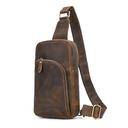
A sling is tall and narrow with one wide strap, worn diagonally across the chest or rotated onto the back. Its load rides high and close to the spine, which is why it stays put when you move. Our sling bag roundup is the format on its own terms at every price.
A chest pouchis a short, wide sling — the same carry, less capacity, and usually convertible to a waist pack by shortening the strap. Two of our five are this shape, and it is the most flexible thing in the band.
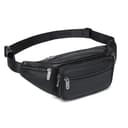
A belt bag or waist pack straps around the waist and carries the least. It is the right answer if you want your hands and shoulders free entirely, and our belt bag page covers it in full.
And the format that is not in this band: the shoulder crossbody, a wider-than-tall bag on a long thin strap worn at the hip and swung forward to open. For that, our crossbody bag roundup is the page, and the picks on it start meaningfully above this cap. Crossbody vs. shoulder bag takes the neighbouring decision, and types of leather bags maps every format on the site.
What $50 buys in leather, and what it does not
It buys a stated grade on two of five.One states full-grain with a crazy-horse finish, one states full-grain buffalo. Two more say “genuine leather,” which is the bottom rung and at least an honest one, and one says nothing at all. That is a reasonable disclosure profile for the money — read full-grain vs. genuine leather if the gap between those two phrases is new, because it is the single most useful thing to understand before buying any leather bag.
It buys published capacity, on four of five.Pocket counts, pouch dimensions, and in two cases a stated phone size. On a small bag that is the spec that decides satisfaction, because the most common disappointment at this price is not failure — it is the bag arriving and not closing over what you assumed would fit.
It does not buy a named zipper.None of the five names a zipper brand. On a one-compartment body-worn bag the zip is the part most likely to end the bag’s useful life, because the main compartment isthe bag. A “metal zipper” is a material, not a quality claim.
It does not buy a thickness, a tannage or a country,on any of the five. Those three rows are empty across the whole band. On the strap anchors of a body-worn bag the thickness is the one we most want — leather weight and thicknesscovers why ounces of hide predict a tab’s life better than a grade word does.
The crazy-horse question, since two picks use it
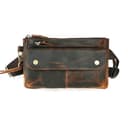
Our top pick states full-grain and a crazy-horse finish, and that pairing is worth understanding because it is the single best value proposition in this band.
Crazy horse is a finish, not a grade.It is a heavily hot-waxed pull-up treatment: scuff it and the wax migrates out of the stress line so the color lightens, then redistributes with handling so the mark closes up again. On a bag worn against your body all day, rubbing against a coat and a car seat, that is genuinely the most useful property you can buy at this price — it hides the exact kind of wear this format collects. What is crazy horse leather and what is pull-up leather cover the mechanism.
Three consequences to go in with your eyes open. It darkens continuously and irreversibly. It can transfer color onto pale cloth early in its life. And it is permanently ruined by heat, which almost nobody warns about — so never dry one on a radiator, and read how to waterproof a leather bag before it meets real weather. The critical point for this page: crazy horse tells you nothing about which layer of hide is underneath it, so a listing stating full-grain and crazy horse has told you two separate useful things, while a listing stating only crazy horse has told you one.
The five, side by side
Every cell is read from the listing or marked “Not published.” Read the carry column first — it is the decision, and the grade is the tiebreak.
| Bag | Carry | Stated grade | Named zipper |
|---|
| Handadsume crazy horse | Waist, chest or shoulder | Full-grain, crazy-horse finish | Not published |
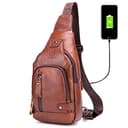
| BULLCAPTAIN sling | Chest or back (vertical sling) | Genuine leather | Not published |
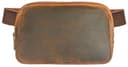
| RUSTIC TOWN belt bag | Waist, with a hidden rear pocket | Full-grain buffalo | Not published |
| Yevabo chest sling | Chest | Not published (contradictory) | Not published |
| ZZNICK waist pack | Waist | Not published (cowhide stated) | Not published |
Two stated grades, one stated finish, five published capacities, and zero named zippers, thicknesses, tannages or countries. If you want the full-size shoulder crossbody, the picks on our crossbody roundup start above this cap, and bags under $100 is the next band up if you can stretch.
How to buy one, in order
Decide where it goes on your body first. Waist, chest, or across the back. This is the only decision you cannot reverse after it arrives, and two of these five do more than one so they are the safer buy if you are unsure.
Then start from the biggest thing you need to carry.A 6.7-inch phone in a case, a passport, a water bottle — whichever is largest. These bags have almost no spare volume to absorb a mistake, so buy from the object rather than from the look.
Then check the strap against your own chest or waist measurement, with a coat on. None of these five publishes a strap range, which means you should treat the quoted carry style as the only one it will do comfortably.
Then expect the anchors to stretch and the zip to be the risk.Hide fibers under sustained tension lengthen and do not return — does leather stretchexplains why the bag will ride lower in a year than it does new. That is normal. The zip is the thing that ends these bags, and no listing here names its maker, so judge it on the photographs. Keep the strap and the panel conditioned lightly — how to condition leather covers how little to use, and much less on a waxed crazy-horse surface than on a plain one.
One closing note on method. We do not own any of these bags and we have not tested them. Every specification above is read from a live listing on the date shown on each card, every price renders from the live price layer rather than a figure typed into this page, and the $50 cap is enforced at request time against those live prices rather than trusted. The full rules are on our methodology page.