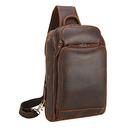
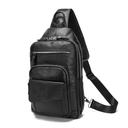
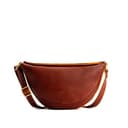
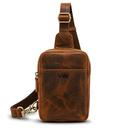
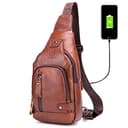
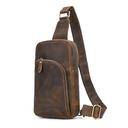
Sling, crossbody or belt bag? Get the format right first
These three words are used interchangeably in listings and they are three different objects. A sling (also sold as a chest bag or a one-strap daypack) is tall and narrow, worn diagonally across the chest or rotated onto the back, with a single wide strap and no second strap at all. A crossbody bag is a shoulder bag on a long strap: wider than tall, worn at the hip, designed to be swung forward and opened at waist height. A belt bag straps around the waist and carries far less.
The practical difference is where the weight goes. A sling’s load rides high and close to the spine, which is why people choose it for bikes, transit and airports. A crossbody’s load hangs at the hip and swings when you move. If you are not sure which you want, our comparison of crossbody against shoulder bag covers the neighboring decision, and types of leather bags maps every format on the site.
The three specs we ranked on, and why
1. Published empty weight.This is the single most under-published number in the category and the most important one on a sling. The range here is genuinely large: 0.8 lb for the Handmade World against 2.4 lb for the Polare, which is three times the weight before anything goes in. Leather is heavy for its strength compared with nylon — leather vs. nylonsets out that trade honestly — and on a one-strap bag you feel every ounce of it on one side of your body. Four of the six publish a weight.
2. Stated strap range.A sling is only comfortable in a narrow band of strap lengths, and that band depends on your chest, not on the bag. Two listings publish a range (35 to 49 inches on the Polare, 35 to 50 on the LANNSYNE), which is enough to tell a 44-inch chest whether the bag will sit high enough. The other four say “adjustable,” which tells you nothing. If you want the bag on your back rather than your chest, you need the top of that range.
3. A stated size limit.The most common disappointment with a sling is not failure, it is the bag arriving and not closing over what you assumed would fit. Three listings here state a limit outright — a 13.3 to 14.1 inch laptop, a 12.9 inch tablet, a 6.9 inch phone “and not bulky items” — and we rank a stated limit above an unstated one even when the stated limit is small. The Handmade World listing saying in its own bullet that the bag is “not designed for bulky items” is the most useful sentence any of these six writes.
Where a leather sling actually fails
Three places, in this order, and none of them is the leather panel in the middle of the bag.
The strap anchors come first.Two small areas of leather carry the entire load whenever the bag is on, and hide fibers under sustained tension lengthen and do not return — the mechanism is in does leather stretch. On a sling that shows up as the anchor tabs gradually elongating and the bag riding lower than it did when new. It is slow, it is normal, and it is the reason a thicker, denser full-grain panel at the anchor is worth more here than anywhere else on a bag.
The zipper comes second,and it is the part most likely to end the bag’s useful life outright, because a failed zip on a sling cannot be worked around — the main compartment is the bag. Exactly two of these six name the zipper brand (both say YKK). The rest say “metal zippers,” and a metal zipper is a material, not a quality claim.
The strap-adjustment hardware comes third. A slider or buckle under constant load works loose. Two of the listings here state metal buckles explicitly; where a listing says nothing, assume plastic until the photographs prove otherwise.
The honest grade problem on this page
Five of these six listings use the words “full grain” somewhere. Only four of the five survive being read carefully, and the two failures are instructive in different ways.
The Yevabo’s first bullet describes the material as “high-grade full-grain top-grain cowhide.”Full-grain and top-grain are two different layers of the same hide — top-grain is what you get when the outer surface of a full-grain hide is sanded off and refinished — and a panel is cut from one or the other. A phrase naming both at once has told you nothing at all, which is why we leave the grade field empty on that pick rather than take the flattering half. Our explainer on full-grain vs. top-grain leather is the twenty minutes that makes a sentence like that readable.
The LANNSYNE’s problem is a warranty rather than a grade.Its title advertises a two-year warranty and its fifth bullet states “One Year Warranty.” Same listing, two terms. We record neither, for the same reason: a contradiction is not a disclosure. The hide claim on that listing is also worth unpacking, because it stacks three different things into one phrase — “Italian waxed full grain cowhide” is a hide-origin claim, a finish and a layer, and only the last of the three is a grade. “Nappa,” which appears in the same title, is a softness-and-finish descriptor too; what nappa leather is covers why.
The BULLCAPTAIN takes the opposite and more honest route: it says “genuine leather,” which is the bottom rung of the grade ladder, and does not dress it up. That is a two-or-three-year bag rather than a keeper, and the listing is not pretending otherwise. Read full-grain vs. genuine leatherif that distinction is new — it is the single most useful thing to understand before buying any leather bag.
The six, side by side
Every cell is read from the listing or marked “Not published.” Read the weight column against the capacity column: on a one-strap bag, that ratio is the comfort spec.
| Sling | Stated grade | Empty weight | Stated limit |
|---|
| Polare sling daypack | Full-grain | 2.4 lb | 13.3-14.1 in laptop |
| LANNSYNE sling | Full-grain | 2.1 lb | 12.9 in tablet |
| Portland Koala sling | Full-grain | Not published | Not published |
| Handmade World EDC sling | Full-grain | 0.8 lb | 6.9 in phone, no bulky items |
| BULLCAPTAIN sling | Genuine leather | Not published | Not published |
| Yevabo chest sling | Not published (contradictory) | 1.1 lb | Not published |
Three rows are empty for all six: hide thickness, country of manufacture and any statement about the lining. Thickness is the one we most wish was published — on a strap anchor, ounces of hide predict how long the tab holds its shape far better than the grade name does, which is the argument of leather weight and thickness.
How to buy one, in order
Decide the biggest thing that goes in it, then buy one size up from nothing. A sling is a format with almost no slack: the difference between the Handmade World at 7.5 inches tall and the Polare at 16 inches is the difference between a phone-and-passport bag and a bag that takes a laptop, and neither does the other job. Start from the largest object, not from the look.
Then check the strap against your own chest measurement, and add for a coat. A 35-inch minimum is short enough for most people to wear high on the chest; a 49 or 50-inch maximum is what you need to rotate the bag onto your back over a winter jacket. If the listing will not state the range, treat the bag as a chest-only bag.
Then weigh the grade against the price honestly.Stated full-grain on a small panelled bag at this money is a believable claim — a sling needs far less hide area than a tote, which is why stated full-grain is common here and nearly absent on larger bags under $100, as best leather bags under $100 sets out. And then condition it: a strap that rubs against a coat all day is the fastest place on any bag to dry out, so how to condition leather is the maintenance that actually extends the life of one of these.
One closing note on method. We do not own any of these bags and we have not tested them. Every specification above is read from a live listing on the date shown on each card, every price renders from the live price layer rather than a figure typed into this page, and no grade, thickness, warranty or country is asserted that a listing does not state. The full rules are on our methodology page.
For the same body-worn formats filtered to a cap, our best leather crossbody bags under $50 page checks five picks against the live price layer and is honest about what hide area allows at that money.