How Long Does a Leather Belt Last?
Long enough that the honest answer is a sequence rather than a number. A belt fails at the hole first, the fold second, the edge third and the buckle last - and only two of those four are worth repairing.
How this is funded: we earn a commission if you buy through our links, at no extra cost to you. It never changes which product we recommend, and we’ll tell you when we’d skip one. Full disclosure.
People want a number, and every number you find online is invented. A belt worn twice a week by someone whose waist sits on the middle hole is a different object from the same belt worn daily on its last hole with a holster hanging off it. So instead of a figure, here is something more useful and entirely checkable: the order in which belts fail, what causes each stage, and which stages you can do something about.
Get this sequence into your head and you can look at any belt — including the one you are wearing — and say where it is in its life.
The failure order
| Stage | What you see | Cause | Repairable? |
|---|---|---|---|
| 1. The hole | One hole stretched into an oval or a slot | Constant tension through a single point of leather | Only by shortening the strap |
| 2. The fold | A permanent crease at the buckle; creasing, or fine cracks and flaking | Daily flexing through a tight radius | No - but the look differs by grade |
| 3. The edge | Edge paint chipping, or raw edges fuzzing | Abrasion against belt loops | Partly - edges can be re-dressed |
| 4. The buckle | Loose prong, worn plating, slipping ratchet | Mechanical wear on the only moving part | Yes on snaps; rarely on a ratchet |
Stage 1: the hole you always use
This is where almost every belt dies first, and it is the stage people least expect, because the leather elsewhere still looks new. A belt holds its load through one hole at a time. The leather around that hole is in permanent tension, and leather under sustained tension creeps — it deforms slowly and does not come back. A round hole becomes an oval, the oval becomes a slot, and eventually the slot tears through to the edge.
Two things change the timeline and both are yours to control. The first is sizing: if you are using the first or last hole, the strap is being pulled at an angle as well as in tension, and that accelerates everything. Measure through the loops of the trousers you actually wear rather than using your jean size — the method is in how to measure belt size. The second is thickness: a thicker strap has more fibre around the hole to resist the deformation. Almost no belt listing publishes an ounce weight, so where you find one, note it; our leather weight guide explains what the figures mean.
The repair is real but limited: shorten the strap so the buckle sits on a fresh section, and punch a new hole set. On a snap-fastened buckle that is a twenty-minute job at home — see how to shorten a leather belt. On a stitched buckle it is a cobbler’s job and often not worth it.
Stage 2: the fold, and the grade tell
The fold is the short section that turns back through the buckle. It is flexed through a tight radius every time the belt goes on, and it is the clearest diagnostic on the whole belt — because full-grain and split hides fail there in visibly different ways.
A full-grain strap creases and darkens at the fold. The grain surface is intact and the fibres beneath it are the densest in the hide, so what you get is a burnished line that deepens into a patina. Many people consider it the best-looking part of an old belt.
A split hide finished with a coating does something else. The coating is less flexible than the fibre underneath it, so repeated flexing crazes it into fine cracks, and those cracks lift into flakes. It usually happens suddenly, after a year or two of looking perfect, and it cannot be repaired — fixing peeling leather is honest about the ceiling there. This single failure is the best everyday argument for the grade; full-grain vs. genuine leather belt works through the cost over a decade.
Stage 3: the edge
Belt edges take constant abrasion against trouser loops, and they are finished in one of two ways. A painted or coated edge chips, leaving a ragged two-tone line. A burnished or raw edge fuzzes instead, which is less unsightly and in some styles looks deliberate. Neither is a structural problem and both are partly fixable: a fuzzed edge can be rubbed down and re-burnished, and a chipped painted edge can be touched in, though matching it is difficult.
One construction detail matters more than the finish here. A strap made from one solid piece of leather has one edge per side. A strap made from two or more plies glued together has a glue line that opens up as the edge wears, and once it starts delaminating the belt is finished. “One piece” or “single piece” in a listing is therefore a longevity claim, and it is worth as much as the grade claim next to it — how to choose a leather belt treats it as one of the seven checks.
Stage 4: the buckle
Buckles outlive straps on traditional belts, which is why the good ones are attached with snaps: when the strap finally goes, you keep the buckle. A worn pin buckle usually means loose plating or a prong that has worn thin, and a replacement is cheap. Our buckle types explainer covers which styles are swappable.
Ratchet belts invert this. The track has no holes to stretch, so stage one effectively disappears — a genuine longevity advantage. But the buckle is a proprietary clamp, and when it wears you cannot fit a generic part, so the belt becomes the disposable half of the pair. Before you assume a ratchet has failed, clean the teeth on the underside of the strap: packed lint is the usual cause of a slipping track. The format is compared properly in our ratchet belt roundup.
What published specs predict longevity
Four, and you will rarely see more than two on one listing: a stated grade, a stated thickness in ounces, a statement that the strap is one solid piece, and a published warranty term. A listing with all four is describing a belt built to last and inviting you to check.
Belts whose listings make a longevity claim
Three picks at three price levels, chosen for what each one publishes about the four specs above rather than for how they look.
- The published-warranty case
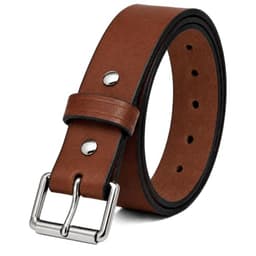
Hanks Gunner Full-Grain Gun Belt (1.5")
Leather grade: Full-grain
States full-grain, a 1.5 inch width, US manufacture, a stainless buckle and a 100-year warranty. A warranty that long is a claim about the strap rather than the marketing, and it is the strongest published longevity commitment on this site. Thickness in ounces is still not published.
$89.00 · View on AmazonPrice as of October 20, 2026. #ad How we’re funded
- One solid piece, mid-price
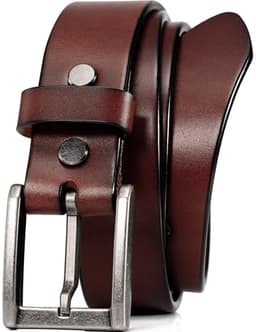
WOLFANT Italian Solid Full-Grain Leather Belt (1.5")
Leather grade: Full-grain
States full-grain Italian leather in a single solid strap rather than glued plies - which is the spec that prevents stage-three delamination, and the one most mid-price belts quietly omit. Stiff at first, which is what a dense strap feels like before it breaks in.
$39.98 · View on AmazonPrice as of October 20, 2026. #ad How we’re funded
- Skips stage one entirely
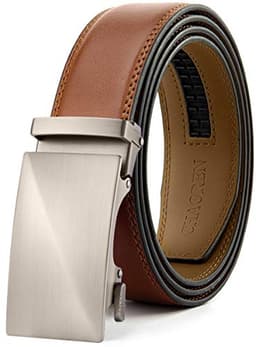
CHAOREN Full-Grain Leather Ratchet Belt (35mm)
Leather grade: Full-grain
The only stated-full-grain ratchet belt we cover. No punched holes means the first failure stage on this page simply does not apply, and the strap is trimmed to your exact length so you are never on the last hole. The trade is a buckle you cannot replace with a generic part.
$14.99 · View on AmazonPrice as of October 20, 2026. #ad How we’re funded
The four habits that actually extend a belt
- Buy the right size. The highest-impact thing on this list, because it decides how hard stage one works.
- Rotate two belts. Leather under constant tension creeps; leather given a day off recovers some of it. Two belts worn alternately last considerably more than twice as long as one worn daily.
- Hang it, do not coil it. A tightly coiled strap sets a curve, and on a thin dress belt that curve shows under a jacket.
- Condition occasionally, not often. Conservation guidance on leather is consistent that over-dressing does harm, and on a belt the specific harm is limpness and faster stretch. Our frequency guide has the intervals.
Bottom line
A belt does not wear out evenly; it fails at four specific points in a predictable order, and the grade mostly changes how stage two looks rather than whether stages one to four happen. The two things you control are sizing and rotation, and together they matter more than any product you can apply. If you want the longest life available from a published spec sheet, look for a stated full-grain hide, one solid piece, an ounce weight, and a buckle on snaps so the hardware outlives the strap — and if you want stage one to not happen at all, buy a ratchet and accept the buckle as the part you cannot replace.
How we know this. Veg Tan Club is written by an enthusiast, not a master leatherworker or a test lab. We compile each product’s published specs — grade, tannage, hardware — and reason from there. We say plainly when a listing doesn’t state a grade, and we haven’t physically handled every item we compare.
Frequently asked questions
How long does a leather belt last?
We will not quote you a figure, because the honest answer depends on three things nobody averages well: the grade of the strap, whether it is one solid piece or glued plies, and how far your waist sits from the middle hole. What is predictable is the order of failure - the hole you always use goes first, then the fold at the buckle, then the edge finish, then the buckle itself. A belt that states full-grain and one-piece construction is being described in the terms that delay all four.
Why does my belt crack where it folds?
Because that is the only part of a belt that is flexed through a tight radius every single day. On a genuinely full-grain strap the fold darkens and creases - that is a patina. On a split hide with a finish sprayed over it, the coating develops fine cracks and then flakes, which looks like the leather failing but is really the finish failing. The difference in appearance is one of the clearest everyday demonstrations of what a grade actually buys.
Can a stretched belt hole be repaired?
Not properly. Once a hole has elongated into a slot the leather around it has been permanently deformed, and nothing puts fibre back. What you can do is shorten the strap so a fresh section of leather takes the buckle, which is a real repair if the belt is on snaps - punch a new hole set or cut from the tail end. On a stitched-loop buckle that is a job for a cobbler.
Does a thicker belt last longer?
Generally yes, which is why thickness in ounces is the most useful number a belt listing can print. A thicker strap has more material to lose before a hole deforms or a fold creases through. Almost nothing publishes the figure - across the belts we cover, a handful state an ounce weight and the rest state nothing - so where it is published, treat it as a signal that somebody measured.
Is a full-grain belt worth the extra money?
On a belt, more than on most items. A belt is the leather good held under constant tension and flexed in one place daily, so the structural difference between a hide's strongest outer layer and a split taken from beneath it shows up fastest here. The belts that fail in a year are almost always bonded or split-hide straps, not full-grain ones.
How can you make a leather belt last longer?
Four habits, in order of impact. Buy the right size so you are not using the first or last hole. Rotate two belts rather than wearing one every day, which lets the fibres recover. Hang it instead of coiling it tight. And condition it occasionally rather than often - over-oiling a strap makes it limp and stretch faster, which is the opposite of what you wanted.
Sources
- Wikipedia — Leather — Overview of leather, grain layers and the full-grain / top-grain / split hierarchy (accessed July 18, 2026)
- 16 CFR Part 24 — FTC Guides for Select Leather and Imitation Leather Products — The FTC guides on leather labeling: unqualified 'leather' claims, imitation-leather disclosure, backing material and misuse of trade names (accessed August 19, 2026)
- American Bench Craft — Leather terminology: Bridle leather — Bridle leather: developed for horse tack; full-grain vegetable-tanned leather finished by waxing or hot stuffing; smooth, polished surface that develops a patina (accessed September 18, 2026)
- Canadian Conservation Institute — Caring for leather, skin and fur — CCI preventive-conservation guidance on cleaning, dressing and storing leather (accessed July 18, 2026)
- Wikipedia — Patina — Patina as the surface change materials develop with age, handling and exposure (accessed July 18, 2026)
Keep reading
How long does a leather bag last?
Stitching, lining, zipper, strap anchor, edge - the bag version of the same failure sequence.
Read the guideHow to care for a leather belt
The routine that delays every failure on this page, and the amounts that matter.
Read the how-toHow to shorten a leather belt
The one real repair for a stretched hole - move the buckle onto a fresh section of strap.
Read the how-toBest full-grain leather belts
The belts whose listings state the grade that changes the timeline on this page.
See the picksHow to measure belt size
Sizing is the highest-impact thing you control, because the hole you use is the first thing to fail.
Get the size rightLeather weight and thickness
What those ounce figures mean, and why a thicker strap simply has more to lose.
Read the guideFull-grain vs. genuine leather belt
The same comparison applied to belts specifically, including what each one costs over a decade.
Compare the grades