Why a cheap belt can still be full-grain
Hide is sold by area, and the area a belt needs is a strip — long, narrow, and cut from the back and butt of the hide where the fiber is densest and most uniform. That strip is the part of a hide least likely to carry the scars and brands that force a tannery to correct and emboss a surface, which is exactly why the cheapest stated-full-grain leather good you can buy is usually a belt. It is also why grade matters more here than people assume: a belt is loaded in pure tension every time it is worn, and a corrected split stretches and takes a permanent set where a full-grain strap does not. The vocabulary is in full-grain vs. genuine leather, and the belt-specific version in full-grain vs. genuine leather belt.
The flip side: the hide is the cheapest thing in a $20 belt to get right, and the buckle is the cheapest thing to get wrong. A pin buckle has no moving parts and effectively cannot fail. A ratchet buckle, a rotating reversible hinge and a roller all do have moving parts, and none of these listings names the metal or the plating in a way you could check. That trade — grade for mechanism — is the real decision on this page.
The six, side by side
Every cell is read from the listing or marked “Not published.” The current price for each belt is on its Check price button in the table above.
| | VATAN | CHAOREN ratchet | F&L Classic | Buffway | Timberland | CHAOREN reversible |
|---|
| Grade as stated | Full-grain | Full-grain | Full-grain cowhide | Full-grain | Genuine leather | Not published (“premium genuine leather”) |
|---|
| Strap construction | Handmade, single strap | Trim-to-fit strap | Woven strips | Solid one piece | Single strap | Two-faced, trim to fit |
|---|
| Width published | Not published | 35 mm | 1.5 in | 1.5 in | 35 mm | 1.25 in |
|---|
| How it adjusts | Fixed holes | Ratchet, ~5 mm steps | Prong through the weave, anywhere | Fixed length, ordered to size | Fixed holes | Rotating buckle, adjustable range |
|---|
| Buckle metal named | Not published | Not published | Not published | Not published | Not published | Not published |
|---|
| Thickness in oz | Not published | Not published | Not published | Not published | Not published | Not published |
|---|
| Warranty stated | Not published | Not published | Not published | Not published | Not published | Not published |
|---|
| Sizing method published | Not published | Trim to fit | Order one size up from pants | Listed at 54 in | Many sizes stocked | Adjustable waist ranges |
|---|
Three rows are empty for all six belts, and they are the same three rows every time: buckle metal, thickness in ounces and warranty. Thickness is the omission that matters most, because weight in ounces is the one number that predicts whether a belt stays flat under a loaded waistband or rolls over. Our leather weight and thickness guide explains how to read it, and the belts that do publish it are mostly work and carry belts several times this price — see best leather work belts and best gun belts.
Width, by contrast, is published by five of six, and it is the spec that quietly decides whether the belt is wearable with what you own. 1.25 in is dress, 1.5 in / 35 mm is jeans and chinos, and a 1.5-inch strap will not thread most suit-trouser loops. The full breakdown is in our leather belt width guide.
The four ways these belts adjust, and who each suits
Fixed holes(VATAN, Timberland) are the simplest and the most durable: nothing to wear out, and the hole you use burnishes into the belt as part of its character. The cost is resolution — holes are an inch apart, so you get whichever of two fits is less bad, and the hole you favor stretches first.
A ratchet track(CHAOREN ratchet) replaces holes with a toothed strip under the strap, adjusting in roughly 5 mm steps. It is genuinely the best fit on this page and the reason is mundane: waists change across a day, a season and a layer of clothing. The trade is a mechanism that can eventually wear where a pin buckle cannot, and a look that reads casual rather than formal. The comparison in full is ratchet vs. traditional belt.
A prong through a weave(F&L Classic) gives infinite adjustment with no mechanism at all — the pin simply goes between the strips wherever you want it. It is the most elegant solution here. The weave is also the failure point: a braided strap is strips rather than one solid piece, so it relaxes over time in a way a single strap does not. More on the format in best braided leather belts.
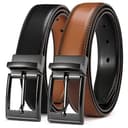
A rotating reversible buckle (CHAOREN reversible) buys you two belts in one, and we are deliberately blunt about what that costs: a hide has only one grain side, so a strap worn either face out cannot be full-grain on both. This is the one belt on the page that states no grade, and that is structural rather than careless. The argument is laid out on best reversible leather belts.
Fixed length, ordered to size(Buffway) is the big-and-tall answer. Above about 50 inches a strap is the easiest place in the whole product to hide a splice, so “solid one piece” is the phrase worth paying for — and it is the only belt here that states both that and its grade. Our big-and-tall belt picks cover the length range properly.
Get the size right before you get the belt right
More cheap belts are returned for size than for quality. Belt size is not trouser size: it is normally your pant waist plus one to two inches, and the reliable way to find it is to measure a belt you already wear from the buckle fold to the hole you use. The step-by-step is in how to measure belt size. Two of the picks here side-step the question entirely — the ratchet and reversible straps trim to fit — which is why they are the safer choice when you are buying for someone else.
Expect a new belt in this band to feel stiff and to crease hard across the first few wears; that is the strap taking a set, not a defect. Do not oil it to soften it faster, and do not store it rolled tight. The routine is in how to break in a leather belt and how to care for a leather belt.
Which one for you
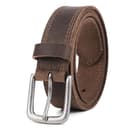
If you want the best hide for the money: VATAN. Stated full-grain, handmade, traditional pin buckle, nothing spent on a mechanism. Fixed holes mean no micro-adjust, and the hardware finish is basic.
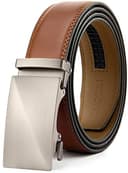
If your waist is not a constant:CHAOREN ratchet. Stated full-grain, roughly 5 mm adjustment steps, trim-to-fit strap, 35 mm casual width. The buckle is a mechanism and will eventually wear.
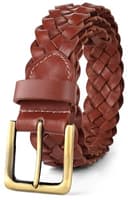
If you want adjustment without a mechanism:F&L Classic braided. States full-grain cowhide across three bullets, 1.5 in wide, and the prong locks anywhere in the weave. No warranty stated, and the distressed woven look will not pass as a dress belt.
If you need 50 inches or more: Buffway. The only belt here that states full-grain andsolid one-piece construction at a big-and-tall length, 1.5 in wide. Sold as fixed lengths, so order carefully, and the thickness is not published.
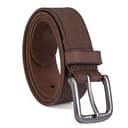
If you want a name on it:Timberland. Genuine leather, 35 mm classic jean-belt width, widely stocked and easy to return. The grade is the lowest rung that still means leather, and there is no micro-adjust.
If the price is the point:CHAOREN reversible. Two colors, a trim-to-fit strap, a published 1.25 in width and the only listing here that addresses the edge — the seam where a two-faced strap actually fails. It states no grade, and its “anti-crack technology” names no coating, backing or process, so we publish it as nothing. Our rules for all of this are on the methodology page.