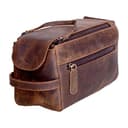
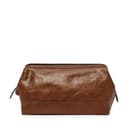
How we chose
The criteria came first and the products second. A kit had to clear all four of these before it could be considered. After that, the ranking came down to how much of its own construction the listing was prepared to put in writing.
- A stated leather grade, in the listing’s own words. “Full grain”, “top grain” or “genuine leather” — an actual grade word, not “premium leather”, not “real leather”, not a photograph of a tan hide. Five of the six picks state full-grain. The sixth states genuine leather, and it is on the page precisely because of what that costs you.
- A published lining. A dopp kit without a stated water-resistant or waterproof lining is a leather bag you are going to pour conditioner into. Every pick here states one. It is the single spec most often missing from listings we rejected.
- Published dimensions. “Large” and “spacious” are not sizes. Every pick publishes numbers, which is what lets you check a kit against the corner of the suitcase it has to live in. Where a listing publishes two different sets of numbers — one of ours does — we print both.
- Currently purchasable. Every kit here returned a live, in-stock listing on the day we built the page. A roundup of dead links is worse than no roundup.
After that the ordering is about disclosure depth. A listing that names its zipper brand outranks one that says “durable hardware”; a listing that states a grade and a tannage anda country outranks one that states only the grade. That is not a proxy for how a kit feels in the hand — we cannot know that without carrying it — but it is a good proxy for how much a maker is prepared to be held to, and in a category with no independent testing that is the most honest signal available.
Why the lining decides this category
Leather and standing water are a bad long-term pairing. Conservation guidance is consistent on the point: leather is a hygroscopic material, it absorbs and releases moisture with its surroundings, and repeated wetting and drying is what stiffens, distorts and eventually cracks it. A bathroom is the most humid room a bag will ever be asked to sit in, and a toiletry kit spends its life being opened in one.
That is why the lining is not a nice-to-have in this category. A lined kit keeps splashes, aerosol overspray and the occasional catastrophic shampoo failure on a surface you can wipe, rather than letting it soak into the flesh side of the hide where you cannot reach it. Every pick above states a lining. What differs is the wording, and the wording is worth reading closely:
- “Water-resistant” means splashes and condensation. It does not mean a bottle can empty itself in there and you will shrug.
- “Waterproof” at the budget end usually describes the lining fabric, not the seams or the zipper line. The lining may hold water; the stitch holes will pass it.
- A padded lining — which one pick here states — is doing a second job: it keeps a soft-sided kit in shape when it is half empty, so it does not collapse into a leather bag of loose objects.
The practical rule is the one the conservation people would give you: nothing wet goes back in. Let the razor dry. If the kit does take a real soaking, our guide on drying a wet leather bag applies exactly — slowly, at room temperature, never on a radiator and never with a hairdryer.
Your dopp kit is not your quart bag
This trips up more first-time buyers than any spec on this page. Two listings we read while building it describe themselves as “TSA approved” or “TSA-approved carry-on size”. TSA does not approve, certify or endorse toiletry bags. There is no such program, and a leather kit cannot be compliant with the liquids rule in the way those listings imply.
What the rule actually says is narrow and easy to check. TSA allows one quart-sized bag of liquids, aerosols, gels, creams and pastes per carry-on, in containers of 3.4 ounces (100 ml) or less, and it asks you to separate that bag from your carry-on at the checkpoint. A leather dopp kit is opaque, is not quart-sized, and does not come apart for the X-ray bin. It cannot do that job.
The way a leather kit actually earns its place in a carry-on is as the container for everything that is nota liquid — razor, brush, comb, clippers, medication in solid form, the charging cable you keep losing — plus the clear quart bag itself, tucked inside and pulled out at security. Buy for that job and the size question answers itself. Buy a leather kit expecting it to replace the clear bag and you will be repacking it in the line.
Size: the question to settle before the grade
The full-size picks above span 9.5 inches to 12.6 inches of stated length, which sounds like a small range and is not. It is the difference between a kit that slots down the side of a packed carry-on and one that has to go in a checked bag. Three rough sizes cover almost everybody:
- Around 9–10 inches. A travel-size kit. Razor, toothbrush, deodorant, the quart bag, done. It fits in a weekender without reorganizing the whole bag. This is the size most people should buy, and the size most people talk themselves out of.
- Around 10–11 inches with two compartments. The default. Enough room to keep wet things away from dry ones, still small enough to pack. Every dual-compartment pick here sits in this band.
- 12 inches and up. A checked-bag kit. Worth it if you travel with full-size bottles, a hair dryer’s worth of accessories or a real grooming routine. Not worth it if you are going to carry air, because a leather kit weighs something before you put anything in it — the heaviest pick here is 1.1 lb empty.
One number nobody prints on the front of the listing: empty weight. Four of our six picks state one in their own copy, and the spread runs from 0.65 lb to 1.1 lb. On a carry-on allowance that is real, and it is the clearest argument for buying the smallest kit that fits your routine rather than the biggest one you can justify. The same logic drives our weekender packing method.
Reading a dopp-kit listing without getting sold
- Read the bullets, not the title. One pick here has “Genuine Leather” in its title and “100% Full Grain Leather” in its first bullet. Two listings we rejected did the reverse: “Full Grain” in the title, “100% genuine buffalo leather” in the bullet underneath. A listing that contradicts itself on grade has told you something useful about how carefully it was written.
- “Genuine leather” is a grade, not a compliment. It sits below full-grain and top-grain, and it usually means a split with a finish sprayed on top. Our full-grain vs. genuine leather comparison covers why that one word predicts how a bag ages.
- Buffalo is a hide, not a grade. Two picks here state full-grain buffalo, which is a real and specific claim — and a large part of why honest full-grain turns up at the budget end at all. Buffalo hide is thicker and more coarsely grained than cowhide and costs less, so a maker can keep the intact top layer and still hit a budget price.
- A named zipper brand is worth more than it looks. The zipper is the first thing that fails on a toiletry bag, because it lives in damp air and gets dragged over toothpaste. Five of the six picks here name YKK or brass; the one that does not, and the many rejected listings that say “durable hardware” and nothing else, are the ones to be careful with.
- “Handcrafted”, “premium” and “luxury” carry no information. None is defined, none is checkable, and all three appear on both the best and the worst listings in this category. “Full-grain” and “vegetable-tanned” are at least specific enough to be wrong, which is exactly what makes them worth reading.
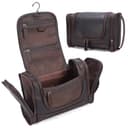
- Check whether a hook is included. Two of these six kits hang; four are counter-top only. In a hotel bathroom with a shelf for a counter, that is the difference between a usable kit and a bag on the floor.
Hanging or counter-top
A hanging kit unzips flat against a door or towel rail and puts everything at eye level. It is the better format for hotels, cruise cabins and any bathroom where the counter is a shelf with a sink on it. The trade-off is packing: a hanging kit is taller and more awkward than a classic dopp shape, and the hook is one more piece of metal to press into whatever it is packed against.
The classic counter-top dopp — the flat-bottomed, zip-across shape the name comes from — packs better, holds its form better and is easier to dig through one-handed. It needs somewhere to sit. If you mostly stay in places where that is a given, buy the classic shape and save the weight.
One warning on hooks: a full toiletry kit is heavier than a hook looks. The listing that names solid brass is making a checkable claim; a listing that says “sturdy metal hook” is not. That is the difference between a kit that hangs on a towel rail for a week and one that ends up in the bath.
Grade, and what it actually buys you here
A dopp kit is small, so the raw material cost is low and the grade premium is unusually cheap to buy. That is the quiet argument of this whole page: the same grade step that moves a large share of the price of a full-size leather bag is close to rounding error on a kit this size. There is very little reason to accept “genuine leather” in this category.
Full-grain keeps the hide’s dense outer surface, so scuffs burnish rather than wearing through and the kit darkens into a patina instead of flaking. A split-based “genuine leather” kit has a finish layer sprayed on a weaker cut of the hide, and in a humid bathroom that finish is exactly what eventually peels. The FTC’s own leather labeling guides exist because those words are marketed loosely; the practical consequence is that reading them carefully is your job, not the retailer’s.
One pick goes a step further and states a vegetable tannage as well as a grade. That is rare anywhere and close to unheard of in this category. It also comes with a genuine trade-off in a bathroom bag: vegetable-tanned leather has a more open fiber structure and marks with water more readily than a pigmented chrome-tanned finish would. It will end up darker, glossier and more marked than it started, which is the point of buying it — but it is not the low-maintenance option.
Keeping one alive
A dopp kit needs less care than a bag that lives outdoors and different care than people assume. Three things cover it. Empty it after a trip rather than leaving damp contents sealed in a warm bag, which is how a leather kit ends up needing our guide on removing mold. Wipe spills out of the lining while they are fresh, because a dried cosmetic spill is a stain problem rather than a cleaning one. And condition the outside occasionally — far less often than the internet suggests, because over-conditioning softens a kit that is supposed to hold its shape.
If you want it to shrug off more than splashes, treating the outside is a reasonable move, with the caveat in our guide to waterproofing a leather bag: every treatment that repels water also darkens the leather, and on vegetable-tanned leather it darkens it permanently.
A note on how we work: we do not handle these products, so nothing above is a durability test. It is a comparison of published specifications and an argument about what those specifications mean, which is what our methodology page sets out. Prices are never stored on this site — they render live from the retailer, or the buy button sends you to the listing to check the current one.