How to Choose a Quality Leather Belt
Seven checks, in the order they matter. Most of them you can run from a listing before the belt ever reaches you; the rest take a moment with the belt in your hands.
How this is funded: we earn a commission if you buy through our links, at no extra cost to you. It never changes which product we recommend, and we’ll tell you when we’d skip one. Full disclosure.
A quality leather belt states full-grain in writing, is cut as one solid strap rather than glued layers, is thick enough to hold its shape at the buckle, has a clean, even edge with no visible layering, and carries a buckle you can replace. Width and size then decide whether it fits you. Those seven checks, in that order, are the whole method. This page runs through each one and points you to the deeper guide where we have one, rather than repeating it.
The seven checks at a glance
| Check | What you want | Red flag |
|---|---|---|
| 1. Grade | Full-grain, stated in the listing’s own words | “Genuine leather,” “real leather” or no grade at all |
| 2. Construction | One solid strap; “solid” or “one-piece” stated | Visible plies, a fabric backing, a splice |
| 3. Thickness | A published ounce or millimeter figure | “Thick” and “heavy-duty” with no number |
| 4. Edge | Clean and even from buckle to tip | A glue line, layering, or a finish already lifting |
| 5. Buckle | A named metal, fastened with screws or snaps | “Premium alloy”; buckle stitched in |
| 6. Width | Matched to your trouser loops | Chosen from a photograph |
| 7. Size | Measured from a belt that already fits | Your jeans size |
1. Grade first, and the “genuine leather” trap
Grade is the check that predicts lifespan, so it comes first. Full-grain is the hide’s intact outer layer, where the fibers are densest and most tightly interwoven. Top-grain is the same layer with the surface sanded and refinished: still a good leather, a little less durable, more uniform to look at. Below those two, the words get slippery on purpose.
“Genuine leather” sounds like a guarantee and is really a grade, and a low one. It usually means a split — the lower layer left once the grain has been taken off — with a finish applied to look like grain. Bonded leather sits further down still: ground fiber and scrap glued to a backing and coated. Neither behaves like full-grain at the fold, which is the one spot on a belt that flexes every single day. Our full-grain vs. genuine leather belt comparison covers why that fold is where the difference shows.
What makes this check work is that nothing requires a seller to name a grade. The FTC’s leather guides govern when a product may be described as leather and when an imitation or a non-leather backing has to be disclosed, but they do not require “full-grain,” “top-grain” or “split” on a label. So read the listing’s own words rather than the photograph, and treat silence as an answer. A maker cutting from full-grain says so, because it is the strongest true thing it can say.
Three other kinds of word look like grades and are not. “Italian leather” is a provenance claim. “Steerhide” and “buffalo” name the animal, not the layer of its hide. And “bridle leather” names a finishing tradition: American Bench Craft describes it as leather developed for horse tack and finished by waxing or hot stuffing. That source defines bridle as full-grain vegetable-tanned leather, but a listing that says “bridle” without also saying “full-grain” has not committed to the layer in writing. Our explainer on what bridle leather is goes further.
Tannage is a separate question from grade, and more a matter of preference than of quality. Vegetable-tanned leather starts firm and darkens with use; chrome-tanned leather starts softer and holds its color more evenly. None of the belt listings we have read for this site states a tannage at all, so on a belt it is rarely something you get to choose on paper.
2. One solid strap, not glued plies
Grade names the layer; construction names how the strap is built, and they are separate claims. The belt you want is cut as one continuous strap. The belt to avoid is several thin layers — splits, leather fiber, sometimes a fabric backing — glued together and wrapped in a finish that looks like a single piece. In a product photo the two look identical. The layered one fails in a specific way: the fold at the buckle works the glue line every time you fasten it, the bond gives, and the belt delaminates and peels from that point outward.
On a listing, look for “solid,” “one-piece” or “single piece” alongside the grade. Those words are rarer than “full-grain,” and on long belts they matter more, because a strap over about 50 inches is where a maker is most tempted to splice shorter pieces together — the reason our big and tall belt picks weight that claim so heavily.
In hand, the edge tells you. Look along the long cut edge of the strap and inside a punched hole, where the full thickness is exposed. A solid strap shows one consistent fibrous cross-section from face to back. A layered strap shows a line through the middle, plies of a different color or texture, or a fabric-like backing. A lined dress belt is a deliberate construction rather than a warning sign — dress belts are often lined so they lie flat — but the face leather should still state a grade.
3. Thickness: how thick should a leather belt be?
Thick enough to hold its shape at the buckle without folding over on itself, and not so thick that it will not bend around you. In the US, leather thickness is sold in ounces, by the common trade convention that one ounce is about 1/64 of an inch, or roughly 0.4mm. Our guide to leather weight and thickness puts belts and straps at roughly 8–10 oz, about 3.2–4mm. Dress belts are usually cut thinner and often lined. Carry belts run heavier still, around 12–16 oz, because a holster needs a strap that resists its leverage; our gun belt picks cover that end of the range.
The problem is that almost nobody publishes the number. Of every belt listing we have read for this site, exactly one prints an ounce figure, and it is a 14 oz holster belt. The rest either say nothing or use words like “thick,” “thickened” or “heavy-duty,” which commit to nothing. So treat a published number as a genuine point in a belt’s favor, and when there is none, fall back on two things. First, the stated grade — thickness is not grade, and a thick split is still a split. Second, how the belt behaves when it arrives: a solid full-grain strap at belt weight is stiff at first and relaxes with wear. Our guide to breaking in a leather belt explains why that early stiffness is a good sign rather than a fault.
4. The edge: the finishing detail that gives the rest away
The long edges of a belt show both how it was built and how carefully it was finished. On a dress belt, the edge is usually cut clean, painted and burnished so it reads as one sealed line. On a casual belt it is often left rawer, sometimes with visible stitching. Either is fine. What you are checking is consistency and honesty.
- Even along the whole length. A good edge looks the same from buckle to tip, with no patches where the finish is thin, no drips of edge paint and no fuzz.
- No lifting or cracking. A finish that is already lifting or cracking on a new belt, at the edge or around a hole, is showing you a coating rather than grain. Grain leather wears and darkens; it does not peel.
- Paint can hide layers. A thick coat of edge paint makes a neat line whatever is underneath, so a painted edge proves finishing care, not construction. Check the inside of a punched hole as well.
This is a check for photographs and shop counters rather than for listing copy. It is also a large part of why dress and casual belts look so different from across a room.
5. The buckle, and whether you can replace it
On a good strap the buckle is usually the first thing to give up, so it deserves more attention than most buyers give it. Two questions settle it.
What type, and how many moving parts? A plain frame with a prong has one pivot and no spring, and is about as close to unbreakable as belt hardware gets. A roller bar adds a turning sleeve so the strap drags less across the frame. A ratchet adjusts in fine steps but is a mechanism that can eventually wear, and a cobbler cannot repair it. Plate and box-frame buckles buy a look at the cost of fussier fittings. Our guide to belt buckle types covers each one, and ratchet vs. traditional settles the most common choice.
How is it attached? Look at the fold. Two screws or snaps mean the buckle can be swapped and the belt can be shortened at home. A stitched fold means neither, short of unpicking and restitching it. A replaceable buckle is what lets a good strap outlive its first set of hardware.
Then read the material. “Solid brass” or “stainless steel” is a fact; “premium alloy” is an adjective. Solid metal dulls and can be polished, while plating wears through at contact points and shows the base metal underneath.
6. Width for the trousers you will wear it with
Width is decided by your belt loops before it is decided by taste. Dress belts run about 1.25 inches (30–35mm) to fit slim suit-trouser loops; casual and jean belts about 1.5 inches (38–40mm); work belts up to about 1.75 inches. A buckle is built for one strap width, so if you are replacing a strap on a buckle you already own, match it exactly. Measure the narrowest loop you need to satisfy, then see our belt width guide for the full table. If the belt is for denim, our roundup of the best leather belts for jeans applies these checks to jean-width straps.
7. Size it from a belt that fits
Belt size is not your pant size. It is the length from the fold at the buckle to the hole you use, which usually works out at your pant waist plus one to two inches. The reliable method is to measure a belt that already fits and buy that number, aiming for the middle hole so you have room either way. Round up between sizes, and add about an inch if you wear tucked shirts or heavy waistbands. The two-minute method is in how to measure your belt size.
Four listings that answer the hard checks in writing
No listing can show you an edge or your size. These four each answer the checks most belt listings leave blank, and each is clear about what it leaves out.
- Grade, construction and width
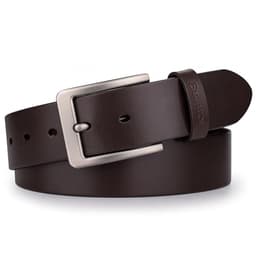
Buffway Full-Grain One-Piece Belt (1.5", 54")
Leather grade: Full-grain
States full-grain, solid one-piece and a 1.5-inch width — checks one, two and six in writing, which very few listings manage. Thickness is not published, and it is sold in fixed lengths: the listing we read is the 54-inch size.
$39.99 · View on AmazonPrice as of September 20, 2026. #ad How we’re funded
- Dressier full-grain
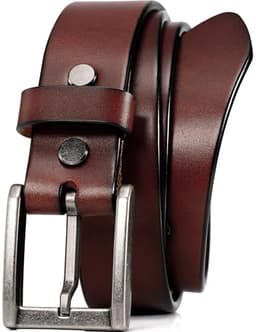
WOLFANT Italian Solid Full-Grain Leather Belt (1.5")
Leather grade: Full-grain
States full-grain Italian leather in a solid single-strap 1.5-inch width, thickened for durability. Italian is the provenance; full-grain is the part that matters. Solid full-grain is stiff at first, and no thickness figure is published.
$39.98 · View on AmazonPrice as of September 20, 2026. #ad How we’re funded
- Removable buckle
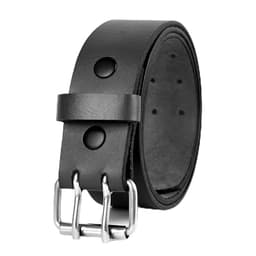
PBF Heavy Duty Full-Grain Work Belt (1.75", 58"-60")
Leather grade: Full-grain
States full-grain with a removable, nickel-free double-prong buckle, so the strap can outlive the hardware. At 1.75 inches it is a jeans-and-work belt, too wide for most dress loops, and the listing covers a 58-60 inch band.
$29.99 · View on AmazonPrice as of September 20, 2026. #ad How we’re funded
- Published thickness
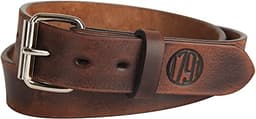
1791 GUNLEATHER Heavy Duty 14 oz Gun Holster Belt
Leather grade: Not published
The only belt listing we have read that prints an ounce figure: 14 oz of American steerhide. It fails check one, because no grade is published, and at that weight it is a stiff holster belt that will not double as a dress belt. Buy it only if a stiffness you can verify matters more than a stated grade.
$68.99 · View on AmazonPrice as of September 20, 2026. #ad How we’re funded
What price does and doesn’t tell you
Less than you would expect. Several of the stated-full-grain belts we track sit in the budget tier, and a familiar brand name is no guarantee of a grade: one well-known name on our men’s belt roundup states only genuine leather. Paying more can buy a better buckle, a warranty or a published spec, but it does not buy a grade the listing will not name. Run the checks first and let price decide between belts that pass them.
Bottom line
Read the listing for full-grain and for a construction word like solid or one-piece, and treat “genuine leather” and silence the same way. Prize a published thickness, because it is rare. Check the edge and the holes for layers, choose a simple buckle held on with screws or snaps, match the width to your loops and size from a belt that already fits. Then look after it: condition the fold a few times a year and rotate belts if you can — our belt care routine has the detail. For a shortlist that already applies the first check, see our full-grain belt picks.
How we know this. Veg Tan Club is written by an enthusiast, not a master leatherworker or a test lab. We compile each product’s published specs — grade, tannage, hardware — and reason from there. We say plainly when a listing doesn’t state a grade, and we haven’t physically handled every item we compare.
Frequently asked questions
How can you tell if a leather belt is good quality?
Start with the listing: it should state full-grain, and ideally say the strap is solid or one-piece. Then look at the belt itself. The cut edge and the inside of a punched hole should show one consistent layer of leather, not plies or a fabric backing, and the edge finish should be even from buckle to tip. Finally, check that the buckle is attached with screws or snaps rather than stitched in.
How thick should a leather belt be?
For an everyday belt, roughly 8 to 10 oz, which is about 3.2 to 4 millimeters by the common trade convention that one ounce is about 1/64 of an inch. Dress belts are usually thinner and often lined; carry belts run heavier, around 12 to 16 oz. Very few listings publish the figure, so a stated number is a genuine point in a belt's favor.
Is genuine leather good for a belt?
It is real leather, but the name describes a lower grade, usually a split with a finish applied to look like grain, and belts built that way often use glued layers. That construction tends to crack and separate at the buckle fold, the most flexed point on any belt. It is a fair choice for occasional wear, not for a belt you want to keep for years.
Does a heavier belt mean better leather?
No. Thickness and grade are separate questions. A thick strap cut from a split or a bonded material is simply a thick low-grade strap, and a full-grain belt of ordinary belt weight will outlast it. Weight is no guide to hardware either: a heavy buckle can be a cheap, brittle casting. Read the stated grade first, then the thickness if the listing publishes one.
What is the most durable type of belt buckle?
A solid one-piece frame buckle with a single prong, because it has one pivot and no spring. A roller bar adds a small moving part that reduces wear on the strap. Ratchet buckles are the most complex, so they are the type with a real wear path, and a cobbler cannot repair them. Whatever the type, screws or snaps at the fold make the buckle replaceable.
Sources
- 16 CFR Part 24 — FTC Guides for Select Leather and Imitation Leather Products — The FTC guides on leather labeling: unqualified 'leather' claims, imitation-leather disclosure, backing material and misuse of trade names (accessed August 19, 2026)
- Wikipedia — Leather — Overview of leather, grain layers and the full-grain / top-grain / split hierarchy (accessed July 18, 2026)
- Wikipedia — Tanning (leather) — The tanning process, vegetable vs. chrome tannage, and why ~90% of leather is chrome-tanned (accessed July 18, 2026)
- American Bench Craft — Leather terminology: Bridle leather — Bridle leather: developed for horse tack; full-grain vegetable-tanned leather finished by waxing or hot stuffing; smooth, polished surface that develops a patina (accessed September 18, 2026)
Keep reading
Best leather belts for jeans
These checks applied to the belt you wear hardest: wide, casual straps compared on grade, construction and buckle.
See the jeans picksFull-grain vs. genuine leather belt
Check one in full: why the grade decides what happens at the buckle fold.
See which lastsLeather weight & thickness, explained
What ounces and millimeters mean on a listing, and the right range for a belt, a wallet or a bag.
Read the guideLeather belt buckle types, explained
Check five in full: how each buckle attaches, and where each one wears out.
See every buckle typeWhat is bridle leather?
A finishing tradition from horse tack that turns up on belts, and why the word is not a grade on its own.
Read the explainerBest full-grain leather belts
Belts whose listings pass the first check in writing, compared on width, buckle and build.
See full-grain picks