How to Care for Vegetable-Tanned Leather
Veg-tan is the most rewarding leather to own and the least forgiving to treat. Almost everything that goes wrong with it comes from doing too much, too fast.
How this is funded: we earn a commission if you buy through our links, at no extra cost to you. It never changes which product we recommend, and we’ll tell you when we’d skip one. Full disclosure.
Vegetable-tanned leather is minimally finished, which means it absorbs everything it touches — water, oil, dye, sunlight. Care for it by doing less: dry-clean rather than wet-clean, treat whole panels rather than spots, condition thinly and rarely, and let it dry slowly. Nearly every ruined veg-tan piece was ruined by an enthusiastic first attempt at fixing something small.
Why veg-tan needs different handling
Most leather goods you meet are chrome-tanned and finished: a pigment or polymer layer sits over the grain, so spills bead, dirt wipes off and the surface is doing the protecting. Vegetable-tanned leather is usually sold with little or none of that. The surface you are touching is the hide itself.
That is precisely why it develops the deep, uneven darkening people buy it for — and precisely why a drop of water leaves a ring, a fingerprint in hand cream leaves a mark, and a dark denim pocket transfers dye into a pale wallet. It is not fragile in the sense of being weak; veg-tan is typically firm and thick. It is fragile in the sense of being honest. It records things.
The two conservation bodies whose leather guidance we lean on — the Canadian Conservation Institute and the U.S. National Park Service — both point the same direction for leather generally: gentle dry cleaning first, minimal intervention, stable moderate humidity, and no aggressive dressings. That advice is more, not less, applicable to unfinished veg-tan.
The routine
- Dry-clean first, always. A soft dry cloth or a soft brush over the whole surface. This is not a token step: grit left on the surface is abrasive, and any conditioner applied over it drives dirt into the grain instead of feeding the leather.
- If you must use moisture, use it everywhere. A barely damp cloth over the entire panel, not a wet cloth on one mark. Water on veg-tan moves tannins around and leaves a tide line where it stops — so the goal is never to have an edge.
- Dry slowly, at room temperature. Away from radiators, hairdryers, sunlit windowsills and car dashboards. Fast drying pulls oils out and leaves veg-tan stiff and brittle at exactly the points it flexes.
- Spot-test every product. Inside a flap, under a strap, on the back of a belt. Wait for it to absorb fully before judging — veg-tan often looks alarming when wet with conditioner and settles considerably as it dries.
- Condition thinly, and treat the whole piece. Product onto the cloth, never poured onto the leather. Even passes over the entire item. A conditioned patch next to an unconditioned one is a permanent two-tone.
- Let it absorb, then buff. A few hours, then a light buff with a clean dry cloth to lift anything sitting on the surface.
What not to do
- No household cleaners, alcohol wipes or detergents. They strip and they stain, and on unfinished leather there is no finish layer to take the hit.
- No neatsfoot oil or heavy oils on a pale piece unless you want it much darker permanently. Oil is not reversible.
- No heat drying, ever. The single most common way a wet veg-tan bag becomes a stiff, cracked veg-tan bag.
- No plastic bags for storage. Trapped moisture is how mold starts. A breathable dust bag, a shelf, and a stable, moderate humidity — conservation guidance for leather generally points at keeping relative humidity well below the mid-60s percent.
- No scrubbing a stain. Rubbing spreads it and burnishes the surface unevenly. Blot, then even the panel out.
Water, oil and dye: the three marks you will get
Water spots are the most common and the most fixable. A ring is a tide line where wetting stopped. The usual approach is not to remove it but to erase the boundary: dampen the whole panel evenly with a barely wet cloth and let it dry naturally. The tone settles more uniformly and the ring stops being a ring.
Oil marks — hand cream, sunscreen, food — are harder, because oil darkens veg-tan the way conditioner does and it does not evaporate. Blot immediately with a dry cloth to lift what has not absorbed. What has absorbed will often blend over weeks as the rest of the piece darkens toward it. Attacking it with solvent almost always makes it worse.
Dye transfer — typically indigo from denim into a pale wallet or bag — is largely permanent. Prevention is the only real answer: keep pale veg-tan away from unwashed dark denim, particularly when either is damp.
Managing the patina rather than the leather
With veg-tan, most of what people call “care” is really about steering the patina. Light and handling darken the hide, so anything that happens unevenly will show unevenly.
Two habits do most of the work. Rotate how the piece sits — a bag stored with the same face to a window will end up two-tone. And use it. A veg-tan wallet carried daily develops a far more attractive, more even tone than one kept in a drawer and brought out occasionally, because the oils from handling reach the whole surface.
What to use on veg-tan
Clean before you condition, then condition with something light. Pale veg-tan is the case where a non-darkening formula genuinely matters — and a spot test still applies.
- Best for pale veg-tan
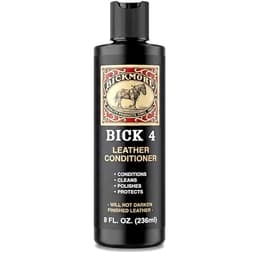
Bickmore Bick 4 Leather Conditioner & Cleaner (8 oz)
Type: Cleaner + conditioner
The listing states a non-darkening formula, which is the reason to reach for it on tan and natural veg-tan where an oil-heavy conditioner would take the color somewhere you cannot undo.
- Gentlest application
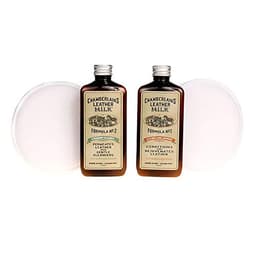
Chamberlain's Leather Milk Conditioner & Cleaner Kit No. 1 (6 oz)
Type: Cleaner + conditioner kit
A two-bottle kit — cleaner first, then the No. 1 conditioner — supplied with reusable terry pads. The pads matter here: even application over a whole panel is what stops veg-tan going patchy.
$36.70 · View on AmazonPrice as of October 20, 2026. #ad How we’re funded
- The step people skip
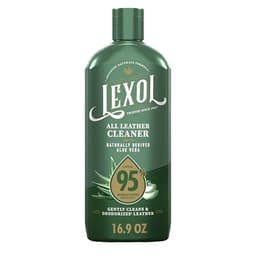
Lexol All Leather Cleaner (with Aloe)
Type: Cleaner
Cleaning first is not optional on veg-tan, because conditioner over trapped grit drives dirt into an absorbent grain. Not for suede or nubuck, and spot-test as with everything else.
$14.99 · View on AmazonPrice as of October 20, 2026. #ad How we’re funded
Bottom line
Veg-tan asks for restraint rather than effort. Dry-clean far more often than you wet-clean, treat whole panels rather than spots, spot-test every product, condition thinly and only when the leather looks dry, and never accelerate drying with heat. Do that and the marks you do collect become the patina you bought it for. For the general routine on finished leather, see how to condition leather; for the timing question, how often to condition.
How we know this. Veg Tan Club is written by an enthusiast, not a master leatherworker or a test lab. We compile each product’s published specs — grade, tannage, hardware — and reason from there. We say plainly when a listing doesn’t state a grade, and we haven’t physically handled every item we compare.
Frequently asked questions
How do you clean vegetable-tanned leather?
Dry first: a soft cloth or brush to lift dust. If that is not enough, wipe the whole panel with a barely damp cloth rather than scrubbing one spot, because localized wetting leaves a ring. Skip household cleaners, alcohol wipes and detergents entirely — veg-tan absorbs, so whatever you put on it stays in it.
What conditioner is best for vegetable-tanned leather?
A light one, applied thinly. Heavy oils darken veg-tan dramatically and permanently, which is fine if you want that and a disaster if you don't. A conditioner marketed as non-darkening is the safer starting point on pale veg-tan, and a spot test on a hidden area is not optional.
Why does my vegetable-tanned leather have water spots?
Because it is minimally finished, so water penetrates and carries tannins with it, leaving a tide line as it dries. The usual fix is to even the tone out rather than remove the mark: lightly dampen the whole panel with a barely wet cloth and let it dry naturally and evenly.
Does vegetable-tanned leather need to be conditioned often?
Less often than people think. Handling transfers oils from your skin, and over-conditioning makes veg-tan limp and permanently darker. Condition when the leather starts to look dry or feel papery rather than on a schedule — see our guide on how often to condition leather.
Can vegetable-tanned leather get wet?
It can, and it will survive, but it will show it. Expect spotting and some stiffening as it dries. Blot rather than rub, let it dry slowly at room temperature away from any heat source, and condition lightly once it is fully dry to restore flexibility.
How do I get an even patina on veg-tan?
Use it evenly and expose it evenly. Patina comes from light, handling and oils, so a bag that always sits with the same face to the window will darken unevenly. Rotating how you store and carry it does more for an even tone than any product.
Sources
- Canadian Conservation Institute — Caring for leather, skin and fur — CCI preventive-conservation guidance on cleaning, dressing and storing leather (accessed July 18, 2026)
- U.S. National Park Service — Curatorial Care of Objects Made From Leather and Skin — NPS museum-handbook guidance on cleaning, handling and storing leather; humidity below ~65% (accessed July 18, 2026)
- Wikipedia — Tanning (leather) — The tanning process, vegetable vs. chrome tannage, and why ~90% of leather is chrome-tanned (accessed July 18, 2026)
- Consorzio Vera Pelle Italiana Conciata al Vegetale — The Tuscan consortium of vegetable tanneries and its guarantee trademark for Italian vegetable-tanned leather (accessed August 19, 2026)
Keep reading
What is vegetable-tanned leather?
The tannage this site is named after — why it firms up, darkens and behaves unlike chrome-tanned leather.
Read the explainerHow to condition leather
The general routine, for the finished chrome-tanned leather most bags are made from.
Read the routineHow often should you condition leather?
The schedule question, and why over-conditioning does more harm than neglect on veg-tan.
See the guidanceLeather patina: what it is and how it forms
The change all this care is protecting — what causes it and how to keep it even.
Read the explainerBest vegetable-tanned leather wallets
Where this routine gets used most — wallets whose listings actually state a vegetable tannage.
See the picks