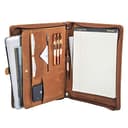
How we chose, in the order the criteria decide it
A padfolio is a simple object — two leather panels, some pockets and a pad clip — so the published facts carry almost all of the signal. These are the four we rank on, in the order they settle the purchase.
- It has to be a hide, stated as a hide. This is the gate, not a criterion. The portfolio aisle is thick with PU and bonded panels marketed with the word leather in the title, and a bonded panel on a document folio fails in a specific, visible way: the coating cracks along the spine fold first, exactly where a client’s eye lands when you open it. If the phrase is new to you, start with what bonded leather is and what PU leather is. Five listings here clear the gate.
- Then the stated grade. Two of the five state full-grain, one states top-grain, one states only “genuine leather” — the vaguest grade word in the trade — and one states both “genuine” and “full-grain” in different places, which is why it has no grade in our table at all. The hierarchy behind those words is in full-grain vs. top-grain leather.
- Then depth, because this is a thing you carry inside something else. A portfolio is almost never the only bag. It goes into a briefcase, a tote or a backpack, and a published depth of 0.8 inch versus 1.2 inches is the difference between fitting a slim bag’s document sleeve and not. Four of the five publish a depth. We rank the thinner one higher when the grade is equal.
- Then the closure, which is a real decision and not a detail. An open folio is slimmer and faster; a zip-around is secure and heavier; a button strap sits between them. What you are choosing is what happens when the thing tips over in a bag, and that depends entirely on whether you carry loose paper in it.
The five, side by side
Every cell is read from the listing or marked “Not published.” The grade row is why the order is what it is; the depth row is the one most buyers discover they cared about after the folio arrives.
| | Moonster | KomalC | Leather Village | Wanderings | Gavarnie |
|---|
| Grade as stated | Full-grain | Top-grain | Full-grain | Genuine leather | Contradicts itself |
|---|
| Hide named | Buffalo | Buffalo | Not published | Not published | Cowhide |
|---|
| Tannage stated | Not published | Not published | Not published | Vegetable-tanned | Not published |
|---|
| Closure | Open folio | Button strap | YKK zip-around | Open folio | Dual YKK zip |
|---|
| Published depth | 0.8 in | 1.2 in | 1 in | Not published | 1 in |
|---|
| Laptop fit stated | No | No | Tablet to 13" | No | Laptop to 13.3" |
|---|
| Ring binder | No | No | Yes, removable 4-ring | No | No |
|---|
| Warranty stated | Not published | Not published | Not published | Not published | 1 year replacement |
|---|
Read the first row and the last row together and you get the shape of this category in one glance. The two listings that state full-grain publish no warranty. The one listing that publishes a warranty cannot keep its own grade claim straight across two fields of the same page. That is not a coincidence peculiar to padfolios — it is the standing trade-off in the whole mid-market leather aisle, and we found exactly the same pattern when we ranked wallets with an ID window: a brand sells you recourse, and a specification-led seller sells you a specification.
The Gavarnie problem, and why its grade cell is empty
One pick here needs explaining, because the explanation is the most useful thing on the page. The Gavarnie listing’s title says “Genuine Leather.” Its first bullet says the portfolio is “handmade with superior full-grain cowhide leather finish.” Those are not two ways of saying one thing. In the trade, genuine leather is the grade belowtop-grain — the split and corrected layers left after the good hide is taken off the top — and full-grain is the layer above both. A product cannot be both.
We could pick the flattering claim, print “full-grain,” and the page would look better. We do the opposite: the grade field stays empty and the contradiction goes in the card. The reasoning is simple — the only thing a listing’s spec text is good for is being checkable, and a spec that disagrees with itself is not checkable. Note also the hedge word in that bullet: full-grain cowhide leather finish. A finish is a surface treatment. A grade is a layer of hide. Sellers use the first word to imply the second, and the US Federal Trade Commission’s leather guides exist precisely because that substitution misleads buyers. The whole vocabulary is unpicked in genuine leather vs. real leather.
We still rank it, and rank it last rather than excluding it, because everything else it publishes is unusually complete: a named zipper brand, a weight, a stated laptop capacity and the only warranty in the group. Buy it for those four published facts and the recourse behind them, not for a hide claim it has not settled.
Open folio, button strap or zip-around
Three closures, and the right one follows from one question: do you carry loose paper?
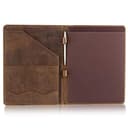
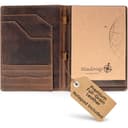
An open folio— the Moonster and the Wanderings — is two panels with pockets and no fastening. It is the slimmest format, it opens in one motion, and it is the only version that genuinely disappears into a bag. It is also the one that spills a document sleeve if it goes in sideways. Buy it if what lives inside is a pad and a couple of pages.
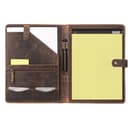
A button strap— the KomalC — is a tab that crosses the open edge and snaps. It costs almost no depth, it stops the folio yawning open in transit, and it does not pretend to be secure. The failure point is the snap itself rather than the leather, which is worth knowing because a dead snap on a leather tab is a ten-minute repair at a cobbler and a cracked zip usually is not.
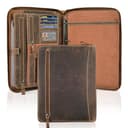
A zip-around— the Gavarnie and the LEATHER VILLAGE — closes on three sides, holds a laptop or tablet safely, and turns the folio into a thin case. The cost is depth, weight and one more thing to break. This is the format where a named zipper brand stops being a trivia item: a zip that fails on a zip-around folio ends the product, and both of these name YKK. The same logic drives how we read leather briefcases— hardware is the most common failure point on any structured leather good, and it is the spec most listings leave out.
Portfolio, padfolio or briefcase — which one you actually need
The words get used interchangeably and they should not be. A padfolio is sized around a writing pad: letter or A4, a clip or a slot to hold it, and pockets around it. A portfolioin business use means the same object most of the time, though in design and art it can mean a much larger presentation case. Neither is a briefcase. A briefcase has a base, a structure and a handle, and it carries a laptop, a lunch and a charger. A folio carries documents and nothing with a battery in it — with the single exception of the zip-around picks above.
Which means the honest answer for a lot of readers is that a folio is the wrong purchase. If you are carrying a laptop to an office five days a week, you want a work bag, and the folio rides inside it. Our briefcase roundup is the place to start, or leather laptop bags if you prefer a messenger across the body. If the bag it rides inside is still undecided, leather tote vs. backpack settles that one on load, access and capacity shape. If a laptop is involved and you want one item rather than two, read what size laptop bag you need before you try to make a 13-inch folio do a 15-inch job.
Where a folio genuinely wins is the interview, the client meeting, the deposition and the signing. It is a small, deliberate object that says you brought the documents and nothing else, and it is the one leather good whose entire job is to be looked at while open.
What the money buys as you go up the range
Prices on this page come from our live price layer with the date they were read, so the numbers on the cards are the current ones rather than something typed into this paragraph. The bands behave like this.
At the bottom of the real-leather rangeyou are buying a hide and a grade word and very little else: no named hardware, no warranty, no laptop capacity. Two of the five sit here, and both of them state a grade, which is the unusual part. Below this band the aisle turns synthetic almost completely, and the cheapest genuine-hide folio is a better ten-year purchase than a PU folio at half the price — the argument we make at length in is full-grain leather worth it.
In the middleyou start buying construction rather than material: a closure, a zippered pocket, a published tannage, an audited factory. This is where the Wanderings sits, and its vegetable tannage is the clearest example of paying for a property rather than a feature — veg-tan is the tannage that darkens with handling instead of staying the color it shipped in, which is the entire reason a document folio can look better after three years of meetings than it did new. That mechanism is what vegetable-tanned leather is, and the way it changes is leather patina.
At the top of the categoryyou are buying hardware, capacity and recourse — YKK zips, a ring mechanism, a stated laptop fit, a warranty. What you are not reliably buying is a better hide. The most expensive pick on this page is the one with no settled grade, and the cheapest states full-grain. That inversion shows up in every category we cost out; it is the same finding as how much a leather briefcase costs, where labor and structure, not the leather, turn out to be the biggest line in the price.
Keeping one looking like it was a good decision
A folio lives a gentler life than a bag and needs less, but it has one specific vulnerability: it is stored flat and closed, often in another bag, which traps moisture against the grain. That is how a folio grows mold in a damp office cupboard over a summer while the briefcase next to it is fine. Store it where air reaches both faces, and if it does bloom, the fix is in how to remove mold from leather.
Beyond that: condition it rarely rather than often, clean before you condition rather than over the top of dirt, and keep anything oily away from a clear pocket or a pad clip. The order matters more than the product, which is the whole point of leather cleaner vs. conditioner, and the frequency question is answered in how often to condition leather. The veg-tanned pick is the one that needs the lightest hand of the five; caring for vegetable-tanned leather covers why.
One closing note on method. We do not own these five, so nothing above is a durability test. It is a comparison of what five sellers were willing to put in writing, plus an argument about which of those published facts should decide your purchase. The long version is on our methodology page, and if a folio turns out not to be the object you need, the leather briefcases hub has the formats that are.