Why a kit beats a single bottle (and when it does not)
Conditioning dirty leather is the most common way people make a bag worse. A conditioner drives whatever is on the surface into the hide along with the oils, so grit, hand grease and old product end up sealed under a fresh layer rather than removed. That is why a cleaner and a conditioner belong together and why both maintenance kits here are ranked for having the two steps in one box in the right order. The full argument is in leather cleaner vs. conditioner.
A kit is also the right buy if you own more than one leather thing. The products in these boxes are general-purpose by design — bags, boots, belts, furniture, car seats — and a single bottle of conditioner treats far more than people expect, which is why one kit usually outlasts several years of use. A few drops do a whole bag.
When is a kit the wrong buy? Three cases. If you own one pale or vegetable-tanned item, buy the single non-darkening product instead of a general kit, because a general conditioner can shade a natural hide several tones in one application — the picks for that job are on best leather conditioners and the handling rules in how to care for vegetable-tanned leather. If your problem is water rather than dryness, you want a protectant, not a kit — see best leather protector sprays. And if the item is suede or nubuck, almost nothing in a standard kit is safe on a nap; start with nubuck vs. suede.
The four, side by side
Every cell is read from the listing or marked “Not published.” Current prices sit on the Check price button in each row of the table above.
| | Leather Honey | Lexol | Coconix | ARCSSAI |
|---|
| Kind of kit | Maintenance | Maintenance | Repair | Repair |
|---|
| What is in the box | Cleaner + conditioner + cloths | Separate cleaner + conditioner | Color-mixing compounds, multi-piece | Color compounds, multi-piece |
|---|
| Fixes dryness and dullness | Yes | Yes | No | No |
|---|
| Fixes tears and holes | No | No | Yes - tears, holes, deep scratches | Small areas only |
|---|
| Color matching | n/a | n/a | Mixing system, many tones | Fewer tones to mix from |
|---|
| Surfaces named in the listing | Multi-surface; non-toxic | Furniture, auto, shoes | Leather and vinyl | Furniture and couches |
|---|
| Ingredients published | Not published (states non-toxic) | Not published | Not published | Not published |
|---|
| Safe on pale or veg-tan leather | Spot-test first - can darken | Spot-test first | Color match is the risk, not darkening | Color match is the risk |
|---|
One row is blank for all four and it is worth naming: not one of these kits publishes an ingredient list. “Non-toxic” is a claim about hazard, not a disclosure of contents, and “color compounds” names a function rather than a chemistry. That is the norm in this category rather than a failing of these four, but it is the reason we rank care products on what they state about behavior— whether they darken, what surfaces they are declared safe on, what they explicitly rule out — and not on formulation. Two single products we cover do publish their chemistry, and both are protectants rather than kits.
The other useful pattern: the two maintenance kits differ mainly in how premium the formulas are, and the two repair kits differ mainly in how many color tones you get to mix from. That is the real axis in each pair. On a repair kit, tone count is the whole game, because a filler that is structurally perfect and two shades off is a worse result than a slightly soft fill in exactly the right color.
What a repair kit can and cannot do
Set expectations before you buy one, because this is where disappointment lives. A repair blends damage, it does not make it invisible. The compound fills the void and the color tones hide the edge, and on a matte, pigmented, fine-grained surface a good repair is genuinely hard to find afterwards. On a heavily textured hide, a glossy finish, or an aniline leather where color runs through the hide, the repair will read as a slightly different surface from 12 inches away, no matter whose kit it is. That is a property of filling leather, not a product defect.
Two practical notes. Color matching takes patience and is done in daylight, not under a bulb, and it is worth mixing on a scrap or an unseen area first — the compound dries darker than it looks wet on almost every kit. And a repair on a flex point will not last: a fill across a fold line, a strap crease or a seat bolster is working against the one thing leather does all day, and it will crack again. If the damage is on a flex point, the honest answer is that you are buying time rather than a fix. The specific cases are in how to fix peeling leather and how to get scratches out of leather, and the dedicated ranking is on best leather repair kits.
The order of operations, in full
Whichever kit you buy, the sequence is the same and it does not vary by product.
1. Dust it dry first. A dry cloth or a soft brush removes grit that a wet cloth would otherwise grind into the surface. Skip this and you are polishing with sandpaper.
2. Clean, lightly, and in sections. A little cleaner on a cloth, not on the leather, and never a soaked panel. The full method is in how to clean a leather bag.
3. Let it dry completely, at room temperature.Never near a radiator or in a hot car — heat drives the oils out of a hide permanently, and that is the one kind of damage no kit reverses. See how to dry a wet leather bag.
4. Repair, if you are repairing. Filler goes onto clean, dry, unconditioned leather. A conditioner underneath stops it bonding, which is why this step comes before feeding and not after.
5. Condition, sparingly, and spot-test first.A few drops treat a whole bag and almost everyone uses too much. Concentrate on the flex points — folds, strap anchors, gusset corners — rather than coating the whole panel, and allow a few hours to absorb before use. How often to repeat it is in how often to condition leather, and how to condition leather covers the technique.
Which one for you
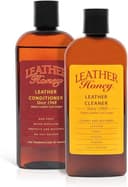
If you own good leather and nothing to look after it with: Leather Honey Complete Care Kit. A cleaner plus the conditioner that is one of the longest-running bestsellers in the category, in the correct order, declared non-toxic and multi-surface so one box covers a bag, a pair of boots, a sofa and a car interior. It will not fix an existing tear, and the conditioner can darken pale leather, so spot-test.
If you want the two-step routine for less:Lexol kit. Separate cleaner and conditioner in one box at a value price, aimed at furniture, auto and shoes — the right choice for larger jobs where you will use a lot of product. Two steps take longer than a 2-in-1, and the formulas are basic rather than premium.
If you have a tear, a hole or a gouge:Coconix. A color-mixing system that fills tears, holes and deep scratches on leather and vinyl — the kit to buy for a cracked seat or a bag corner you would otherwise write off. Color matching takes patience, and a repair blends damage rather than erasing it.
If you want to try a repair cheaply first: ARCSSAI. A furniture-oriented color-match set at the lowest price here, and a sensible first kit for a small sofa scuff before committing to a pricier system. Fewer tones to mix from, and it is for small areas rather than big tears. Every rule behind these picks is on our methodology page.