Leather Cleaner vs. Conditioner
One takes something out, the other puts something in. Doing the second without the first is the most common leather-care mistake there is - and it drives the dirt inward.
How this is funded: we earn a commission if you buy through our links, at no extra cost to you. It never changes which product we recommend, and we’ll tell you when we’d skip one. Full disclosure.
The short answer: a cleaner takes dirt out, a conditioner puts flexibility back in, and you do them in that order with drying time in between. They are not competing products and buying one does not mean you can skip the other.
The reason this gets confused is that both arrive as a bottle of liquid you wipe on with a cloth, and plenty of products are sold as both at once. But the two jobs pull in opposite directions, and that is precisely why doing them in the wrong order makes things worse rather than merely less good.
What a cleaner actually does
A leather cleaner is a mild surfactant formula — soap chemistry, tuned down. Its job is to loosen the bond between the leather surface and everything stuck to it: dust and grit, skin oils from handling, dye transfer from denim, the slightly greasy film that builds on anything carried against clothing. It lifts that material so a cloth can carry it away.
Two things follow from that. First, a cleaner is a removal tool, so it also removes some of the oils already in the leather — which is exactly why conditioning after cleaning is part of the routine rather than an optional extra. Second, the surface it is working on matters enormously. On a pigmented, finished hide there is a coating between the cleaner and the leather. On an aniline, unfinished or vegetable-tanned hide there is not, and a cleaner can lift dye along with the dirt. Spot-testing exists for this exact reason.
What a cleaner is not: a stain remover. Something absorbed into the fiber structure — ink, grease, water marks — is a different problem with different answers, covered in how to remove stains from leather.
What a conditioner actually does
Leather is a fiber network that depends on lubrication between the fibers to stay flexible. Tanning puts fats and oils into that network; time, handling, cleaning, heat and repeated wetting take them out. A conditioner replaces some of them, so the fibers slide past each other instead of resisting and eventually fracturing. Dry leather does not simply feel unpleasant — it cracks at the folds, which is a failure you cannot undo.
The important and counterintuitive part is that more is not better. Conservation guidance is consistent on the point: oils applied to leather oxidize over time, and oxidized oils can stiffen a hide rather than keep it supple. An over-conditioned bag is a real and common outcome, and it looks like a dull, slightly tacky surface that attracts dust. Thin coats, well spaced, buffed off — the schedule is in how often to condition leather.
The second thing to know is that most conditioners darken leather a little, because an oil in the grain changes how light scatters off it. On a dark brown bag nobody notices. On a pale tan or natural veg-tan piece it is a permanent cosmetic decision, and it is the reason non-darkening formulations exist and advertise the fact.
Why the order is not negotiable
Condition a dirty bag and you do three bad things at once.
You drive the grit inward. The oils carry surface particles into the grain, where they stay — and grit inside the fiber structure keeps abrading it every time the leather flexes. This is the mechanism behind the standing advice to clean first: a conditioner applied over trapped dirt feeds the dirt into the leather instead of feeding the leather.
You get uneven absorption. Conditioner soaks in where the surface is clean and sits on top where it is not, so the finish ends up blotchy. People read that as a bad product and buy a different bottle.
And you seal in moisture if the item is damp. Which is why the routine includes a genuine drying pause between the two steps, not a quick wipe-over — especially on something that has been rained on. See how to dry a wet leather bag for the other half of that problem.
So should you buy two bottles or one?
Three honest answers, depending on what you own.
Two separate bottles, if you care about the item. A dedicated cleaner and a dedicated conditioner each do their job properly, and the pair covers everything from a wallet to a sofa. This is the default we would recommend for a bag with a stated full-grain hide, because the whole point of that purchase is a long relationship.
A 2-in-1, for maintenance on finished leather.Car seats, a sofa, a pair of work boots — surfaces that are large, pigmented and not precious. A single wipe-down that does a light version of both jobs is genuinely the right tool when the alternative is doing nothing because the full routine takes an afternoon. Just do not expect a 2-in-1 to rescue something neglected.
A kit, if you want the right order enforced. A box with a cleaner and a conditioner in it is the two-bottle answer with the sequence built into the packaging, and it is usually cheaper than buying the two separately.
What to buy for each job
One product per role, so the choice above maps onto something you can actually order. Claims are read from each maker's own published description - we have not tested these, and no product here is credited with a result we did not see published.
- The cleaner
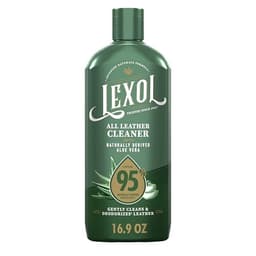
Lexol All Leather Cleaner (with Aloe)
Type: Cleaner
A naturally derived, aloe-based cleaner for the step most people skip. It is the right tool for lifting body oils and denim transfer before you condition - and it is explicitly a cleaner only, so you still need to feed the leather afterward. Not for suede or nubuck.
$14.99 · View on AmazonPrice as of October 20, 2026. #ad How we’re funded
- The correct order, in one box
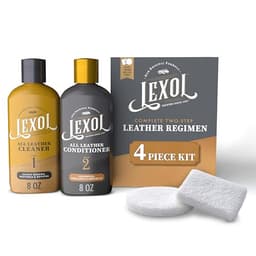
Lexol Leather Cleaner & Conditioner Kit
Type: Cleaner + conditioner kit
Separate cleaner and conditioner packaged together, which is the two-step routine with the sequence enforced by the packaging and at a lower price than buying both. Slower than a 2-in-1, which is the point.
$17.08 · View on AmazonPrice as of October 20, 2026. #ad How we’re funded
- The conditioner
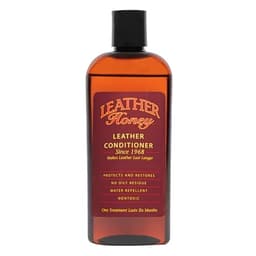
Leather Honey Leather Conditioner (8 oz)
Type: Conditioner
The all-purpose second step: one formula for bags, boots, furniture and car interiors, and a few drops treat a whole panel - which matters, because thin coats are the rule. It can darken very pale or untreated leather, so spot-test a hidden area first.
- For pale leather
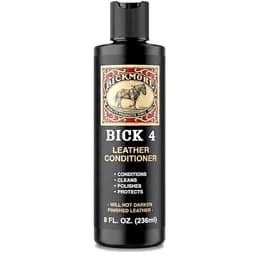
Bickmore Bick 4 Leather Conditioner & Cleaner (8 oz)
Type: Cleaner + conditioner
Bickmore states that Bick 4 is formulated not to darken leather, which makes it the safer conditioner on tan, cognac and natural veg-tan hides where an oil-heavy product goes muddy. It conditions more lightly than a heavy oil, and "will not darken" is still a formulation claim rather than a promise - spot-test anyway.
The things that are neither
Three products get mistaken for one or the other, and all three deserve their own decision.
Saddle soapis a cleaner with a high fat content, which is why it feels like it conditions. It is traditional, effective on tack and work leather, and more aggressive than a modern cleaner — not the first thing to reach for on a finished bag.
Leather oil— mink oil, neatsfoot — is not a stronger conditioner. It penetrates further, softens more, darkens more and is harder to undo, which makes it a tool for boots and tack rather than for bags. The distinction is in leather conditioner vs. leather oil.
Protectant sprays add a water-repellent surface layer. They do not clean and they do not condition, and they do not make leather waterproof, because nothing does. Treat them as a fourth, optional step rather than a substitute for either of the first two.
One closing note on method. Everything above comes from published conservation guidance and from what each maker states about its own product — we have not run comparative tests, and nothing here credits a product with a result we did not see published. That rule is explained on our methodology page.
How we know this. Veg Tan Club is written by an enthusiast, not a master leatherworker or a test lab. We compile each product’s published specs — grade, tannage, hardware — and reason from there. We say plainly when a listing doesn’t state a grade, and we haven’t physically handled every item we compare.
Frequently asked questions
What is the difference between leather cleaner and leather conditioner?
A cleaner is a mild surfactant formula that lifts dirt, body oils and grit out of the grain and carries them away on a cloth. A conditioner is an oil, wax or emulsion that soaks in and restores flexibility to the fiber structure. One removes, one replaces. They are sequential steps in a single routine, not two ways of doing the same thing.
Do you clean or condition leather first?
Clean first, always, and let the leather dry completely before conditioning. Conditioning dirty leather does the opposite of what you want: the oils carry surface grit inward and lock it into the grain, where it keeps abrading the fibers from the inside. It also leaves a dull, blotchy finish, because the conditioner is absorbing unevenly through a layer of dirt.
Can you use a 2-in-1 leather cleaner and conditioner?
Yes, for routine maintenance on finished leather like a car seat or a sofa, where speed matters more than thoroughness. The limitation is structural: a product cannot thoroughly lift dirt and deposit oils in the same wipe, so a 2-in-1 does a light version of both. Use one to keep clean leather clean, and reach for separate products when something is actually dirty or dried out.
How often should you clean and condition leather?
Clean when it is dirty, which for a bag in daily use is a few times a year, and condition roughly twice a year. Conditioning is the step people overdo - oils oxidize over time and can leave leather stiff rather than supple, so more product is not more protection. A new item usually needs nothing for its first several months.
Will leather cleaner remove the color?
A proper leather cleaner should not, but it can on aniline-dyed, unfinished or vegetable-tanned leather, where there is no pigment layer protecting the surface. That is why the first step in any routine is a spot test on a hidden area. Household soaps, degreasers and alcohol wipes are a different matter - those genuinely strip dye and finish, and should stay away from leather.
Does leather conditioner darken leather?
Oil-based conditioners usually do, slightly, and on pale or vegetable-tanned hides the change can be noticeable and permanent. Some products are explicitly formulated not to darken - Bickmore states this for Bick 4 - which makes them the safer first choice on tan and cognac leather. Whatever the label says, spot-test somewhere hidden, because "will not darken" is a formulation claim rather than a guarantee for every hide.
Can you condition leather without cleaning it?
You can, and on something genuinely clean - a bag that lives indoors and has only been handled - it is fine. The rule exists because most leather that feels dry is also dirty, and the two conditions arrive together. If you cannot remember the last time it was wiped down, clean it.
Sources
- Canadian Conservation Institute — Caring for leather, skin and fur — CCI preventive-conservation guidance on cleaning, dressing and storing leather (accessed July 18, 2026)
- U.S. National Park Service — Curatorial Care of Objects Made From Leather and Skin — NPS museum-handbook guidance on cleaning, handling and storing leather; humidity below ~65% (accessed July 18, 2026)
- Wikipedia — Conservation and restoration of leather objects — How the field cleans and stabilizes leather; why oils oxidize and can harden leather over time (accessed July 18, 2026)
- Lexol — All Leather Cleaner (maker's product page) — Maker's claims: pH-balanced formula that matches the natural pH of leather; free of silicones, alcohols and waxes; leaves leather prepared for conditioning (accessed September 18, 2026)
- Lexol — All Leather Conditioner (maker's product page) — Maker's claims: liquid formula that penetrates leather pores, no greasy residue, no harmful silicones; for auto, footwear, furniture, handbags, sports gear and luggage; use every 6 months (accessed September 18, 2026)
- Leather Honey — Leather Conditioner (maker's product page) — Maker's claims: free of silicone, solvents, fragrances and animal-derived ingredients; for every leather color, not for suede, faux leather or vinyl; apply a quarter-size drop in a thin layer; dry at least two hours, preferably overnight; one treatment protects six months or more; made in the USA since 1968 (accessed September 18, 2026)
- Bickmore — Bick 4 Leather Conditioner (maker's product page) — Maker's claims: will NOT darken leather; completely wax-free; for smooth finished leather; not for suede, rough-out, distressed or napped leathers; always check colorfastness in a hidden area first; made in the USA (accessed September 18, 2026)
Keep reading
Best leather cleaners
The cleaning half of the routine, with the picks compared on formula and what each one is safe on.
See the picksBest leather conditioners
Four conditioners compared on what their makers publish - including which ones darken a pale hide.
See the picksHow to condition leather
The step-by-step method, including how thin a thin coat actually is.
Read the guideHow often to condition leather
Why over-conditioning is more common than neglect, and the cadence that suits real use.
Read the guideLeather conditioner vs. leather oil
The other product comparison in this aisle - why an oil is not simply a stronger conditioner.
Read the guideLeather Honey vs. Bick 4 vs. Lexol
Three conditioners head to head, starting with what each maker says about color change.
Compare the three