What Is Bridle Leather?
The leather made for horse tack, explained: how it's made, why belt makers love it, how it ages, and why the word on a listing still doesn't tell you the grade.
How this is funded: we earn a commission if you buy through our links, at no extra cost to you. It never changes which product we recommend, and we’ll tell you when we’d skip one. Full disclosure.
Bridle leather is full-grain, vegetable-tanned leather finished by waxing or hot-stuffing — working waxes and tallow into the hide. It was developed for horse tack, which is why it is stiff and smoothly polished when new, softens with break-in, and develops a patina with years of use. It is one of the classic belt leathers, and one of the most misunderstood words on a leather listing, because the name describes a finish and a tradition rather than guaranteeing a grade.
Where bridle leather comes from
The clue is in the name. Bridle leather was developed for horse tack — bridles, reins and the straps that hold tack together — and that is a demanding job for a strip of leather. It is pulled hard, flexed constantly, handled with bare hands, rubbed against a horse, and used outdoors in whatever the weather is doing.
A tack strap also has two faces that matter. One side rubs against the animal or another strap, the other is gripped and handled, so both surfaces need to be finished rather than just the grain side you look at. That origin explains nearly everything people like about bridle leather today: strength under tension, a finish on both faces, and a surface built to take daily handling. Those are exactly the qualities you want in a belt, a strap or a hard-working wallet.
How bridle leather is made
The two leather-supply references we rely on here, American Bench Craft and Buckleguy, describe three steps stacked on top of each other.
- It starts as full-grain. American Bench Craft defines bridle leather as full-grain: the top layer of the hide with its natural grain left intact rather than sanded away. That is the strongest part of the hide and the part that ages rather than wears through — the difference is laid out in full-grain vs. top-grain leather.
- It is vegetable-tanned. Tanning is the step that turns raw hide into stable leather, and the main tanning agents are vegetable tannins, chromium salts and oils. Most leather made today is chrome-tanned, which is fast and produces soft leather. Bridle leather is built on the slower vegetable tannage, which produces a firmer, denser leather that darkens with light and handling.
- It is dyed, then stuffed. This is the step that makes it bridle leather rather than just veg-tan. Buckleguy describes English bridle as drum-dyed and then hot-stuffed with waxes and tallows on both the grain and the flesh side. American Bench Craft describes the finish as waxing or hot-stuffing, leaving a smooth, polished surface. In plain terms, fats and waxes are worked into the leather itself rather than wiped onto the surface as a coat.
The exact recipe — which waxes, which fats, how much and for how long — varies from maker to maker, and neither reference publishes a single standard. What defines bridle leather is the combination: full-grain, vegetable-tanned, then waxed or stuffed. Take any one of those away and, by that definition, you have a different leather, whatever the listing calls it.
Why bridle leather suits belts
A belt is a strap under tension all day, folded at the same point every time it is buckled, and rubbed on both faces by belt loops and waistbands. That is close enough to tack work that the leather developed for one carries straight over to the other.
- It holds tension. A full-grain, vegetable-tanned strap keeps the hide’s densest layer, which is the part that takes a daily pull without stretching out of shape.
- It is finished on both faces. Because the stuffing goes into the flesh side as well as the grain, the back of the strap has been treated too rather than left as raw flesh side. That is the side that rubs against your waistband all day.
- It arrives stiff, and that is expected. Buckleguy notes that English bridle is stiff when new and softens with care and break-in time. A new bridle belt that feels like a board is behaving normally; see how to break in a leather belt for the safe way through that stage.
- It looks smart without looking delicate. The smooth, polished surface reads more finished than a rugged oiled leather, so a bridle belt sits comfortably between jeans and business casual.
None of that makes the finish more important than the fundamentals. A bridle belt still has to be a solid strap of a stated grade, the right width for your loops and fitted with a buckle that will outlast it. Those checks are in how to choose a quality leather belt, and they apply to bridle leather exactly as they do to any other.
How bridle leather ages
American Bench Craft describes bridle leather as developing a patina, and that follows from what is underneath the wax: a vegetable-tanned hide, which darkens with light, skin oils and handling. The patina on bridle tends to be quieter than on a pale, unfinished veg-tan, because the leather is usually dyed and already carries a polished surface. Expect the tone to deepen and the sheen to build where the strap is handled most — the buckle end, the first few holes, the edge that runs through the keeper.
It is worth separating bridle from crazy horse leather, the other wax-heavy finish you will meet on a listing. Both rely on wax, and both are usually built on full-grain. Crazy horse is designed to lighten where it is scratched and then blend back, so it looks rugged from day one. Bridle aims at the opposite first impression: a smooth, polished surface that looks tidy on day one and gains its character slowly.
Bridle vs. saddle vs. full-grain vs. “genuine leather”
The confusion here comes from mixing two different kinds of word. Some leather words are grade words: they tell you which layer of the hide you are getting. Full-grain, top-grain, genuine and bonded are grade words. Others are process or tradition words: they tell you how the leather was tanned or finished, or which trade it came from. Vegetable-tanned, bridle, crazy horse and saddle leather belong in that second group. A good listing gives you one of each.
| Term | What it describes | Does it state a grade? | What to check next |
|---|---|---|---|
| Full-grain | A grade: the top layer of the hide, grain intact | Yes — it is the grade | Whether the tannage is stated too |
| Bridle leather | A finish and tradition: veg-tan stuffed with waxes and tallow, developed for tack | Traditionally full-grain, but only if the listing says so | The word "full-grain" beside it |
| Saddle leather | A descriptive name borrowed from saddlery | No | A stated grade and tannage |
| Crazy horse | A hot-waxed finish that lightens where scratched | No, though usually applied to full-grain | A stated grade |
| "Genuine leather" | A low grade, usually from the split layers of the hide | Yes, and it is a low one | Whether you want a strap that creases rather than patinas |
Bridle vs. full-grain is therefore not a choice between two things. Traditional bridle leather isfull-grain, with a particular tannage and finish on top — the same way vegetable-tanned and full-grain answer different questions rather than competing ones. The practical question is whether a given listing has told you both.
Bridle vs. saddle leather is harder to pin down, because the two terms are not equally defined. Both names come from the tack room. But where the references above describe a specific process for bridle, “saddle leather” on a retail listing is used far more loosely — read it as a description of the look and feel the maker is aiming for, and look for a grade next to it. The same applies to “genuine leather,” which sounds like a quality claim and is actually a lower grade than full-grain.
Leather labeling rules don’t close that gap for you. The FTC’s guides for leather products are concerned with whether an item is leather at all, whether imitation leather and backing materials are disclosed, and whether trade names mislead. They don’t turn a tradition word like “bridle” into a promise about which layer of the hide you are buying.
How to read a listing that says “bridle”
Treat “bridle leather” on a listing as a real, useful fact about how the leather was finished — and as the start of your reading, not the end of it.
- Look for the grade word beside it. “Full-grain bridle leather” tells you two things. “Bridle leather” on its own tells you one. If the grade isn’t there, record it as unknown rather than filling it in from the tradition.
- Look for the tannage. Traditional bridle is vegetable-tanned, and a maker who uses it has every reason to say so. Silence is not proof of anything, but it is not confirmation either.
- Check the construction. Part of the appeal of bridle is a strap finished through its thickness on both faces. A listing that mentions a lining, a backing or bonded layers is describing a different construction, whatever the face is called.
- Check what else is missing. Thickness, width, buckle material, country and warranty are routinely unpublished on belt listings. Each gap is small; several of them together tell you how much of the story you are being asked to take on trust.
- Weigh the brand, but not instead of the spec. A familiar name with a returns process behind it is worth something. It is not the same thing as a disclosed grade.
That is the whole thesis of this site, applied to one word: a name that sounds like quality is not the same as a published specification. Bridle leather is a genuinely good leather. A listing that says “bridle” and nothing else has told you about the finish and left the grade to your imagination.
The labels in practice
Only one listing we track names bridle leather, and it is a useful lesson in reading one. The other two show what a stated grade looks like beside a tradition word, and on its own.
- States bridle, not the grade
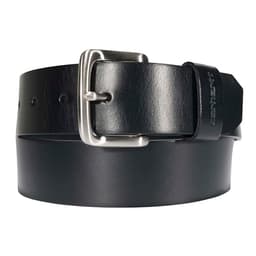
Carhartt Bridle Leather Belt, Nickel Roller Buckle (52")
Leather grade: Not published
The one belt we track that names bridle leather, with a nickel roller-bar buckle from a recognized workwear brand. The listing does not state the grade, thickness or width, and it is listed at 52", so it suits big-and-tall waists who want a familiar name and read it with open eyes.
- Saddle leather, grade stated
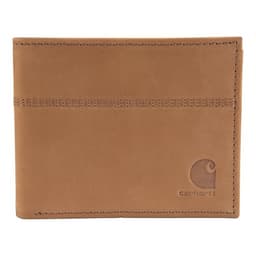
Carhartt Full Grain Saddle Leather RFID Wallet
Leather grade: Full-grain
The saddle-leather comparison done properly: the listing pairs "saddle leather" with a stated full-grain grade, plus an RFID-blocking lining. Tannage is not published, and it is chunkier than a slim wallet.
$42.99 · View on AmazonPrice as of September 20, 2026. #ad How we’re funded
- Stated full-grain alternative
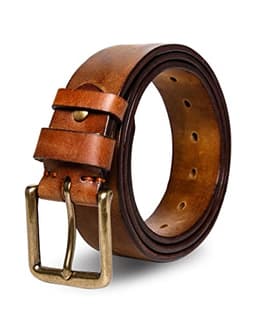
wolksprong Thick Full-Grain Heavy-Duty Work Belt
Leather grade: Full-grain
No bridle claim, but the grade is stated: a thickened full-grain work belt. Like bridle, expect it thick and stiff at first. It needs a break-in and is heavier than a dress belt.
$39.99 · View on AmazonPrice as of September 20, 2026. #ad How we’re funded
If you need the length the Carhartt belt comes in, the rest of the field is in best big and tall leather belts. If you would rather start from a stated grade, the best full-grain belts page lists only straps whose listings say full-grain outright, and best full-grain wallets does the same for wallets.
How to care for bridle leather
Bridle leather asks for less than most leathers, because a good part of the care was done at the tannery: the waxes and tallow are already in it.
- Wipe it, don’t wash it. A soft, dry cloth after wear lifts dust and grit. If it needs more, a barely damp cloth over the whole strap, never a soak.
- Condition rarely and thinly. Reach for conditioner when the leather starts to look dry, not on a schedule, and use very little. Spot-test first on the back of the strap: the veg-tan base can darken with conditioner, and that change is permanent. The general method is in how to condition leather, and the gentler veg-tan version is in how to care for vegetable-tanned leather.
- Dry it slowly if it gets wet. Room temperature, away from radiators and hair dryers. Heat pulls out the fats that make the leather what it is.
- Let wear do the softening. Don’t soak a stiff new belt or oil it heavily to speed things up. Wearing it is what breaks it in.
- Rest it between wears. Rotating belts spreads the flexing at the buckle fold; the rest of the routine is in how to care for a leather belt.
Bottom line
Bridle leather is full-grain, vegetable-tanned leather that has been stuffed with waxes and tallow — a finish developed for horse tack, which is why it makes such a good belt: it holds tension, it is finished on both faces, it arrives stiff and softens, and it gains a patina slowly rather than scuffing into one. The word on a listing is a genuine description of that finish. It is not a grade. Look for “full-grain” beside it, treat “saddle leather” the same way, and when the grade isn’t stated, read that silence as information. For the full belt checklist, start with how to choose a quality leather belt.
How we know this. Veg Tan Club is written by an enthusiast, not a master leatherworker or a test lab. We compile each product’s published specs — grade, tannage, hardware — and reason from there. We say plainly when a listing doesn’t state a grade, and we haven’t physically handled every item we compare.
Frequently asked questions
Is bridle leather full-grain?
Traditionally, yes. American Bench Craft, a leather-supply reference, defines bridle leather as full-grain, vegetable-tanned leather finished by waxing or hot-stuffing. On a retail listing, though, the word describes a finish and a tradition, not a stated grade. If a listing says "bridle" but never says "full-grain," the grade is still unpublished, and it is fair to ask before you assume.
Is bridle leather vegetable-tanned?
By the traditional definition it is: bridle leather starts as vegetable-tanned leather and is then stuffed with waxes and tallow. That puts it in the minority, since most leather made today is chrome-tanned. As with grade, a listing that only says "bridle" has not confirmed the tannage, so look for the words "vegetable-tanned" before treating it as a given.
Is bridle leather good for belts?
It is one of the classic belt leathers, for the same reasons it suited tack: it was developed to be pulled, flexed and handled every day, and it is stuffed with waxes and tallow on both faces. Expect it to be stiff when new and to soften with break-in time. The grade underneath still matters as much as the finish on top.
Does bridle leather patina?
Yes. American Bench Craft describes bridle leather as having a smooth, polished surface that develops a patina, which follows from its vegetable-tanned base. Because the surface starts smooth and polished rather than rugged, the change usually reads as a deepening tone and a richer sheen on the parts you handle most, such as the buckle end of a belt.
What is the difference between bridle leather and saddle leather?
Both names come from horse tack, but only bridle describes a specific finishing tradition: vegetable-tanned leather hot-stuffed with waxes and tallow. "Saddle leather" on a retail listing is a descriptive name rather than a defined grade or process, so it tells you the look the maker is going for. With either word, the grade is a separate claim to look for.
What is English bridle leather?
It is the name most often attached to the traditional version of this leather. Buckleguy describes English bridle as drum-dyed and then hot-stuffed with waxes and tallows on both the grain and flesh sides, which leaves it stiff when new and softening with care and break-in time. The word "English" describes a style; it is not a grade.
Sources
- American Bench Craft — Leather terminology: Bridle leather — Bridle leather: developed for horse tack; full-grain vegetable-tanned leather finished by waxing or hot stuffing; smooth, polished surface that develops a patina (accessed September 18, 2026)
- Buckleguy — What is English Bridle Leather? How it's made and used — English bridle: drum-dyed, hot stuffed with waxes and tallows on grain and flesh; stiff when new, softens with care and break-in time (accessed September 18, 2026)
- Wikipedia — Tanning (leather) — The tanning process, vegetable vs. chrome tannage, and why ~90% of leather is chrome-tanned (accessed July 18, 2026)
- Encyclopaedia Britannica — Tanning — Britannica on the three main tanning agents: vegetable tannin, chromium salts, and oils (accessed July 18, 2026)
- 16 CFR Part 24 — FTC Guides for Select Leather and Imitation Leather Products — The FTC guides on leather labeling: unqualified 'leather' claims, imitation-leather disclosure, backing material and misuse of trade names (accessed August 19, 2026)
Keep reading
What is vegetable-tanned leather?
The tannage bridle leather is traditionally built on, and why it firms up, darkens and patinas.
Read the explainerWhat is crazy horse leather?
The other wax-heavy finish on a leather listing, built to scuff and blend rather than stay polished.
Read the explainerHow to choose a quality leather belt
Grade, construction, width and buckle: the checklist a bridle belt should pass like any other.
Read the checklistBest full-grain leather belts
Belts whose listings state the grade outright, sorted by what each one is for.
See the picksHow to break in a leather belt
Bridle leather arrives stiff on purpose. The safe way to soften it, and what never to do.
Read the guideBest leather belts for jeans
The everyday casual belt, where a thick stuffed strap earns its keep.
See the picks