What Is Split Leather?
The lower layer left over when a hide is sliced in two. Real leather, much weaker than the grain above it — and the quiet basis of most 'genuine leather' goods.
How this is funded: we earn a commission if you buy through our links, at no extra cost to you. It never changes which product we recommend, and we’ll tell you when we’d skip one. Full disclosure.
Split leather is what is left of a hide after the outer grain layer has been sliced off. A thick hide is separated horizontally into two or more layers; the top one, carrying the natural grain, becomes full-grain or top-grain leather, and the lower one — the split — is real leather with no grain surface of its own. To make a split look like grain leather, a finish is sprayed on and a grain pattern is embossed into it.
Where a split comes from
A raw hide is thicker than most finished goods need. Rather than shave that thickness away as waste, tanneries run hides through a splitting machine that slices them into layers, much like resawing a plank.
The layers are not equal. The outer layer — the one that faced the world — has the tightest, most interlocked fiber structure, because that is what gives skin its toughness. Keep it intact and you have full-grain; sand its surface lightly to even it out and you have top-grain. The lower layer has no grain at all. Its fibers are looser, more open and run in less useful directions. That layer is the split, sometimes called the flesh split or drop split.
Nothing dishonest has happened yet. Splitting is normal, efficient tannery practice, and splits have legitimate uses — suede, work gloves, linings, shoe components. The problem starts at the point of sale.
How a split ends up looking like grain leather
A bare split looks like what it is: fuzzy, matte, obviously not a grain surface. To sell it as a smooth leather good, it gets finished:
- A polymer coat is applied to the split’s open surface to seal and smooth it.
- A grain pattern is embossed into that coating under heat and pressure, producing convincing pores and creases.
- Color and topcoat go on, giving the uniform, even shade that mass production wants.
The result is real leather with a fake grain. When that coating is heavy enough to be the dominant surface, the material is sometimes called bicast or coated split. It photographs beautifully and it is very cheap to produce, which is why so much of the market is built on it.
Why it fails differently
Grain leather wears. A full-grain belt or bag thins, softens, scuffs, darkens and keeps going — the surface you are wearing is the material itself.
A finished split fails in two stages instead. First the coating goes: it crazes, then cracks along the lines the item flexes on, then lifts. Underneath is the fuzzy split, so there is no recovering the look. Second, the split itself gives up sooner than grain leather would, because the strong fiber layer is not there — it stretches at strap anchors, creases permanently at folds, and thins where it rubs.
This is also why a split will never develop a patina. Patina is the grain surface changing with light, oils and handling. On a coated split you are handling a polymer, and polymer does not patina — it degrades.
The label problem
Almost nothing forces a seller to use the word “split.” The FTC’s leather guides are aimed at deception about composition — passing imitation off as leather, hiding that a leather surface is backed with another material, using hide-shaped tags on products that are not substantially leather. Splits are leather, so a listing that says “genuine leather” over a coated split is on far safer ground than one selling vinyl as hide.
The upshot is a vocabulary that works against the buyer. “Genuine leather” sounds like a guarantee of authenticity, and it is instead the phrase most reached for when the material is a split. Related terms to treat the same way: “bicast,” “corrected grain” (which can mean a heavily sanded and coated top-grain, or worse), “coated leather,” and any listing that names a country, a color and a hardware finish but never a grade.
How to spot a split before you buy
- Check the cut edge in the photos. A split’s edge shows a thin, distinctly different-colored surface layer over a fibrous body. Full-grain is the same material all the way through.
- Look for grain that is too regular. Embossed grain repeats. Natural grain varies across a panel and shows the odd scar or wrinkle.
- Read the underside. Unfinished grain leather has a suede-like back that still feels dense. A split’s back is loose and fuzzy in a softer, more open way.
- Weigh the silence. A maker who paid for full-grain says so in the title. When the grade appears nowhere on the page, the split is the default assumption, not the pessimistic one.
Escaping the split tier doesn't cost much
The useful thing about grade is that it is cheap to insist on. Both of these state full-grain in the listing at prices where 'genuine leather' splits are the norm.
- Stated full-grain wallet
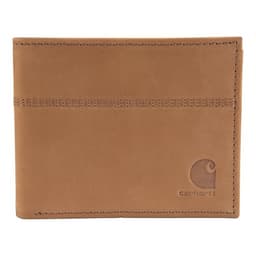
Carhartt Full Grain Saddle Leather RFID Wallet
Leather grade: Full-grain
A wallet is where a split shows up fastest — constant folding, constant pocket friction. This listing states full-grain, so the surface you wear is the leather itself, not a coating over a split.
$42.99 · View on AmazonPrice as of October 20, 2026. #ad How we’re funded
- Stated full-grain belt
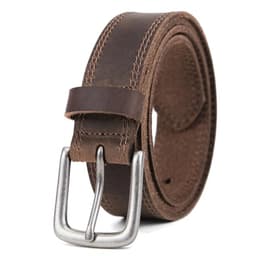
VATAN Full-Grain Leather Casual Jean Belt
Leather grade: Full-grain
A belt folds at the same point every day, which is exactly where a coated split cracks first. A solid stated-full-grain strap sidesteps the failure mode entirely.
Bottom line
Split leather is the honest by-product of an honest process, sold under a dishonest vocabulary. It is real leather from the weak half of the hide, usually coated and embossed so it reads as grain. It has genuine uses — suede, gloves, linings, low-stress accessories — and one clear disqualification: anything you intend to use hard and keep for years. The way to avoid it is not to hunt for the word “split,” which you will rarely see, but to insist on the word full-grain, which sellers state when they have it. Start with types of leather for the whole ladder, or the full-grain versus genuine comparison for the two ends of it.
How we know this. Veg Tan Club is written by an enthusiast, not a master leatherworker or a test lab. We compile each product’s published specs — grade, tannage, hardware — and reason from there. We say plainly when a listing doesn’t state a grade, and we haven’t physically handled every item we compare.
Frequently asked questions
Is split leather real leather?
Yes. Split leather is genuinely animal hide — it is simply the lower layer, taken after the strong outer grain has been sliced off for something else. It is real, it is leather, and it is much weaker than the layer above it. Those three facts are all true at once, which is exactly why the term causes so much confusion.
Is 'genuine leather' the same as split leather?
Not by definition, but in practice they overlap heavily. 'Genuine leather' is an informal grade term with no strict standard, and goods sold under it are commonly made from splits, usually with a polymer finish sprayed and embossed onto the surface to imitate grain.
How long does split leather last?
Far less time than full-grain under the same use, because the tight outer grain that gives leather its tensile strength was removed. Splits stretch, thin and crease at stress points, and finished splits also lose their surface coating. We won't give you a number of years — that depends on the item, the thickness and how hard you use it — but the direction is not in doubt.
Is suede split leather?
Often, yes. Suede is made by napping a soft, fibrous layer, and that layer is frequently a split. It can also be made from the flesh side of a whole hide. Either way, suede's characteristic plushness comes from the same open fiber structure that makes splits weaker.
Should I ever buy split leather?
For items that take little stress and that you do not expect to keep for years, it can be a fair purchase — a decorative pouch, a lightly used accessory, a first bag on a tight budget. What you should not do is pay full-grain money for it, or expect it to develop a patina, because it will not.
Sources
- Wikipedia — Leather — Overview of leather, grain layers and the full-grain / top-grain / split hierarchy (accessed July 18, 2026)
- Encyclopaedia Britannica — Leather — Britannica on leather as chemically treated animal hide and its uses (accessed July 18, 2026)
- 16 CFR Part 24 — FTC Guides for Select Leather and Imitation Leather Products — The FTC guides on leather labeling: unqualified 'leather' claims, imitation-leather disclosure, backing material and misuse of trade names (accessed August 19, 2026)
Keep reading
Full-grain vs. genuine leather
The top of the grade ladder against the label most often used to disguise the bottom of it.
See the differenceWhat is bonded leather?
One rung further down — ground leather scrap glued to a backing, and why it fails fastest of all.
Read about bondedTypes of leather, explained
The full map — where splits sit relative to full-grain, top-grain, nubuck and suede.
See the full guideNubuck vs. suede
Two napped leathers from opposite layers of the hide — and why one of them is usually a split.
Compare the two