Can You Wash Leather?
Not in a machine, and never in a dryer. Water itself is not the enemy - agitation, detergent and heat are, and a washing machine applies all three at once. Here is what actually happens, and the method that replaces washing.
How this is funded: we earn a commission if you buy through our links, at no extra cost to you. It never changes which product we recommend, and we’ll tell you when we’d skip one. Full disclosure.
No to the washing machine. Never to the dryer. A qualified yes to water, used deliberately and dried slowly. Those three answers cover almost every version of this question, and the reason they differ is worth understanding, because it is not that leather hates water — a tannery immerses hides in water for days. It is that a washing machine does three damaging things at once, and a dryer does the worst one on its own.
What a washing machine actually does to a hide
Leather is the preserved fiber network of a hide, kept flexible by moisture and by fatty substances worked into it after tanning. A wash cycle attacks all of that in three ways simultaneously.
Prolonged immersion.Soaking swells the fiber structure and carries the hide’s fatty content out with the water as it leaves. One rain shower does a little of this; forty minutes submerged does a great deal of it. The item comes out measurably drier in the only sense that matters — less oil in the fibers — than it went in.
Mechanical agitation. A drum tumbles the item against itself and against the drum wall for the whole cycle, which abrades the grain surface, stresses every seam and can tear stitching out of a saturated, softened hide. On a coated or corrected leather it will also lift the finish, which produces the flaking described in how to fix peeling leather.
Detergent. Laundry detergent is a degreaser. That is its entire purpose, and it is precisely the opposite of what a material kept supple by grease needs. It strips the fatliquoring oils far more aggressively than water alone, which is why a machine-washed leather item usually comes out both stiff and visibly lighter.
Put together, the result is an item that is smaller, harder, paler and out of shape, with stressed stitching. None of it is reversible. Conditioning afterwards softens the surface a little and does not restore the structure.
Why the dryer is worse than the washer
If you only remember one thing from this page, make it this one. Wet leather dried with heat shrinks, and the shrinkage is permanent, uneven and often accompanied by cracking. A tumble dryer is the most efficient possible way to do that: hot air, forced circulation, continuous tumbling, for an hour.
The mechanism is explained properly in does leather shrink. In short: heat drives bound moisture out of the collagen structure faster than the fibers can accommodate, so they contract and set in the contracted position. A hide that has done this is hard, a size smaller, and no longer able to flex without tearing — which is where cracking comes from. This is also why a hair dryer, a radiator and a hot car are on the same list as a tumble dryer, and why the correct response to a soaked bag is patience: see how to dry a wet leather bag.
So what about plain water?
Water is fine. Leather is water-resistant rather than waterproof — the full version of that claim is in is leather waterproof— and an item that gets rained on, splashed or wiped with a damp cloth is in no danger provided two conditions hold. It dries slowly, at room temperature, away from heat. And it is not under load or tension while it dries, because wet leather under tension stretches into whatever shape it is held in and keeps it, per does leather stretch.
That is the whole rule. Take the wet bag off your shoulder before you dry it; unbuckle the wet belt rather than leaving it fastened; stuff a wet bag loosely with paper so it holds its shape rather than collapsing into a new one. Then wait.
One genuine exception worth naming: vegetable-tanned leather is more sensitive to water marking than chrome-tanned leather, and a drop of water on a pale veg-tan wallet can leave a visible ring even after it dries. That is a cosmetic consequence of the tannage rather than damage, and the full routine for that material is in how to care for vegetable-tanned leather.
What replaces washing
Surface cleaning, in a fixed order, with a cloth that is damp rather than wet. The step-by-step is in the numbered method above and in how to clean a leather bag, but the two principles behind it are worth stating plainly.
First: the cleaner goes on the cloth, not on the leather. This is how you control how much liquid reaches the hide, and it is the difference between cleaning a surface and soaking a material. Second: clean before you condition, always. Conditioning over trapped dirt drives grit into the grain, where it abrades the fiber structure from the inside for the rest of the item’s life. That argument is made at length in leather cleaner vs. conditioner.
What not to use: dish soap, laundry detergent, bleach, alcohol wipes, baby wipes with added fragrance, or a magic-eraser style abrasive pad. All of them either degrease the hide or sand the finish. Mild saddle soap is the one traditional exception, and a purpose-made leather cleaner costs so little that it is hard to justify improvising.
What surface cleaning actually needs
Three options for the method above, depending on whether you want the cleaning step alone, both steps in one box, or a single fast-maintenance bottle for finished leather. We have not handled any of them - every claim is read from the live listing.
- Best cleaner on its own
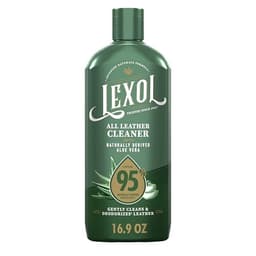
Lexol All Leather Cleaner (with Aloe)
Type: Cleaner
The straightforward answer if you already own a conditioner: a naturally derived aloe-based cleaner for lifting dirt and body oils without harsh solvents, at a low price. The listing states it is not for suede or nubuck, which is the one exclusion that matters - napped leather cannot be wiped this way.
$14.99 · View on AmazonPrice as of October 20, 2026. #ad How we’re funded
- Best both-steps kit
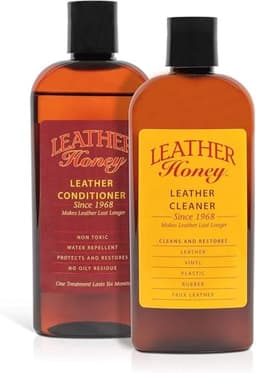
Leather Honey Complete Leather Care Kit (Cleaner + Conditioner)
Type: Cleaner + conditioner kit
Cleaner and conditioner in one box, which is the right purchase if the reason you are here is that something needs cleaning and you have never conditioned it either. Buying both at once is the practical fix for the most common mistake on this page - skipping the clean and going straight to the oil.
- Best fast maintenance
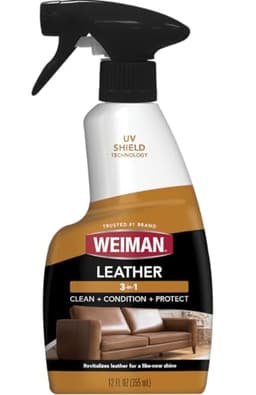
Weiman Leather Cleaner & Conditioner (with UV)
Type: Cleaner + conditioner
A single-bottle cleaner-conditioner with added UV protection, for quick upkeep on finished leather like car seats and sofas. The honest limitation is in the format: a two-in-one does neither job as thoroughly as separate products, and the listing states it is not for unfinished or vegetable-tanned leather.
$9.98 · View on AmazonPrice as of October 20, 2026. #ad How we’re funded
The cases people ask about specifically
A leather jacket lining that smells. The lining can often be cleaned in place with a damp cloth and mild cleaner; the jacket cannot go in a machine because of the shell. If the smell is musty rather than absorbed, it is mold and the answer is in why does leather smell.
A wallet that has been through the wash by accident. It happens, and it is usually survivable if it did not also go through the dryer. Take everything out, reshape it by hand, press it gently between towels without wringing, and let it dry flat at room temperature over a day or more. Then condition thinly. Expect some stiffness and some color change.
A bag with a specific stain rather than general grime.Do not wash the whole thing to deal with one mark. Stains have specific treatments and the wrong one sets them — see how to remove stains from leather and can you use olive oil on leather, which is the household remedy that causes the most avoidable damage.
Suede or nubuck.Different material behavior entirely. No liquid cleaner, no conditioner, no water if you can help it — a brush and a dedicated nap product instead. Start at nubuck vs. suede.
How we know this. Veg Tan Club is written by an enthusiast, not a master leatherworker or a test lab. We compile each product’s published specs — grade, tannage, hardware — and reason from there. We say plainly when a listing doesn’t state a grade, and we haven’t physically handled every item we compare.
Frequently asked questions
Can you put leather in the washing machine?
No. A washing machine applies the three things that damage leather simultaneously: prolonged soaking, mechanical agitation and detergent. Soaking swells the fiber structure and carries the hide's fatty content out with the water; agitation abrades the grain surface and stresses stitching; detergent is a degreaser, which is precisely the wrong chemistry for a material kept supple by oils. The item will come out stiff, misshapen and lighter in color, and none of it is reversible.
Can you put leather in the dryer?
Never, and this is the more serious of the two mistakes. A dryer drives moisture out of the fiber structure far faster than it can be replaced, and wet leather dried with heat also shrinks - permanently and unevenly. The result is a hard, smaller, often cracked item. If leather has already been soaked, the correct response is slow air drying at room temperature, which can take a day or more.
Can leather get wet?
Yes, and a soaking is survivable if you dry it properly. Water on its own is not the enemy - rain, a spill, a wet commute are all recoverable. What ruins leather is how the water leaves: dried fast or with heat, the hide shrinks and stiffens; left under tension while wet, it stretches into whatever shape it is held in and stays there. Dry it slowly, unloaded, away from heat, and most of the time nothing is lost.
How do you wash a leather bag?
You clean it rather than washing it. Empty it, brush the grit out, spot-test a leather cleaner in a hidden area, then wipe in sections with a cloth that is damp rather than wet - putting the cleaner on the cloth, not on the hide. Wipe off residue, let it dry at room temperature stuffed loosely to hold its shape, and condition thinly once it is bone dry. Never immerse it and never machine wash it.
Can you use soap and water on leather?
Mild saddle soap is designed for leather and is the traditional exception, but ordinary dish soap and laundry detergent are degreasers and should not go anywhere near a hide. Leather stays flexible because of the oils worked into it during tanning, and a degreaser removes exactly those. If you want the simple version: a purpose-made leather cleaner costs very little and is formulated not to strip.
What about leather in the rain?
Fine, within reason, and it is not what people think it is. Leather is water-resistant rather than waterproof, so a shower does no harm as long as you let the item dry slowly afterwards and do not leave it loaded or buckled while wet. Repeated soaking does gradually carry the hide's fatty content away, which is why a bag that lives outdoors needs conditioning more often than one that does not.
Sources
- Wikipedia — Leather — Overview of leather, grain layers and the full-grain / top-grain / split hierarchy (accessed July 18, 2026)
- Wikipedia — Tanning (leather) — The tanning process, vegetable vs. chrome tannage, and why ~90% of leather is chrome-tanned (accessed July 18, 2026)
- Wikipedia — Conservation and restoration of leather objects — How the field cleans and stabilizes leather; why oils oxidize and can harden leather over time (accessed July 18, 2026)
- Canadian Conservation Institute — Caring for leather, skin and fur — CCI preventive-conservation guidance on cleaning, dressing and storing leather (accessed July 18, 2026)
- U.S. National Park Service — Curatorial Care of Objects Made From Leather and Skin — NPS museum-handbook guidance on cleaning, handling and storing leather; humidity below ~65% (accessed July 18, 2026)
- Encyclopaedia Britannica — Leather — Britannica on leather as chemically treated animal hide and its uses (accessed July 18, 2026)
Keep reading
How to dry a wet leather bag
The step that actually decides whether a soaking is survivable. Slowly, unloaded, no heat.
Read the how-toHow to clean a leather bag
The full surface-cleaning routine that replaces washing, in the right order.
Read the how-toIs leather waterproof?
No - and three of the four damage mechanisms are about how the water leaves, not its presence.
Read the explainerDoes leather shrink?
Why the dryer is worse than the washer, and what heat does that cannot be undone.
Read the explainerLeather cleaner vs. conditioner
Two products with opposite jobs and a fixed order - and what skipping the first one does.
Read the guideHow to remove stains from leather
For when the reason you wanted to wash it was one specific mark.
Read the how-to