Can You Use Olive Oil on Leather?
It looks like it works. That's the problem — the damage from household oils shows up months after the shine does.
How this is funded: we earn a commission if you buy through our links, at no extra cost to you. It never changes which product we recommend, and we’ll tell you when we’d skip one. Full disclosure.
Short answer: don’t. Olive oil will darken leather immediately and permanently, it oxidizes over time in a way that can stiffen the very leather it was supposed to soften, and it can develop an odor in a porous hide. The reason the tip persists is that the first ten minutes look fantastic. The consequences arrive months later, when nobody connects them to the bottle from the kitchen.
Why a food oil is the wrong tool
Leather is a fiber network of tanned collagen. What keeps it flexible is a small amount of lubricating material sitting between those fibers, letting them slide past each other instead of gripping and cracking. Conditioning is about replenishing that.
A purpose-made conditioner is formulated to be absorbed and retained by that structure without going anywhere afterwards. Food oils are not. Three things follow:
- They oxidize. This is the serious one. The conservation literature on leather objects is explicit that oils applied as dressings can oxidize over time and contribute to leather hardening rather than staying soft — the opposite of the intent. It is slow, and it is not reversible by applying more.
- They darken permanently. Oil in the fiber structure changes how the hide refracts light. On mid-brown finished leather you may not mind. On pale or vegetable-tanned leather it is dramatic, blotchy where application was uneven, and there is no undo.
- They can go rancid. A food oil left in a warm, porous material is a food oil in a warm, porous material. Not everyone gets this, but the people who do cannot fix it.
The broader conservation guidance points the same way for everything in this article: clean gently, intervene minimally, keep storage humidity moderate, and be very cautious with dressings of any kind. That advice exists because museums have spent decades watching well-meant oil treatments age badly.
The other kitchen and bathroom remedies
| Remedy | What it does | Verdict |
|---|---|---|
| Olive oil | Darkens, oxidizes, can turn rancid | Avoid |
| Coconut oil | Same as olive oil, plus it sets solid when cool | Avoid |
| Baby / mineral oil | Sits in the surface, attracts dirt | Avoid |
| Petroleum jelly | Greasy surface film, transfers to clothes | Avoid |
| Hair conditioner | Formulated for keratin, not hide | Avoid |
| Household soap | Strips oils, can leave alkaline residue | Avoid |
| Baby wipes | Water plus surfactants and fragrance | Emergency blot only |
| Mink oil | A real leather product — but heavy and darkening | Specific uses only |
| Neatsfoot oil | A real leather product — softens and darkens a lot | Specific uses only |
The last two deserve a note, because they are not household improvisation — mink oil and neatsfoot oil are genuine leather products with a long history. They are also heavy, strongly softening and strongly darkening, which makes them appropriate for work boots and harness leather and a poor choice for a bag or a wallet you want to keep structured. That distinction is the subject of conditioner versus oil.
“But my leather looks great after olive oil”
It does, and that is not in dispute. Any oil fills the microscopic surface texture, deepens the color and makes a dry hide look revived. If the test is “does it look better this evening,” olive oil passes.
The problem is the test. Leather care is judged over years, and the failure modes here are all slow: oxidation-driven stiffening, color that keeps deepening past where you wanted it to stop, an uneven finish where application was heavier, dust binding to a slightly tacky surface. By the time any of that is obvious, the connection to a treatment from eighteen months ago is easy to miss.
What to do instead
- Work out whether it actually needs conditioning. Dry leather looks matte, feels papery and shows pale creases when flexed. Leather that simply looks dusty needs a wipe, not a treatment. See how often to condition.
- Clean first. Conditioning over trapped grit drives dirt into the grain. A dry cloth is often enough; a leather cleaner when it is not.
- Spot-test. Inside a flap, under a strap. Wait until it is fully dry before judging the color change — everything looks darker while wet.
- Apply thinly, to the cloth, over the whole panel. Not poured on, not concentrated on one dry-looking area. Even coverage is what stops a patchy result.
- Let it absorb, then buff off the excess. Anything still sitting on the surface after a few hours is not doing anything useful except collecting dust.
The full step-by-step is in how to condition leather, and for unfinished veg-tan — the hide type that punishes household oils fastest — see caring for vegetable-tanned leather.
Products made for the job
None of these is exotic or expensive, which is rather the point: the cost of doing this properly is low enough that the kitchen shortcut was never worth it.
- One bottle for everything
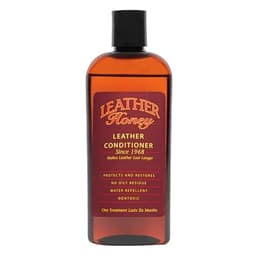
Leather Honey Leather Conditioner (8 oz)
Type: Conditioner
An all-purpose conditioner that covers bags, boots and furniture, and a few drops treat a whole bag. It can darken pale or untreated leather, so spot-test — the listing says as much.
- Budget option
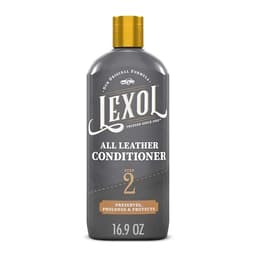
Lexol All Leather Conditioner
Type: Conditioner
A long-standing purpose-made conditioner at a low price. If cost was the reason the olive oil looked tempting, this removes the argument entirely.
- Clean and condition together
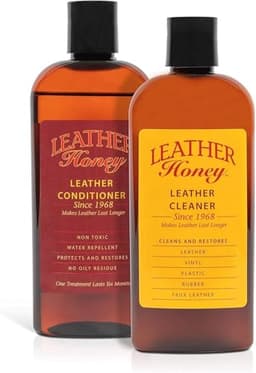
Leather Honey Complete Leather Care Kit (Cleaner + Conditioner)
Type: Cleaner + conditioner kit
Pairs the cleaner with the conditioner, which matters because cleaning first is the step most people skip — and skipping it is how conditioner seals grime into the grain.
Bottom line
Olive oil is not a leather conditioner, and neither is coconut oil, baby oil, petroleum jelly or hair conditioner. They all look like they work for a day and then commit you to permanent darkening, slow stiffening and, in the food-oil cases, a smell you cannot get out. Purpose-made conditioners cost very little and are formulated to be absorbed and retained. Clean first, spot-test always, apply thinly, and condition only when the leather asks for it — that routine is the whole of leather care, and it does not have a kitchen shortcut.
How we know this. Veg Tan Club is written by an enthusiast, not a master leatherworker or a test lab. We compile each product’s published specs — grade, tannage, hardware — and reason from there. We say plainly when a listing doesn’t state a grade, and we haven’t physically handled every item we compare.
Frequently asked questions
Can you use olive oil on leather?
You can put it on, and it will look darker and richer immediately. That is not the same as it being good for the leather. Olive oil is a food oil that oxidizes over time, and conservation guidance on leather warns that oils applied as dressings can oxidize and harden leather rather than preserve it. It also darkens permanently and can go rancid.
Does olive oil damage leather?
Over time, yes, in three ways: it darkens the hide permanently and often unevenly, it oxidizes and can stiffen the leather it was meant to soften, and any food oil left in a porous material can develop an odor. None of this is visible on day one, which is exactly why the advice keeps circulating.
What about coconut oil or baby oil on leather?
Same category of problem. Coconut oil is another food oil that oxidizes and darkens; baby oil is mineral oil, which does not feed leather fibers and mostly sits in the surface attracting dirt. Neither is formulated for leather and neither is reversible once absorbed.
Can I use Vaseline or petroleum jelly on leather?
It will make leather look glossy and feel supple briefly, but petroleum jelly does not absorb into the fiber structure the way a leather conditioner does. It stays greasy on the surface, collects dust, and can transfer onto clothing. On finished leather it can also soften or lift the finish.
Is hair conditioner a good leather conditioner?
No. Hair conditioners are water-based emulsions with silicones and fragrance designed for keratin, not for tanned collagen. Some leave a slick film, some contain ingredients that dry leather out, and none are formulated to be absorbed and retained by a hide.
What should I use instead?
A product actually formulated for leather, applied thinly and only when the leather needs it. Clean first, spot-test on a hidden area, and use less than you think. The most common real-world damage we see described is not neglect — it is over-treatment with the wrong thing.
Sources
- Wikipedia — Conservation and restoration of leather objects — How the field cleans and stabilizes leather; why oils oxidize and can harden leather over time (accessed July 18, 2026)
- Canadian Conservation Institute — Caring for leather, skin and fur — CCI preventive-conservation guidance on cleaning, dressing and storing leather (accessed July 18, 2026)
- U.S. National Park Service — Curatorial Care of Objects Made From Leather and Skin — NPS museum-handbook guidance on cleaning, handling and storing leather; humidity below ~65% (accessed July 18, 2026)
- Wikipedia — Leather — Overview of leather, grain layers and the full-grain / top-grain / split hierarchy (accessed July 18, 2026)
Keep reading
Leather conditioner vs. leather oil
Two purpose-made products that do different jobs — and when an oil is genuinely the right call.
Compare the twoHow to condition leather
The step-by-step routine, with the clean-first step most people skip.
Read the routineHow often should you condition leather?
Why over-conditioning does more damage than leaving leather alone.
See the guidanceHow to care for vegetable-tanned leather
The hide type that punishes household oils fastest, because it absorbs everything.
Read the routine