Does Leather Shrink?
Yes - and it is the one dimensional change in leather that counts as damage rather than character. Heat and fast drying are the two causes, both are permanent, and between them they account for most ruined leather goods.
How this is funded: we earn a commission if you buy through our links, at no extra cost to you. It never changes which product we recommend, and we’ll tell you when we’d skip one. Full disclosure.
Yes. And the important part of the answer is that shrinking is not the mirror image of stretching. Leather stretches because its fiber bundles slide and realign under load — a working-in process that leaves the material intact, covered in does leather stretch. Leather shrinks because it loses the bound moisture holding that fiber structure open, and the fibers contract and set in the smaller position. One is character. The other is damage.
Between them, heat and fast drying account for most of the leather goods that get ruined rather than worn out. It is worth knowing exactly how, because the prevention is almost embarrassingly simple and the cure does not exist.
The mechanism
A tanned hide is a three-dimensional network of collagen fiber bundles, held apart and lubricated by a combination of bound water and the fatty substances worked in after tanning. That bound water is structural: it is not free moisture sitting in gaps, it is chemically associated with the collagen itself, and the fiber network’s open, flexible arrangement depends on it being there.
Take it away slowly and the fibers relax into a new arrangement that is close to the old one. Take it away fast — with heat, forced air, or a radiator — and they do not have time to relax. They pull together, adhere to one another, and set. The hide is now smaller, denser and much less able to flex. Keep heating it and the collagen begins to break down outright, which is the irreversible end of the process.
Two consequences follow immediately. First, the shrinkage is uneven: the thinnest and most exposed areas go first, so a bag distorts rather than scaling down neatly. Second, a shrunken hide is a hide that cracks the next time it is bent, because stuck-together fibers cannot slide to accommodate a fold — which is the whole argument of why leather cracks. Shrinkage and cracking are usually the same event, a few weeks apart.
The two situations that cause almost every case
Wet leather dried fast.This is the big one. A bag caught in rain, a belt worn in a downpour, boots soaked through — and then put next to a heater, in front of a fan heater, in a hot car, or hit with a hair dryer to speed things up. The soaking itself is survivable; almost nothing is lost if the item dries slowly at room temperature. The acceleration is what causes the damage, and that is why how to dry a wet leather bag is mostly a lesson in patience, and why a tumble dryer is the worst of all available options — see can you wash leather.
Dry heat with no water involved at all.Less dramatic and more common. A leather bag that lives on a car parcel shelf through a summer. A wallet left on a radiator. A belt in an uninsulated attic. Each of these quietly removes bound moisture over weeks, and the owner notices only when the item feels hard. By then the dimensional change has already happened. Conservation guidance on leather storage is consistent about both ends of this: avoid heat, and keep relative humidity moderate rather than very low or above roughly 65 percent, which is where the opposite problem — mold — begins.
What it looks like on the things you own
A belt that no longer reaches the hole it used to.Counter-intuitive, because belts are the classic stretching example, and both can happen to the same belt. If a belt got soaked and dried hard, it can genuinely come up short — and it will also have stiffened at the fold, which is where it will crack. The failure order for belts generally is in how long a leather belt lasts.
A bag whose zipper suddenly fights you. A leather panel that has contracted pulls the zipper tape into tension it was not built for. People read this as a hardware failure. It is usually a hide failure expressed at the hardware.
Shoes and boots a half size smaller. The most frequently reported case, because feet notice immediately. Soaked and heat-dried footwear shrinks across the width first.
A wallet that has gone board-hard.Often from a back pocket, body heat and repeated damp-and-dry cycles. If it has stiffened but not cracked, you have caught it at the last useful moment — go to how to soften stiff leather now rather than later.
Does grade or tannage change any of this?
Grade helps, modestly. A full-grain hide has the densest, most intact fiber layer, so there is more structure to lose before the item distorts noticeably — and no sprayed-on finish to fail separately from the leather. A corrected or split hide has less to give and shows the damage sooner. The grade vocabulary is in full-grain vs. genuine leather, and the case for paying for it is in is full-grain leather worth it.
Tannage does not rescue anybody. Vegetable-tanned leather is firmer and more water-sensitive at the surface — a drop can leave a visible ring — while chrome-tanned leather is generally more tolerant of wetting. But neither tannage survives being dried with heat, and we are not going to pretend one does. This is the same position we take in does leather stretch: tannage changes firmness and appearance, not dimensional stability, and nobody publishes a number for either.
Thickness helps for the same reason grade does: more fiber, more margin. It is also the spec you almost never get. Of everything in our registry, a bare handful of listings publish a thickness figure, which is why leather weight and thicknessexists as a page — so that when a listing does publish one, you know what you are reading.
Prevention, which is the entire cure
Four rules, and they are the same four that prevent cracking, because it is the same underlying failure.
Dry wet leather slowly, at room temperature, with air moving around it but nothing blowing directly at it. Hours to days, not minutes. Stuff a bag loosely with paper so it keeps its shape, and take the weight out of it — wet leather under load stretches into the loaded shape at the same time as it dries.
Never apply heat. No hair dryer, no radiator, no heat vent, no tumble dryer, no leaving it in a car. This single rule prevents more damage than every product on this site combined.
Store it somewhere stable. A cupboard in a heated room, in a cotton cover rather than plastic, not in an attic, basement or garage — the full version is in how to store leather bags. Too dry causes this page; too humid causes mustiness and mold, which is why does leather smell.
Condition two or three times a year, thinly, after cleaning. The point is to keep the fatty content topped up so the fiber network stays lubricated. More often is not better and over-conditioning is its own permanent failure — see how often to condition leather.
Prevention, and salvage for a hide that has already stiffened
Two conditioners for keeping the fiber network lubricated before any of this happens, and one repair kit for the stage after - where a shrunken hide has cracked and the honest goal is cosmetic. We have not handled any of them; every claim is read from the live listing.
- Best prevention pairing
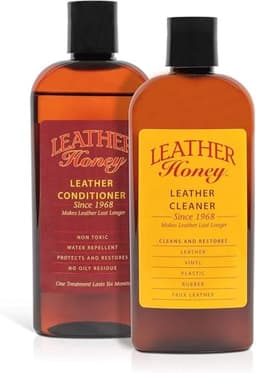
Leather Honey Complete Leather Care Kit (Cleaner + Conditioner)
Type: Cleaner + conditioner kit
Cleaner and conditioner in one box, which is the correct order and the thing most people skip. A hide that is cleaned and thinly conditioned two or three times a year keeps enough fatty content to survive a soaking - and the kit removes the excuse for conditioning straight over dirt.
- Best for large surfaces
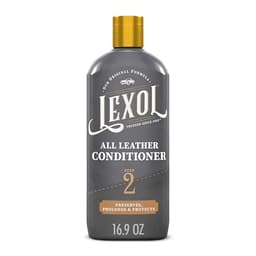
Lexol All Leather Conditioner
Type: Conditioner
The case where heat damage is most common is also the largest: car seats and furniture that live in sun and heat all year. This is a low-cost conditioner made for exactly those big jobs, where a premium bag product would be an expensive way to cover a sofa. Basic formula, right application.
- Best after the damage
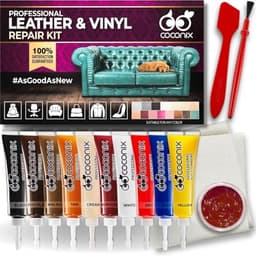
Coconix Leather & Vinyl Repair Kit
Type: Repair kit
If shrinkage has already taken a hide hard and it has cracked at a fold, no conditioner closes that - a crack is torn fiber. A color-mixing filler kit levels and blends the damage so the item stays usable. It is cosmetic by nature, and the listing is honest that a repair blends damage rather than making it invisible.
$19.95 · View on AmazonPrice as of October 20, 2026. #ad How we’re funded
One legitimate use for shrinking
Wet-forming. Leather that is wetted, shaped over a form and allowed to dry in position will hold that shape, and craftspeople use this deliberately — most visibly in holster making, where a holster is molded to a specific firearm. It is the same mechanism this entire page describes, used on purpose and under control.
What it is not is a way to resize something you already own. You cannot choose the direction, the amount is not predictable, and the hide stiffens as part of the bargain. A bag, jacket or belt that is too large is a job for a leather repairer with a knife and a needle, not for a bathtub and a radiator. The one adjustment that genuinely is a home job is shortening a belt, and that is cutting rather than shrinking — see how to shorten a leather belt.
How we know this. Veg Tan Club is written by an enthusiast, not a master leatherworker or a test lab. We compile each product’s published specs — grade, tannage, hardware — and reason from there. We say plainly when a listing doesn’t state a grade, and we haven’t physically handled every item we compare.
Frequently asked questions
Does leather shrink?
Yes, when it loses bound moisture faster than its fiber structure can accommodate - which in practice means heat, or wet leather dried quickly. The collagen fiber bundles contract and set in the contracted position, so the item ends up smaller, harder and often cracked. Unlike stretching, which is a rearrangement you can live with and sometimes use, shrinkage is damage and it does not reverse.
Does leather shrink when wet?
Not while it is wet - it shrinks as it dries, and how fast it dries decides everything. Wet leather is swollen and pliable; dried slowly at room temperature it returns to roughly the dimensions it had. Dried fast, near a radiator or with a hair dryer or in a hot car, the moisture leaves faster than the fibers can relax into position and the hide contracts permanently. That is why every drying instruction on this site is about patience rather than technique.
Does leather shrink in heat?
Yes, and dry heat alone will do it without any water involved. A leather bag left on a car parcel shelf in summer, a wallet on a radiator, a belt in a hot attic - all of them lose bound moisture to the air and stiffen, and at higher temperatures the collagen structure itself begins to break down. Hot and dry is the single worst environment for leather, and it is also the most common one people store leather in without thinking about it.
Can you shrink leather on purpose to make it fit?
Technically yes, and it is almost always a mistake. Deliberate wet-and-dry shrinking is a traditional technique for specific jobs like molding a holster to a shape, where the leather is wet-formed over a form and allowed to dry in position. Applied to a bag, belt or jacket that is slightly too large, it is uncontrollable: you cannot choose which direction it shrinks, it stiffens the hide, and the result is permanent. Alteration by a repairer is the answer.
Does leather shrink or stretch?
Both, by completely different mechanisms, and only one of them is reversible-adjacent. Leather stretches under sustained load as its fiber bundles realign - early, locally, in the direction of the pull, and it stays stretched. It shrinks when it loses moisture fast, and it stays shrunk. Stretching is a working-in process you can plan around; shrinking is damage. Neither is elastic behavior and neither springs back.
Can shrunken leather be fixed?
Not restored, only improved. Conditioning a hide that has shrunk will soften the surface and make it less brittle, which is worth doing - but it does not return the dimensions, because the fibers have set in their contracted positions. If the item has also cracked at a fold, that is torn fiber and a filler-and-pigment repair is cosmetic at best. The realistic goal is to stop the damage progressing and keep using the item.
Sources
- Wikipedia — Leather — Overview of leather, grain layers and the full-grain / top-grain / split hierarchy (accessed July 18, 2026)
- Wikipedia — Tanning (leather) — The tanning process, vegetable vs. chrome tannage, and why ~90% of leather is chrome-tanned (accessed July 18, 2026)
- Encyclopaedia Britannica — Hide (animal skin) — Britannica on hides and skins as the raw material for leather (accessed July 18, 2026)
- Encyclopaedia Britannica — Leather — Britannica on leather as chemically treated animal hide and its uses (accessed July 18, 2026)
- Wikipedia — Conservation and restoration of leather objects — How the field cleans and stabilizes leather; why oils oxidize and can harden leather over time (accessed July 18, 2026)
- Canadian Conservation Institute — Caring for leather, skin and fur — CCI preventive-conservation guidance on cleaning, dressing and storing leather (accessed July 18, 2026)
- U.S. National Park Service — Curatorial Care of Objects Made From Leather and Skin — NPS museum-handbook guidance on cleaning, handling and storing leather; humidity below ~65% (accessed July 18, 2026)
Keep reading
Does leather stretch?
The other half of this question - one-way, local, load-driven, and not damage.
Read the explainerHow to dry a wet leather bag
The procedure that prevents every case on this page. Slowly, unloaded, away from heat.
Read the how-toWhy leather cracks
What a shrunken, stiffened hide does the next time you bend it.
Read the guideCan you wash leather?
Why the dryer is the worse half of the washer-and-dryer mistake.
Read the guideHow to soften stiff leather
The salvage routine for a hide that has gone hard but has not cracked yet.
Read the how-toIs leather waterproof?
No - and three of the four damage mechanisms are about how the water leaves.
Read the explainer